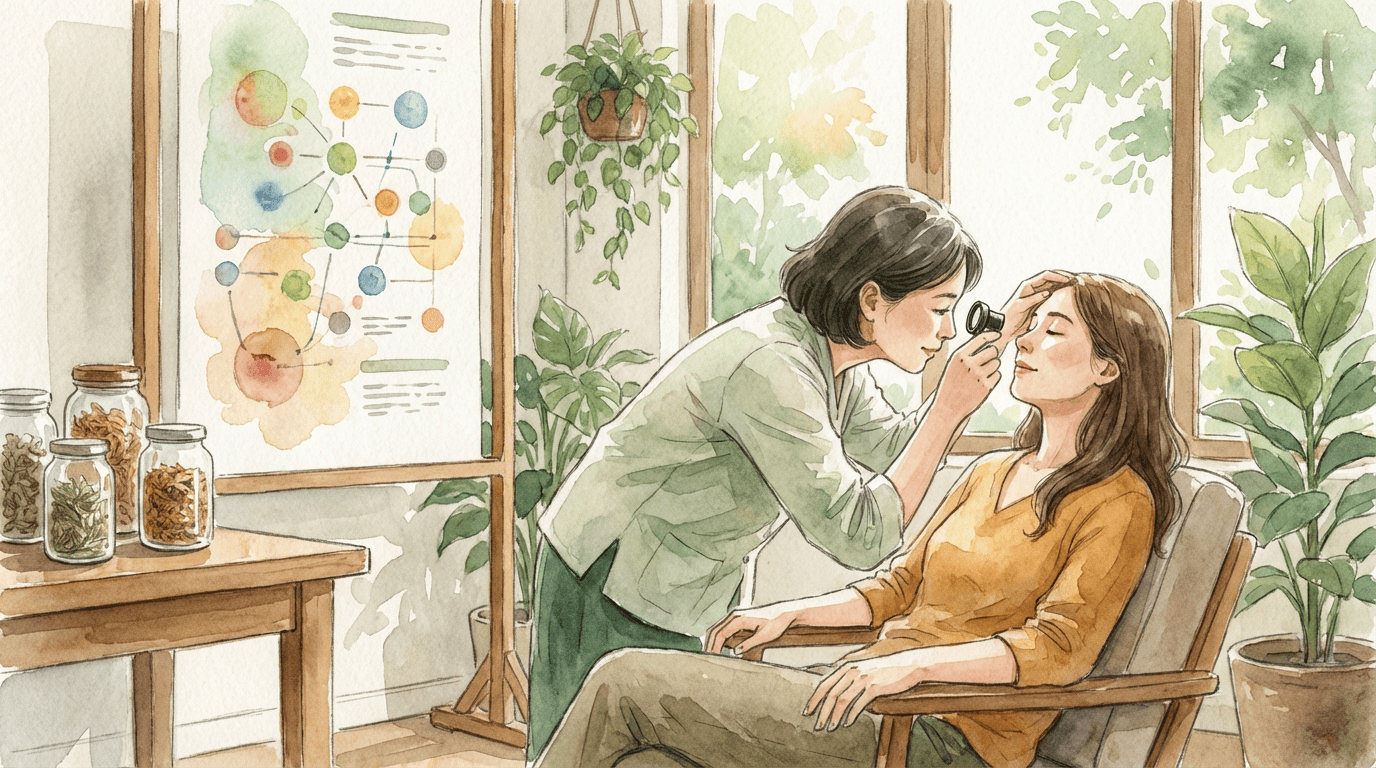
Naturopathic Vitality Assessment
Comprehensive evaluation of the client's vital force through analysis of their constitutional terrain, lifestyle habits and self-healing capacity, the foundation of every naturopathic consultation.
Encyclopedia of naturopathy and therapeutic nutrition: vitality assessments, lifestyle hygiene, seasonal cures, micronutrition, functional dietetics and kinesiology.
Comprehensive evaluation of the client's vital force through analysis of their constitutional terrain, lifestyle habits and self-healing capacity, the foundation of every naturopathic consultation.
Assessment of individual biological terrain according to naturopathic temperaments and diatheses, identifying predispositions and guiding the health strategy.
Ancestral practice of controlled food restriction for therapeutic purposes, including water fasting, intermittent fasting and the Buchinger method, to stimulate autophagy and detoxification.
The five fundamental pillars of naturopathic lifestyle hygiene — nutrition, exercise, psycho-emotional management, sleep and environment — to optimize daily vitality.
Naturopathic prevention program adapted to the four seasons, synchronizing detox, revitalization and strengthening cures with natural rhythms to optimize health throughout the year.
The three fundamental naturopathic cures — detoxification, revitalization and stabilization — forming the sequential protocol for rebalancing the biological terrain.
Therapeutic use of water in all its forms — hot and cold baths, Scottish showers, wraps — to stimulate circulation, elimination and vitality according to naturopathic principles.
Dietary protocol aimed at reducing chronic low-grade inflammation through selection of anti-inflammatory foods and avoidance of pro-inflammatory foods, supported by robust scientific evidence.
Targeted temporary exclusion dietary protocols — low-FODMAP, gluten-free, lactose-free diets — to identify food intolerances and relieve functional digestive disorders.
Therapeutic approach using nutrients — vitamins, minerals, amino acids and fatty acids — at optimal doses to prevent and treat functional and metabolic disorders.
Nutritional approach focused on optimizing micronutrient intake — vitamins, minerals, trace elements, fatty acids and amino acids — to correct functional deficits and restore metabolic balance.
Integrative nutritional approach using foods as therapeutic tools to modulate physiological functions, prevent chronic diseases and optimize overall health.
Nutritional approach aimed at maintaining body pH balance through selection of alkalizing foods and reduction of acidifying foods, to prevent demineralization and chronic inflammation.
Nutritional approach that synchronizes food intake with circadian biological rhythms, adapting the nature and quantity of foods to the enzymatic and hormonal secretions of each time of day.
Method of simple body movements developed by Paul and Gail Dennison to improve learning, concentration and coordination by stimulating connections between the two brain hemispheres.
Fundamental kinesiology tool consisting of evaluating the neuromuscular response of an isolated muscle to different stimuli to obtain information about the body's overall functional state.
Energy rebalancing system accessible to the general public, derived from applied kinesiology, using muscle testing and corrections through reflex points and meridians to harmonize vitality.
Branch of kinesiology specialized in identifying and releasing unconscious emotional blockages through muscle testing, integrating stress defusion and positive reprogramming techniques.
Holistic evaluation system developed by Dr. George Goodheart using manual muscle testing to assess structural, chemical and emotional imbalances according to the health triangle model.
Essential diagnostic techniques in Applied Kinesiology used to identify dysfunctional body areas and verify the appropriateness of specific corrections through targeted muscle testing.
Cranial reflex points discovered by Terence Bennett in the 1930s and integrated into Applied Kinesiology, stimulated through light fingertip contact to improve vascular supply to associated organs and muscles, including the famous Emotional Stress Release points.
Foundational technique of Applied Kinesiology developed by George Goodheart in 1964, evaluating a muscle's neurological response through calibrated pressure to identify functional imbalances in the body.
Reflex points discovered by Frank Chapman in the 1920s and integrated into Applied Kinesiology by George Goodheart, stimulated through deep rotary massage to activate lymphatic drainage of specific organs and strengthen associated muscles.
Fundamental muscle correction technique in Applied Kinesiology developed by George Goodheart, using manipulation of neuromuscular spindles and Golgi tendon organs to restore normal muscle tone and proprioceptive neurological function.
Key Touch for Health technique for releasing emotional stress through light contact on the frontal eminences (neurovascular forehead points), redirecting blood flow from the limbic system to the prefrontal cortex to deactivate stress responses.
Advanced Touch for Health protocol based on the five element theory of Traditional Chinese Medicine (Wood, Fire, Earth, Metal, Water), analyzing energy flows in the generating (Sheng) and controlling (Ko) cycles to identify and correct inter-element imbalances through sedation and tonification.
Simplified application of Chapman's reflex points within the Touch for Health framework, using deep rotary massage on specific torso and back points to activate lymphatic drainage, correct muscle weaknesses, and restore meridian energy flow.
Core Touch for Health protocol created by John Thie in 1973, testing 14 muscles associated with the 14 main meridians of Traditional Chinese Medicine to identify and correct energy imbalances through neurolymphatic massage, neurovascular points, meridian tracing, and acupressure.
Brain Gym exercise stimulating alertness and mental clarity by massaging the infraclavicular points (K-27) with one hand while the other rests on the navel. Promotes cerebral blood flow, concentration and interhemispheric communication. Central element of the PACE protocol.
Calming and centering Brain Gym exercise in two postures: (1) crossing ankles, wrists and fingers, hands pulled to chest; (2) uncrossing, fingertips touching, tongue on palate. Creates a closed electromagnetic circuit that calms the nervous system, reduces anxiety and promotes sensory integration.
Brain Gym exercise tracing an infinity symbol (∞) in the air with an extended arm, eyes following the hand to repeatedly cross the visual midline. Improves reading fluency, eye tracking, hand-eye coordination and integration of right and left visual fields.
Brain Gym lengthening exercises centered on The Owl and grounding movements (Earth Buttons, Space Buttons). The Owl involves gripping the trapezius with one hand and slowly turning the head while making an 'ooh' sound, releasing neck tension and improving auditory attention and postural stability.
Foundational Brain Gym exercise created by Paul Dennison, the Cross Crawl involves alternately touching the right knee with the left hand and vice versa, simultaneously activating both brain hemispheres via the corpus callosum to improve coordination, reading and writing.
A central tool of the Three In One Concepts system created by Gordon Stokes and Daniel Whiteside, the Behavioral Barometer is a visual map of emotional states used to identify discrepancies between conscious awareness and body response through muscle testing.
Created by Scott Walker, DC in 1988, the Neuro Emotional Technique (NET) identifies and resolves stuck emotional patterns stored in the body via spinal reflex points, combining muscle testing with the five element emotional associations of Traditional Chinese Medicine.
A core psycho-emotional kinesiology technique from the Three In One Concepts system, age recession uses muscle testing to identify the exact age when a stress pattern was first established, then diffuses it through prefrontal cortex activation.
An applied kinesiology technique for behavioral change and habit modification, the temporal tap uses light tapping along the temporal bone arc to bypass the brain's natural resistance to change and install new behaviors.
A rapid method for transforming limiting beliefs created by Robert M. Williams in 1988, PSYCH-K uses muscle testing and specific body postures to create a whole-brain state enabling the installation of new beliefs at the subconscious level.
Specialized branch of kinesiology dedicated to supporting pregnancy, birth and early development, using adapted muscle testing to balance the mother-baby energetic connection, prepare for delivery and resolve traumatic birth imprints.
Specialized kinesiology approach focusing on identification and integration of retained primitive reflexes in children and adults, addressing learning difficulties, coordination issues and emotional dysregulation linked to neurological immaturity.
Therapeutic system developed by Carl Ferreri working on the four primary survival programs of the nervous system (fight/flight, feeding, reproduction, immunity) through cranial corrections and muscle testing to restore optimal neurological organization.
Gentle method for primitive reflex integration developed by Harald Blomberg and Moira Dempsey, using passive and active rhythmic movements replicating infant spontaneous movements to stimulate brainstem and vestibular system maturation.
Comprehensive post-graduate kinesiology system created by Dr. Bruce Dewe and Joan Dewe (New Zealand, 1990s), integrating over 300 muscle tests and a correction 'menu system' covering structural, nutritional, emotional and energetic dimensions.
Bioenergetic kinesiology system created by Jimmy Scott, PhD (1978), that identifies and corrects energy disturbances using a unique 'permission' system where the body directs the entire session through muscle testing.
Advanced energy kinesiology system and RESET technique for the temporomandibular joint, created by Philip Rafferty (Australia, 1990s). Kinergetics uses the energy hydration concept, while RESET releases jaw tensions for whole-body impact.
Specialized kinesiology system created by Frank Mahony (Australia, 1980s), focused on hypertonic (chronically over-tight) muscles and their effects on sports performance, proprioception and neuromuscular compensation patterns.
Specialized kinesiology protocol created by Charles Krebs, PhD (Australia, 1990s), designed for learning and brain integration difficulties, combining advanced neurological research, muscle testing and acupressure to restore communication between brain areas.
Study of correspondences between facial morphology and psychological traits, used in naturopathy to refine temperament understanding and adapt therapeutic support.
Classification system of individual biological constitution in naturopathy, integrating morphotype, temperament and diathesis to fully personalize the health strategy.
Biological terrain evaluation technique through detailed observation of the eye's iris, whose signs (spots, fibers, rings) are believed to reflect the organism's constitutional state and predispositions.