Psoas Stretch
The psoas stretch in a low lunge releases the primary hip flexor, often shortened by prolonged sitting.
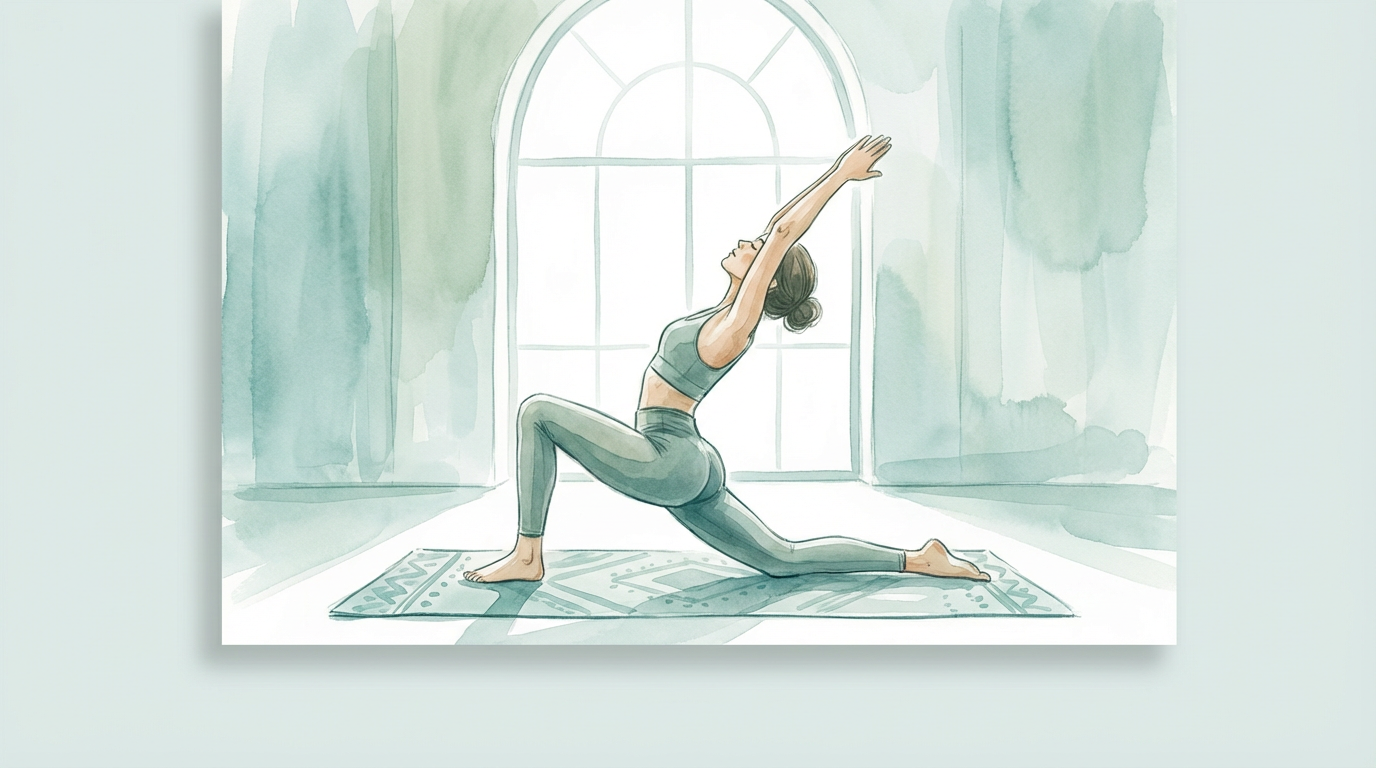
Psoas Stretch — Releasing the Hip Flexor
The iliopsoas is the deepest and most powerful muscle in the hip flexor group. It connects the lumbar vertebrae to the femur and plays a central role in posture, walking, and trunk stability. Unfortunately, prolonged sitting shortens it considerably, creating permanent traction on the lumbar vertebrae that causes chronic lower back pain.
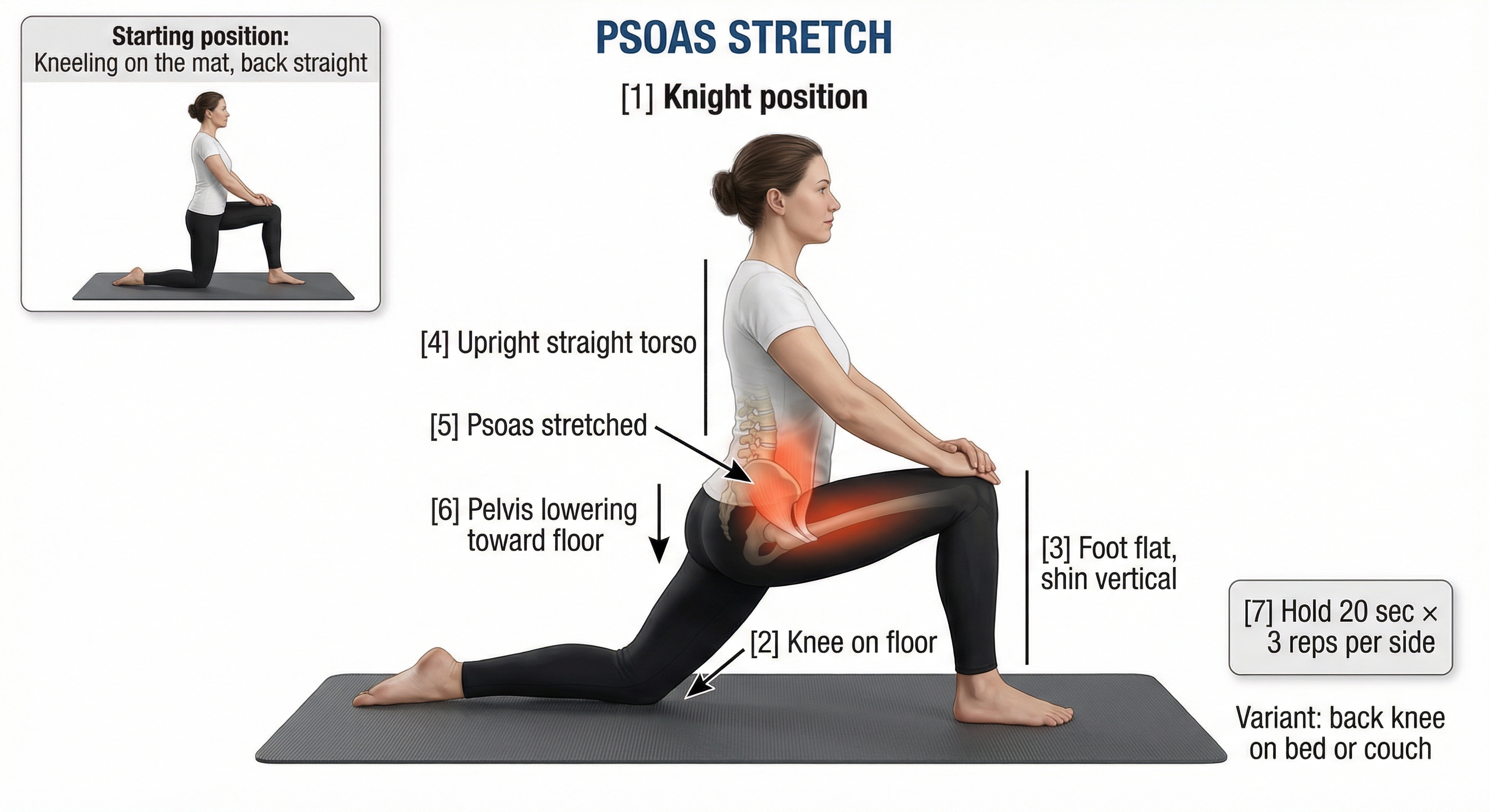
Why Stretch the Psoas?
A shortened psoas is one of the most overlooked culprits behind lower back pain. When contracted, it pulls the lumbar vertebrae forward, increasing lordosis (arch) and compressing the discs. Stretching the psoas regularly restores its natural length, relieves lumbar compression, and significantly improves posture. It is a muscle that anyone working in a seated position should stretch daily.
Anatomy Involved
- Iliopsoas muscle — composed of the psoas major (from vertebrae L1-L5) and the iliacus (from the iliac fossa), it inserts on the lesser trochanter of the femur.
- Rectus femoris muscle — part of the quadriceps involved in hip flexion, stretched simultaneously.
- Lumbar vertebrae L1 to L5 — directly benefit from psoas release.
- Hip joint — gains extension range of motion.
Step-by-Step Instructions
Step 1 — Low Lunge Position
Get into a low lunge on the floor: right knee forward (foot flat, knee above the ankle), left knee on the floor (on a cushion if needed). The top of the left foot rests on the floor.
Step 2 — Adjust Alignment
Ensure the front knee does not extend past the toes. The pelvis faces forward. Place your hands on the front knee for stability. Gently engage the abdominals.
Step 3 — Push the Pelvis Forward
As you exhale, gently push your pelvis forward and down, without arching your back. You should feel a deep stretch at the front of the left hip and groin. This is the psoas stretching. Keep your torso upright.
Step 4 — Hold and Breathe
Hold the position for 30 seconds. Breathe deeply. With each exhale, try to push the pelvis one millimeter further forward. Release and switch sides. Perform 2 to 3 sets per side.
Duration and Repetitions
- Hold: 30 seconds per side
- Sets: 2 to 3 per side
- Frequency: daily, especially after long periods of sitting
Safety Tips
- Do not arch your back — the natural tendency is to compensate by arching. Engage the abdominals to keep the pelvis neutral.
- Protect the back knee with a cushion or folded towel.
- The front knee should never extend past the toes.
- If you feel pain in the groin (not a stretch), stop and consult a professional.
- Progress slowly — the psoas is a deep muscle that takes time to lengthen.
Who Benefits from This Exercise?
The psoas stretch is essential for anyone spending more than 4 hours a day sitting, runners, dancers, martial arts practitioners, and anyone suffering from lower back pain or hip stiffness. It suits all levels.
Diagrams and illustrations
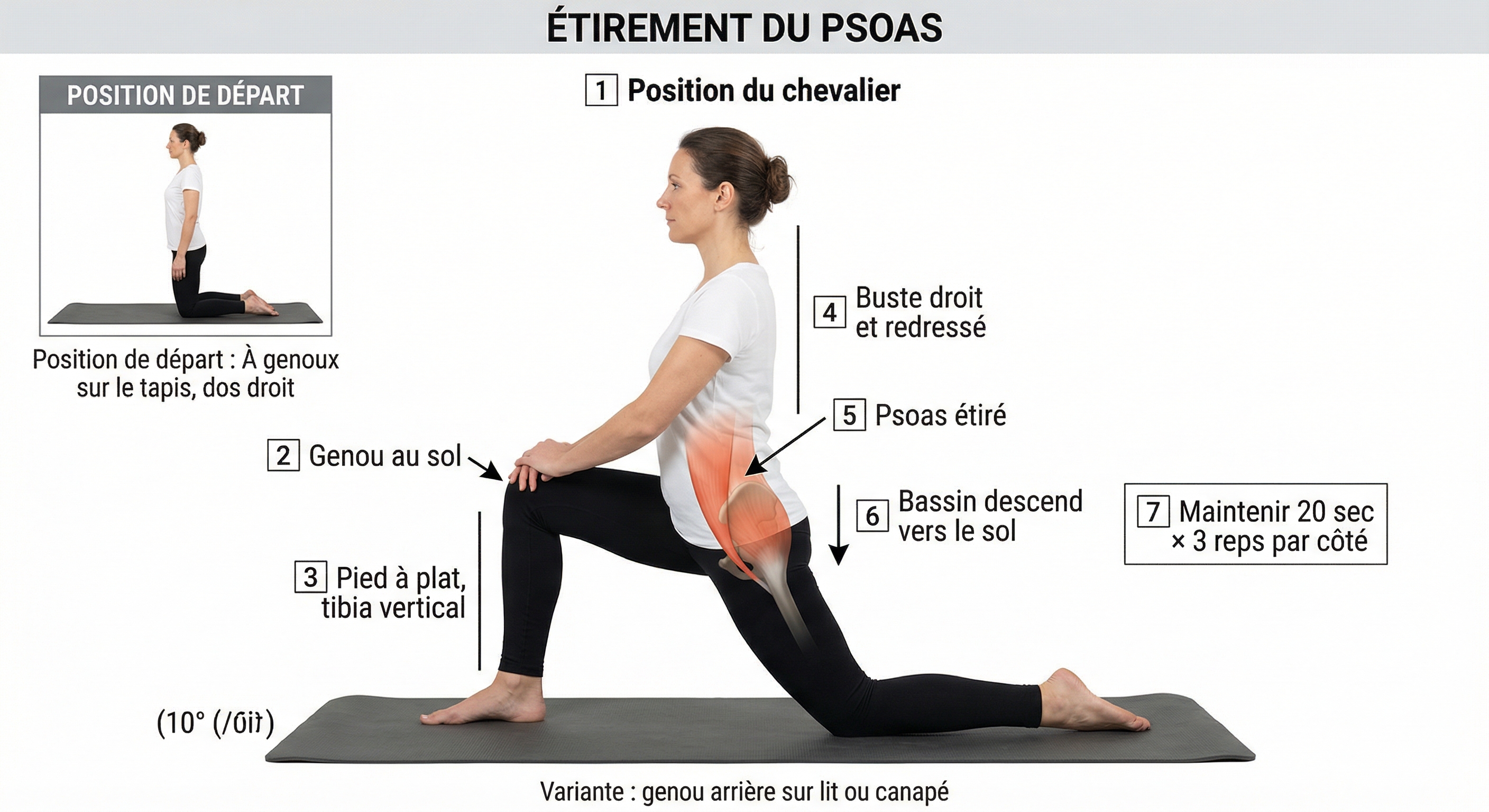
Psoas stretch illustration
Psoas stretch in a low lunge on the floor with a 30-second hold.