Prone Quadriceps Stretch
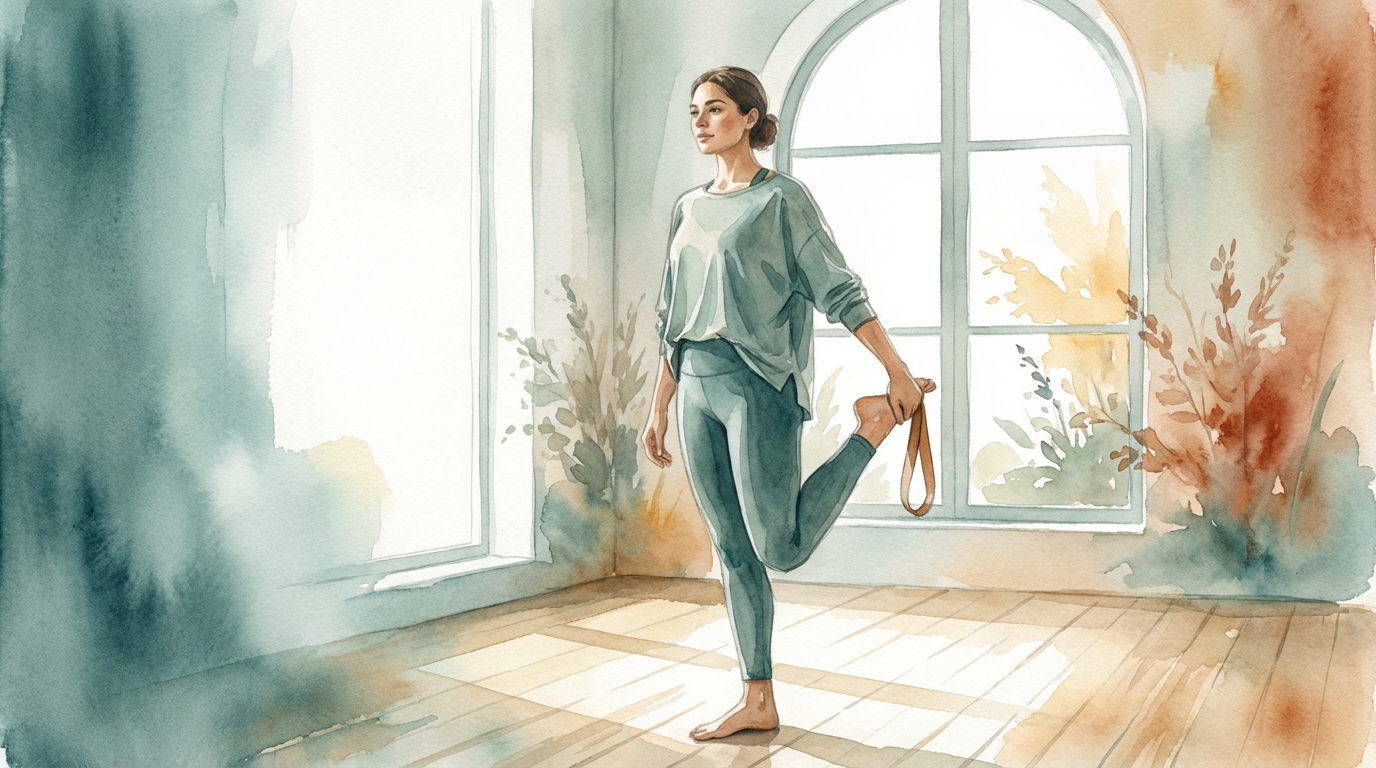
Prone quadriceps stretch with ankle hold, allowing a deep and controlled stretch of the rectus femoris and vasti muscles.
Prone Quadriceps Stretch
The prone quadriceps stretch offers the most stable and intense version of this classic exercise. By lying face down, you stabilize the pelvis and perfectly isolate the quadriceps without any possible trunk or hip compensation. Body weight naturally helps keep the pelvis on the floor, preventing the anterior pelvic tilt that reduces stretch effectiveness in other positions. This is the variation of choice for people needing maximum stretch or in advanced rehabilitation.
Advantages of the Prone Position
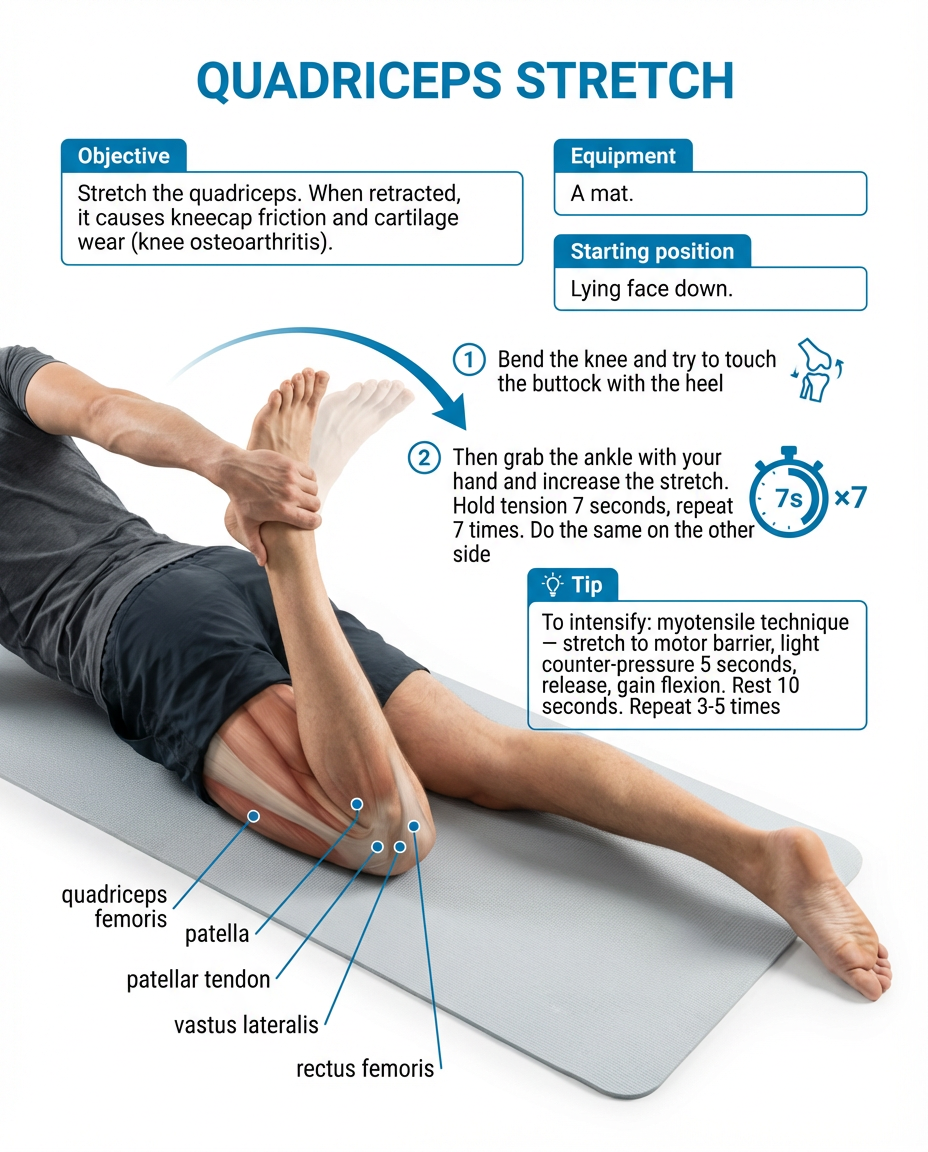
Compared to standing or side-lying, the prone position has several biomechanical advantages: the pelvis is locked to the floor by gravity, preventing anterior tilt; both hips are in neutral extension, maximizing the biarticular rectus femoris stretch; and the absence of balance demands allows full focus on stretch sensation and breathing. This position is also the most reproducible for objectively measuring flexibility progress.
Anatomy Involved
- Rectus femoris — biarticular quadriceps head, maximally stretched in this position through combined hip extension and knee flexion.
- Vasti (lateralis, medialis, intermedius) — the three monoarticular heads are stretched by knee flexion.
- Quadriceps tendon — common tendon above the kneecap, placed under maximum tension.
- Suprapatellar bursa — serous bursa between quadriceps and femur, whose flexibility is essential for full knee flexion.
Step-by-Step Instructions
Step 1 — Starting Position
Lie face down on a mat, forehead on crossed hands or turned to the side. Legs are straight and feet relaxed.
Step 2 — Grasp the Ankle
Bend the right knee and grasp the ankle or top of the foot with the right hand. If flexibility is insufficient, use a strap or towel around the foot.
Step 3 — Bring Heel to Buttock
Gently pull the heel toward the buttock. The pelvis stays firmly on the floor — this is the key to exercise effectiveness. You should feel an intense but tolerable stretch along the entire front of the thigh.
Step 4 — Hold
Hold for 30 to 45 seconds, breathing deeply. Release slowly, then switch sides. Perform 3 sets per side.
Duration and Repetitions
- Hold: 30 to 45 seconds per side
- Sets: 3 per side
- Frequency: 1 to 2 times daily, ideally post-exercise
- Total duration: approximately 6 minutes
Safety Tips
- If the pelvis lifts off the floor, the stretch is too intense: slightly ease the ankle pull.
- If you experience anterior knee pain (in front of the kneecap), do not force flexion and consult your practitioner.
- People with lumbar compression in prone position can place a cushion under the abdomen.
- Never pull the foot abruptly — movement should be progressive and continuous.
Who Benefits from This Exercise?
This stretch suits athletes, those rehabilitating knee or hip, and anyone wanting maximum quadriceps stretch. It is particularly useful after intense leg activity (running, cycling, skiing, squats). People with balance difficulties will find it a safe alternative to the standing stretch.
Diagrams and illustrations
Prone quadriceps stretch illustration
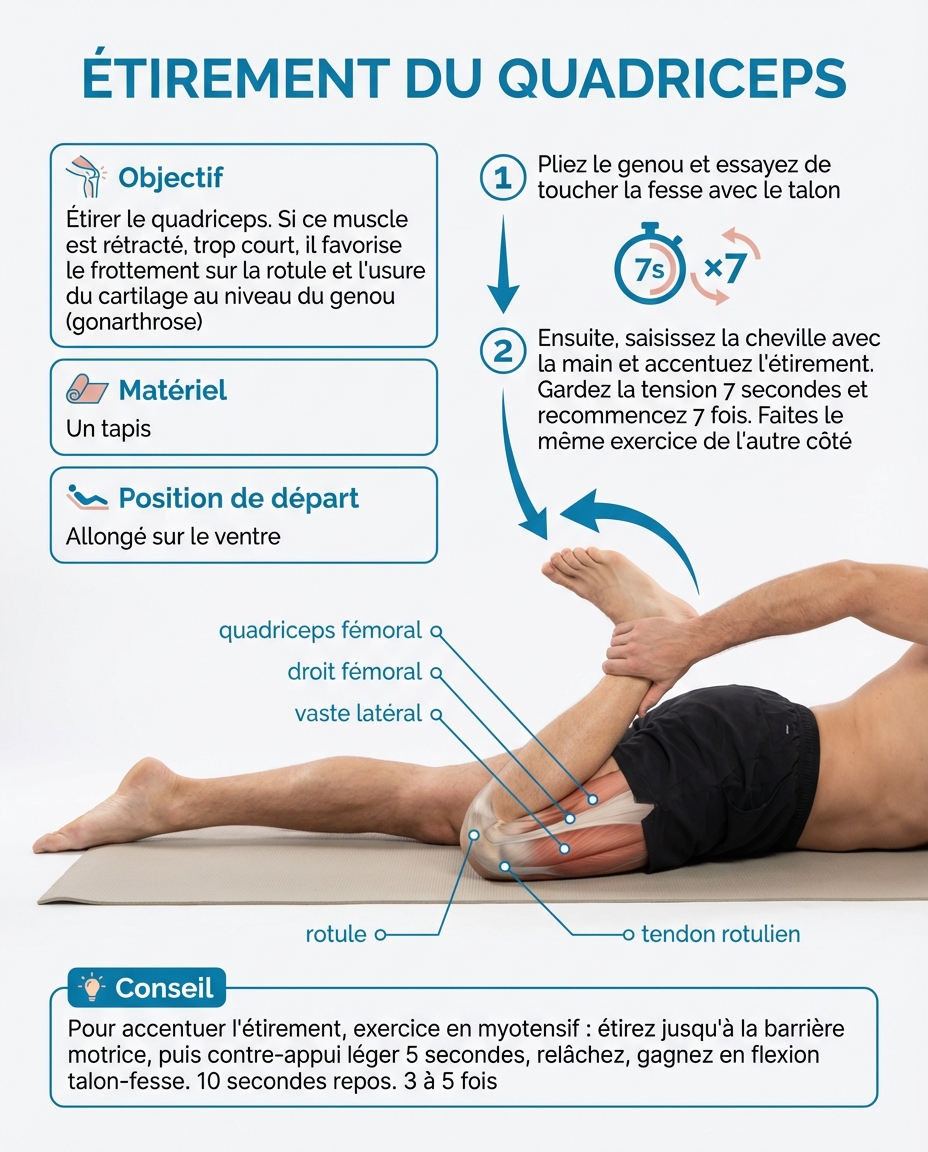
Prone position with ankle hold for maximum quadriceps stretch.