Roll-Up
Classic Pilates exercise developing segmental spinal mobility and abdominal control by rolling up and down the spine vertebra by vertebra.
Roll-Up
The Roll-Up is one of the most fundamental exercises in the Pilates repertoire. It teaches segmental control of the spine, a core principle of the Pilates method that involves mobilizing each vertebra independently. This exercise develops functional abdominal strength while improving posterior chain flexibility.
Targeted Anatomy
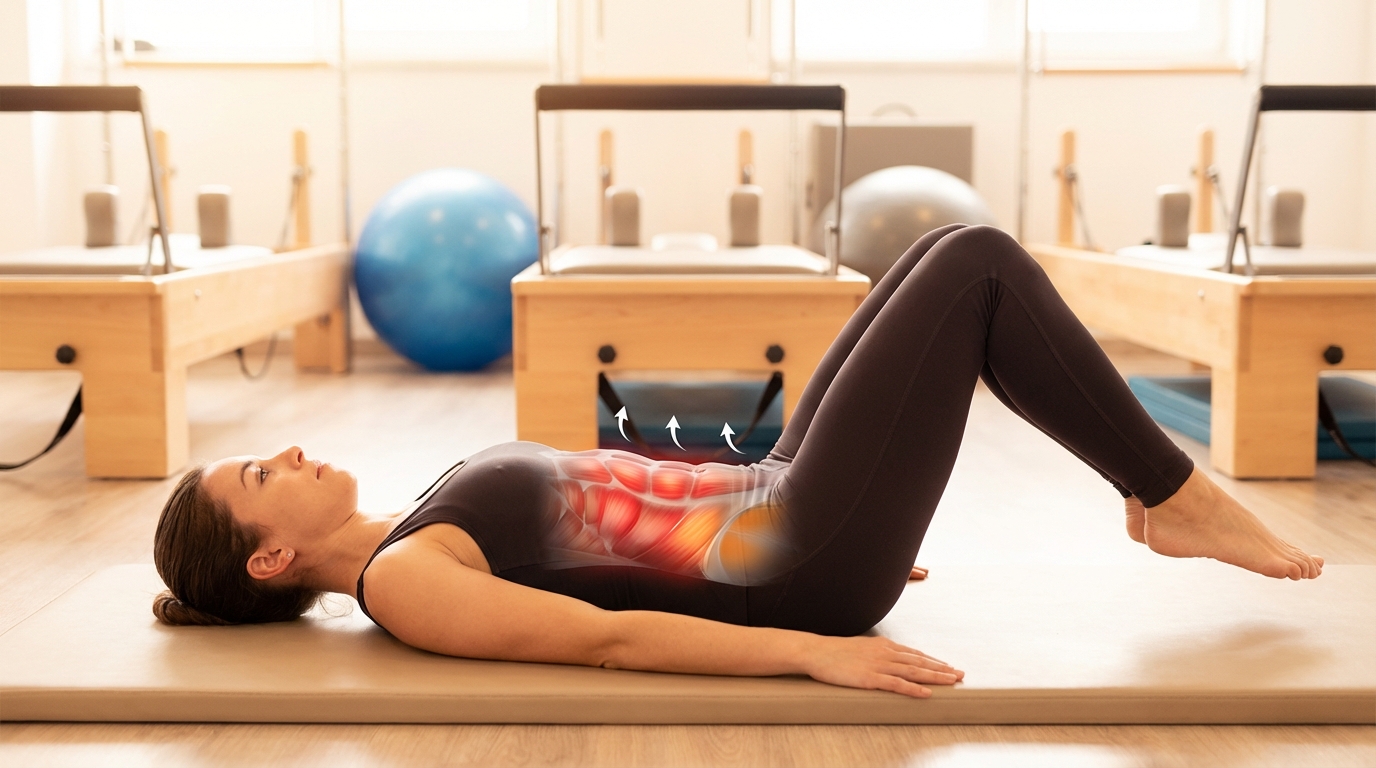
The Roll-Up primarily engages the rectus abdominis in its segmental spinal flexion function. The transversus abdominis provides deep stabilization throughout the movement phase. The hip flexors (psoas-iliacus, rectus femoris) anchor the legs to the floor. During the forward flexion phase, the erector spinae work eccentrically to control the descent. The hamstrings are stretched at the end of the movement during the forward fold.
Step-by-Step Execution
- Starting position: Lie on your back, legs extended on the floor, feet flexed. Arms extended overhead, resting on the floor.
- Inhale: Raise arms toward the ceiling.
- Exhale — Ascending phase: Tuck the chin, then roll up the spine vertebra by vertebra. The navel stays drawn toward the spine. Progress slowly: cervical, upper thoracic, lower thoracic, lumbar.
- Forward fold: Continue toward the feet, forming a C-shape with the spine. Reach toward the toes without rounding the shoulders.
- Inhale at the top: Lengthen up on the sit bones.
- Exhale — Descending phase: Initiate the return with a pelvic tilt. Unroll the spine toward the floor, lumbar first, then thoracic, and finally cervical. Arms return overhead.
Key Points and Breathing
- Movement must be fluid and continuous, without jerking or momentum.
- Feet remain on the floor through leg anchoring (do not let them lift).
- Breathing accompanies the movement: exhale going up and coming down.
- Imagine peeling a sticker off the floor, vertebra by vertebra.
Repetitions
6 to 8 repetitions at a slow, controlled pace. Each repetition lasts approximately 15 to 20 seconds.
Modifications
- Beginner: Slightly bent knees, use a strap or resistance band around the feet to assist the roll-up. Reduce range of motion if needed.
- Intermediate: Straight legs, full range of motion, 6-8 repetitions.
- Advanced: Slow the tempo to 30 seconds per repetition, add a 3-second hold at the top, or hold a small weighted ball.
Contraindications
- Acute lumbar herniated disc.
- Severe osteoporosis (risk of vertebral compression fractures).
- Untreated diastasis recti (adapt with reduced range).
- Intense undiagnosed lower back pain.
Target Audience
The Roll-Up is suitable for all levels with appropriate modifications. It is particularly beneficial for sedentary individuals seeking to improve spinal mobility, post-surgical rehabilitation patients (late phase), and athletes wishing to develop superior abdominal control. Seniors and postpartum individuals can perform the modified version with bent knees under supervision.