Transverse Activation (Abdominal Bracing)
Transverse abdominis activation strengthens the trunk's natural corset, stabilizing the spine and preventing lower back pain.
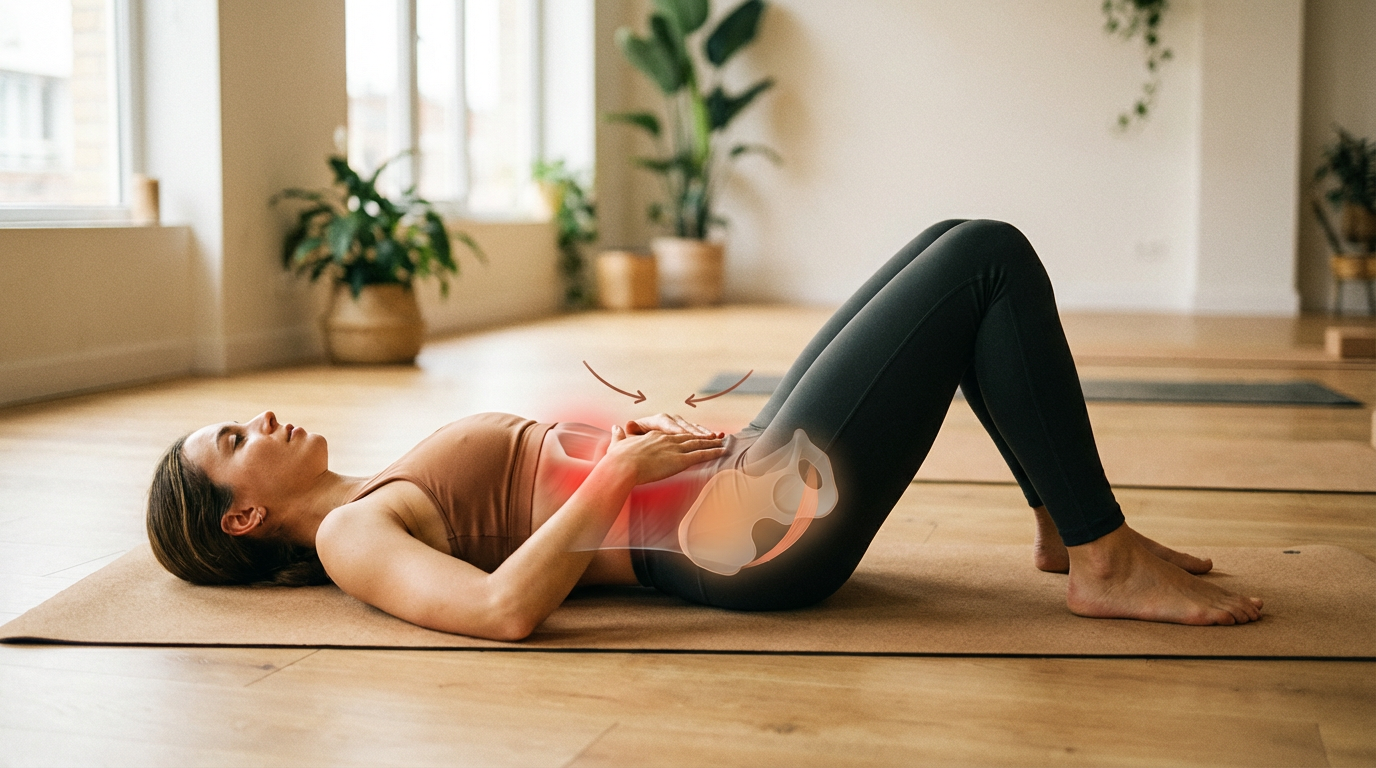
Transverse Activation (Abdominal Bracing)
Posture results from the balance between tonic (postural) and phasic (mobilizing) muscles. Modern life — hours in front of a screen, driving, smartphone use — creates systematic imbalances: shortened anterior muscles, inhibited posterior muscles, forward head and rounded shoulders. Corrective postural exercises specifically target these imbalances to restore optimal alignment and prevent degenerative spinal conditions.
Targeted Anatomy
Postural exercises activate deep stabilizing muscles often inhibited by sedentary lifestyle: deep cervical flexors (longus colli, longus capitis), scapular stabilizers (middle/lower trapezius, rhomboids, serratus anterior), transverse abdominis and glutes. These muscles form the foundations of healthy posture and protect passive structures (discs, ligaments, cartilage).
Step-by-Step Instructions
Step 1 — Postural Assessment
Before starting, observe your natural side-view posture in a mirror. Ears should align with shoulders, shoulders with hips, hips with ankles. Note deviations to target your corrective work.
Step 2 — Target Muscle Activation
Begin with gentle, controlled activation of postural muscles. Intensity is low to moderate — the goal is contraction quality and endurance, not brute strength. Focus on the sensation of correct posture rather than the movement.
Step 3 — Hold and Endurance
Postural muscles are endurance muscles. Hold contractions for recommended durations with fluid breathing. The challenge lies in maintaining quality on the last repetitions.
Step 4 — Daily Life Integration
Corrective exercise is not enough if daily posture is not modified. Integrate the learned principles into activities: work position, driving, phone use.
Duration and Frequency
- Repetitions: 10-20 depending on exercise
- Sets: 2-3
- Frequency: daily, ideally in 5-minute micro-sessions throughout the day
Safety Tips
- Postural exercise should never cause pain — a sensation of muscle work is normal, joint pain is not.
- If you have diagnosed scoliosis, hyperkyphosis or hyperlordosis, consult a physiotherapist for an adapted program.
- Progress gradually — atrophied postural muscles fatigue quickly at first.
- Consistency is key — short daily sessions are more effective than one long weekly session.
Variations
- Isometric version — hold the correct position for 10-30 continuous seconds.
- Dynamic version — add controlled movement to integrate posture in motion.
- With resistance — use a resistance band to increase demand on postural muscles.
Target Audience
Essential for anyone working on screens, growing adolescents, elderly individuals, musicians, professional drivers and anyone wanting to prevent chronic postural pain.