Long Dorsal Muscle Massage
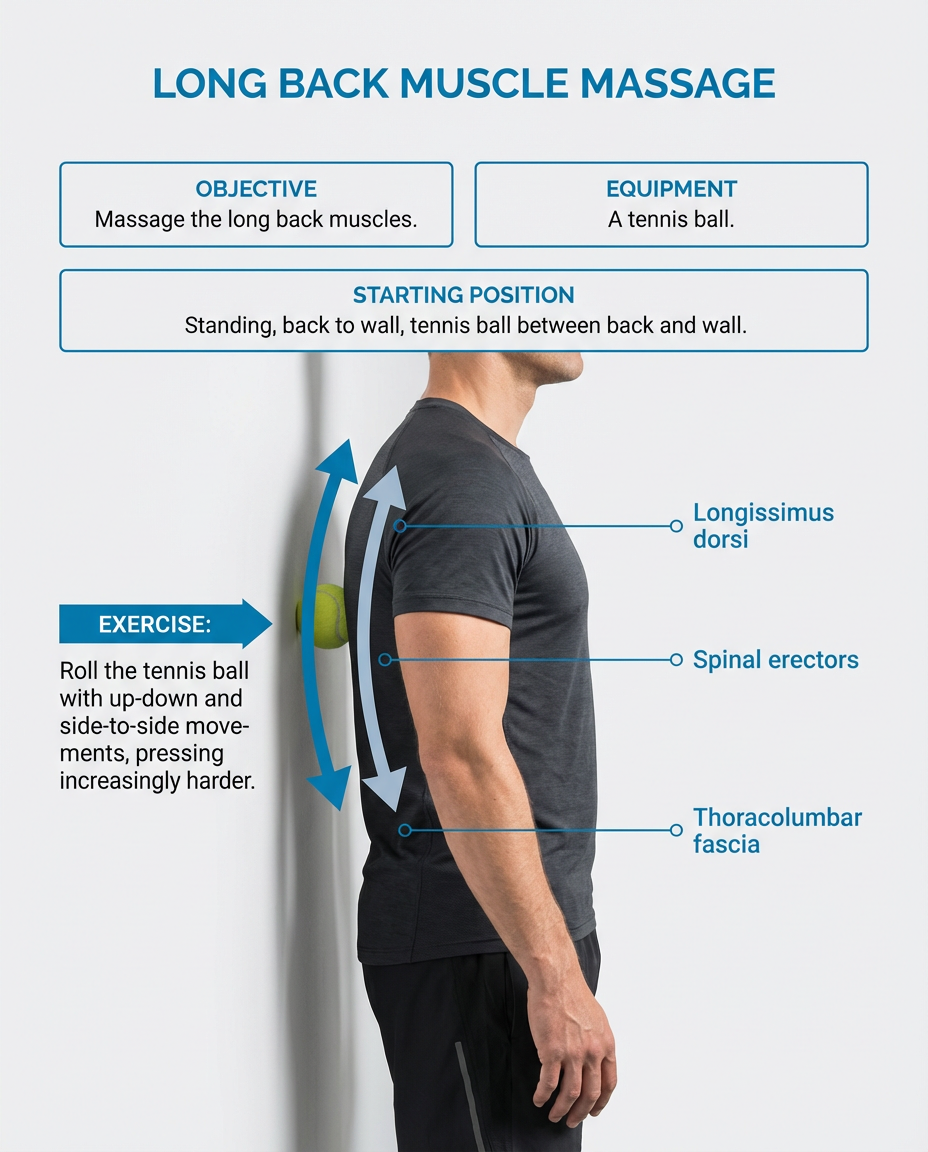
Standing self-massage against a wall with a tennis ball to release the long dorsal muscles, erector spinae and thoracolumbar fascia through multidirectional movements.
Long Dorsal Muscle Massage — Tennis Ball Against Wall
Self-massage of the long dorsal muscles with a tennis ball is an accessible and remarkably effective technique to release deep back tension. By placing a ball between your back and a wall, then performing multidirectional movements, you apply targeted pressure on trigger points and fascial adhesions that accumulate in the paravertebral muscles. This technique replicates deep massage maneuvers without needing a therapist.
Why Massage the Long Dorsal Muscles?
The long dorsal muscles (erector spinae) are tonic muscles that work constantly to maintain upright posture. This constant engagement makes them particularly prone to contractures, trigger points and fascial adhesions. Chronic back pain, so common in the working population, often originates from these overloaded muscles. Tennis ball self-massage precisely targets these tension areas, improves local blood circulation and restores thoracolumbar fascia mobility — a fibrous membrane that envelops the back muscles and whose rigidity is implicated in numerous back pain conditions.
Anatomy Involved
- Long dorsal muscles (longissimus) — the central part of the erector spinae group, running alongside the spine along its full length.
- Erector spinae — a group comprising iliocostalis, longissimus and spinalis, providing spinal extension and stability.
- Thoracolumbar fascia — a multilayered fibrous membrane enveloping the back muscles, connecting the spine to the pelvis and playing a major role in postural force transmission.
- Multifidus — small deep segmental muscles stabilizing each vertebra individually.
Step-by-Step Instructions
Step 1 — Setup
Stand with your back to a wall, feet about 30 cm from the wall. Place a tennis ball between the wall and your back, beside the spine (never directly on the spinous processes). Lean against the wall enough to hold the ball in place.
Step 2 — Vertical Movements
Slowly bend and straighten your knees to roll the ball up and down along the paravertebral groove. Explore the area between mid-back and the bottom of the ribs. When you find a tender spot, stop and maintain pressure for 15 to 20 seconds.
Step 3 — Lateral Movements
Shift your hips left to right to roll the ball horizontally across the muscles. This movement targets fascial adhesions between different muscle layers.
Step 4 — Circular Movements
Combine both movements by making small circles with your hips. Work each tender area for 30 to 60 seconds. Pain should gradually decrease during the massage — this signals the muscle is releasing.
Duration and Repetitions
- Duration per zone: 30 to 60 seconds
- Total duration: 5 to 10 minutes
- Frequency: 1 to 2 times daily
- Equipment: tennis ball (or lacrosse ball for more intense pressure)
Safety Tips
- Never place the ball directly on the spinous processes (the bumps at the center of the spine): always work in the paravertebral groove, 2-3 cm on either side of the spine.
- Pressure should be uncomfortable but tolerable — on a pain scale of 1 to 10, stay between 4 and 6.
- Avoid the kidney area (below the last ribs, on the flanks).
- If you have spinal pathology (herniation, spondylolisthesis, osteoporosis), consult your practitioner before practicing.
Who Benefits from This Exercise?
This self-massage is intended for anyone suffering from chronic back pain, morning stiffness or tension accumulated from stress and sedentary lifestyles. It perfectly complements stretching and strengthening exercises and makes an excellent prelude to a spinal mobilization session. Athletes, manual workers and office employees will find immediate benefit.
Diagrams and illustrations
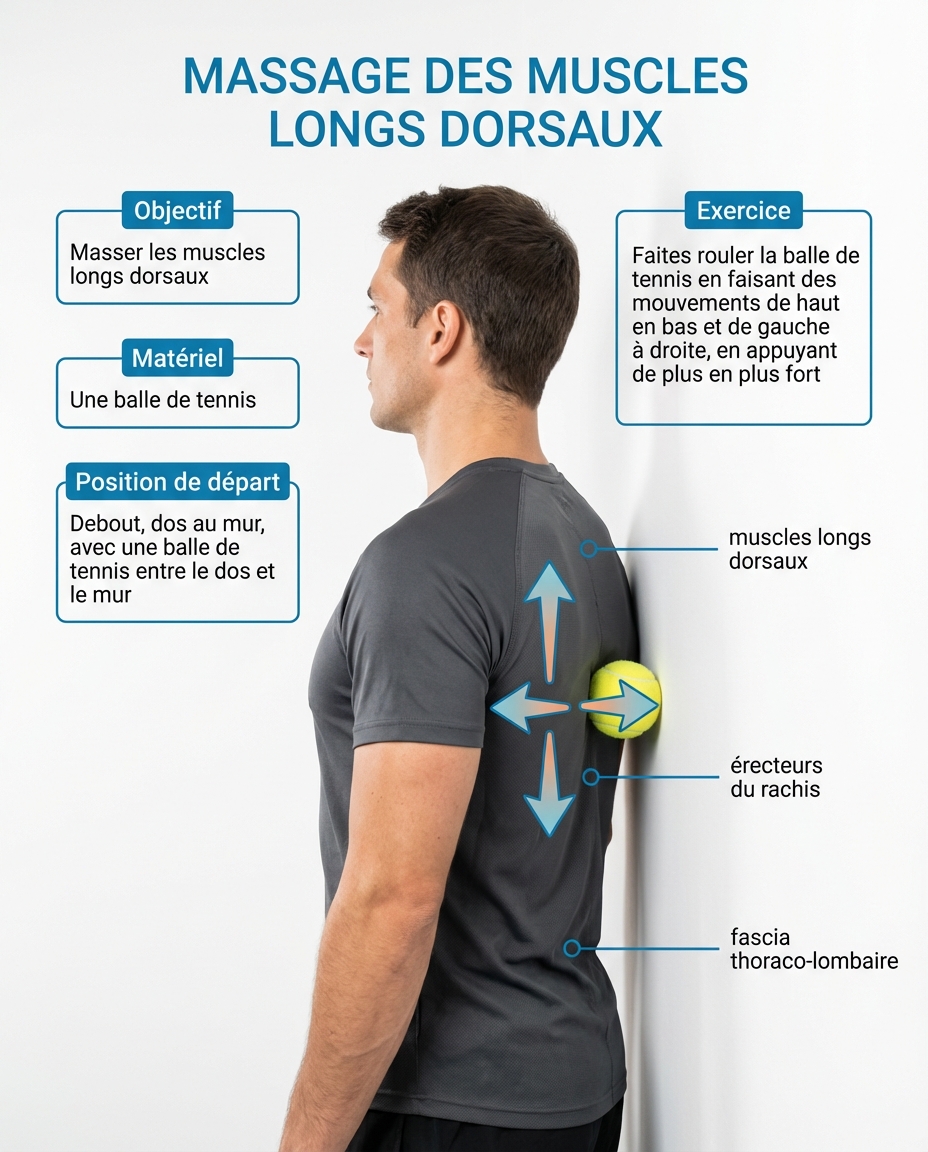
Long dorsal muscle massage illustration
Standing position back to wall with tennis ball for paravertebral muscle self-massage.