Hip Rotator Stretch
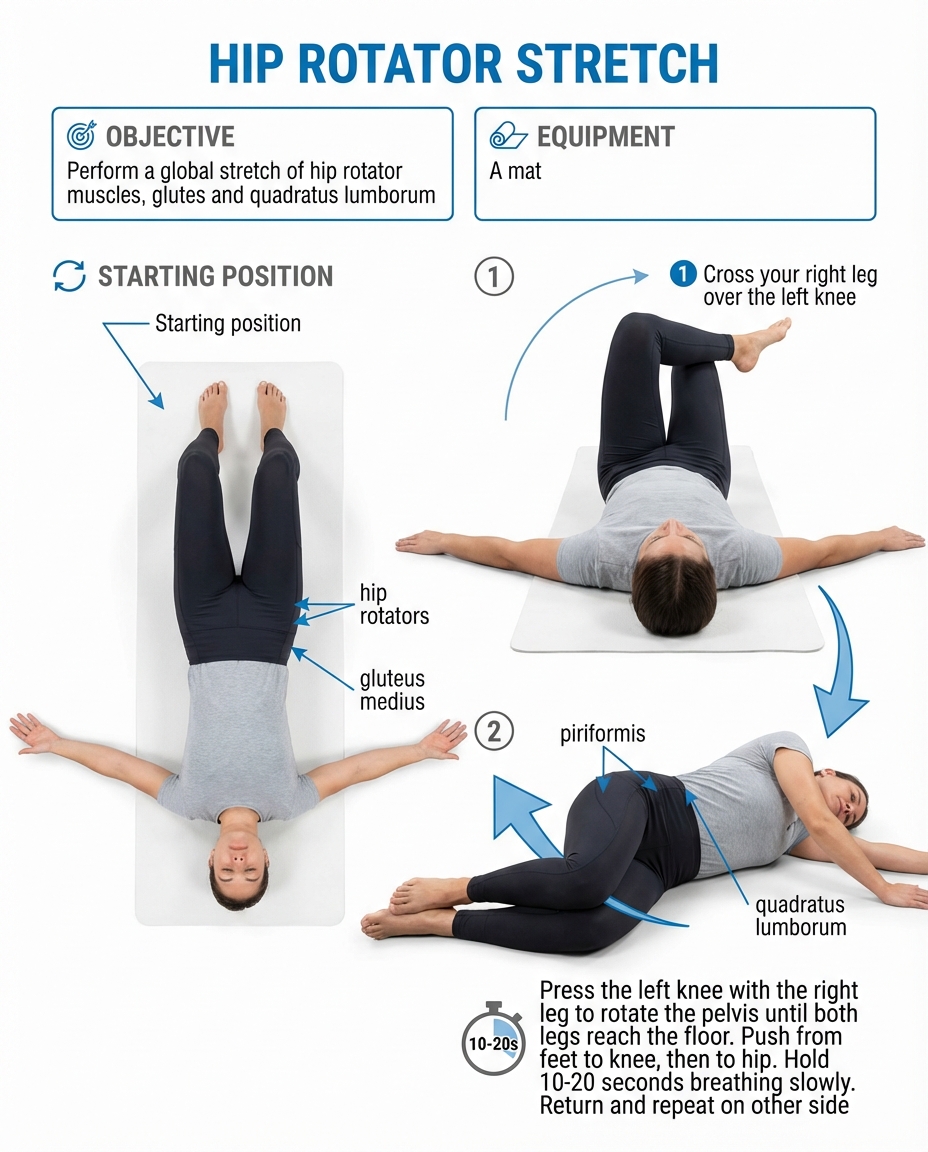
Seated hip rotator stretch with crossed leg and gentle torso rotation to release deep hip muscles and improve rotational mobility.

Hip Rotator Stretch — Seated with Rotation
The hip rotators form a group of deep muscles responsible for internal and external rotation of the femur in the acetabulum. Their stiffness is a frequent and often overlooked cause of hip pain, sciatica and functional limitations in daily activities like crossing legs or turning in bed. This seated stretch, combining leg crossing with gentle trunk rotation, provides a particularly effective multidirectional stretch for all deep rotators.
Why Stretch the Hip Rotators?
The deep hip rotators — piriformis, gemelli, obturators, quadratus femoris — sit directly above the sciatic nerve. Their contracture can compress this nerve, mimicking disc-related sciatica. Moreover, an imbalance between internal and external rotation disrupts knee and ankle biomechanics, increasing injury risk throughout the lower kinetic chain. Regular stretching maintains rotational balance and protects the entire lower limb.
Anatomy Involved
- Piriformis — primary external rotator in neutral hip position, becomes an internal rotator when hip is flexed beyond 60°.
- Superior and inferior gemelli — small muscles flanking the obturator internus tendon, contributing to external rotation.
- Internal and external obturators — deep hip stabilizers, participating in external rotation.
- Quadratus femoris — flat muscle connecting the ischium to the femur, a powerful external rotator.
Step-by-Step Instructions
Step 1 — Seated Position
Sit on the floor, legs extended, back straight. If needed, place a cushion under your buttocks to ease the position.
Step 2 — Cross the Leg
Bend your right leg and place the right foot outside your left knee. The right knee points toward the ceiling. Keep the left leg straight or slightly bent depending on your flexibility.
Step 3 — Trunk Rotation
Place your left elbow on the outside of the right knee and your right hand on the floor behind you for support. Gently rotate your torso to the right using the elbow as leverage against the knee. Rotation comes from the trunk; the pelvis stays stable on the floor.
Step 4 — Hold
Hold for 30 seconds, breathing deeply. With each exhale, slightly deepen the rotation. Release and repeat on the other side. Perform 3 sets per side.
Duration and Repetitions
- Hold: 30 seconds per side
- Sets: 3 per side
- Frequency: 1 to 2 times daily
- Total duration: approximately 5 minutes
Safety Tips
- Rotation should be progressive and controlled — never force beyond comfort.
- If you feel pinching in the groin or sharp pain in the buttock, reduce rotation range.
- People with lumbar disc pathology should limit the trunk rotation component.
- Keep the back straight throughout to maximize the rotator stretch without spinal compensation.
Who Benefits from This Exercise?
This stretch is particularly indicated for people with piriformis syndrome, deep buttock pain, hip rotation limitations or pseudo-sciatica. It suits athletes (runners, soccer players, golfers), sedentary workers and those in post-operative hip rehabilitation. Its simplicity makes it accessible to all fitness levels.
Diagrams and illustrations
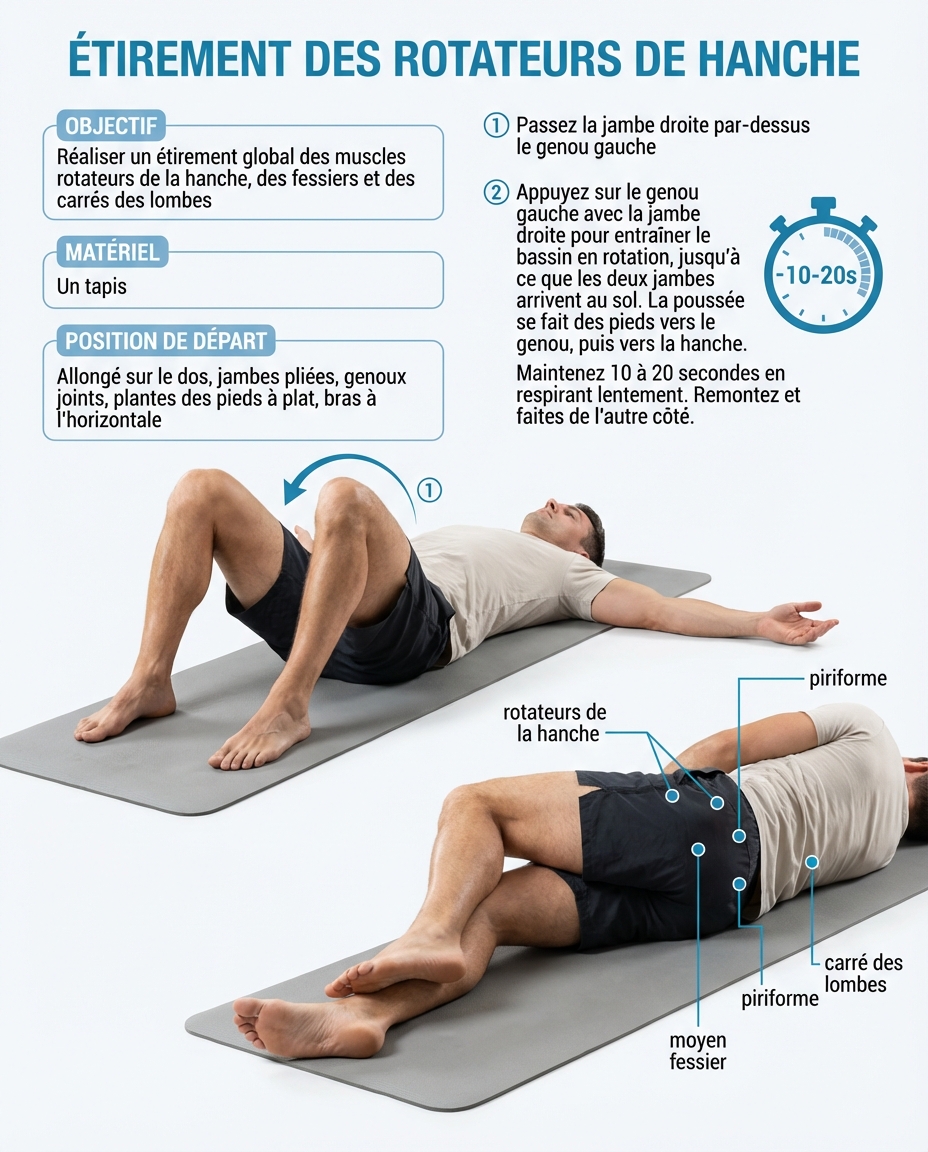
Hip rotator stretch illustration
Seated position with crossed leg and trunk rotation to stretch the deep hip rotators.