Personal Development

Articles tagged "Personal Development"

29 articles

Self-Esteem and Self-Confidence: The Foundations
Self-Confidence

Self-Esteem and Self-Confidence: The Foundations

Self-esteem and self-confidence are distinct but closely linked concepts. Self-esteem refers to the overall value one attributes to oneself as a person, while self-confidence concerns belief in one's ability to act effectively. Nourished by early attachment experiences, successes and failures, and internal dialogue, they are built and repaired throughout life through well-identified psychological processes.

Read more
Practical Exercises to Build Confidence
Self-Confidence

Practical Exercises to Build Confidence

Self-confidence develops through action, not reflection alone. This guide offers concrete, progressive exercises from positive psychology, CBT, sophrology and coaching: victory journal, progressive exposure, power posing, assertiveness training, 'as if' technique and creative visualization. Each exercise includes a detailed protocol and 30-day progression calendar.

Read more
Life Coaching: Methods and Benefits
Personal Development

Life Coaching: Methods and Benefits

Life coaching is a structured professional accompaniment helping individuals clarify goals, identify resources and overcome obstacles for greater personal and professional fulfillment. Distinct from psychotherapy (which treats psychological suffering), coaching addresses functional individuals seeking progress. Validated methodologies include Whitmore's GROW model, motivational interviewing and solution-focused approaches.

Read more
Personal Development: Approaches and Limits
Personal Development

Personal Development: Approaches and Limits

Personal development encompasses a vast set of practices aimed at self-improvement, realizing potential and achieving greater well-being. While some approaches rest on solid scientific foundations — Seligman's positive psychology, Deci and Ryan's self-determination theory, mindfulness — others rely more on marketing than science. This article offers a critical, nuanced view, distinguishing validated approaches from excessive promises.

Read more
Motivation and Goals: A Realistic Approach
Personal Development

Motivation and Goals: A Realistic Approach

Motivation is not a magical emotional state preceding action — it is often the result of action itself. Research in motivation psychology, particularly Deci and Ryan's self-determination theory and Locke and Latham's goal-setting work, reveals that lasting motivation rests on satisfying autonomy, competence and relatedness needs, rather than willpower or external rewards alone.

Read more
Resilience: Bouncing Back from Adversity
Personal Development

Resilience: Bouncing Back from Adversity

Ordinary resilience — the ability to navigate daily life difficulties without breaking down — is a trainable skill. Distinct from post-traumatic resilience, it applies to professional failures, breakups, disappointments, life transitions and intense stress periods. Research identifies key factors: cognitive flexibility, social support, emotional regulation, meaning-making and future projection capacity.

Read more
Emotional Intelligence: Understanding and Developing
Emotion Management

Emotional Intelligence: Understanding and Developing

Emotional intelligence (EI) refers to the ability to perceive, understand, manage, and use one's own emotions and those of others adaptively. Popularized by Daniel Goleman in 1995, this form of intelligence rests on five core competencies: self-awareness, self-regulation, internal motivation, empathy, and social skills. Research shows EI predicts professional success and personal well-being better than IQ alone.

Read more
Managing Daily Stress: A Practical Guide
Stress Management

Managing Daily Stress: A Practical Guide

Daily stress management relies on a set of concrete, immediately applicable strategies: time organization, sleep hygiene, anti-stress nutrition, adapted physical activity, regenerative micro-breaks, and managing boundaries between professional and personal life. This guide offers practical research-based tools for building a sustainable anti-stress routine without disrupting your lifestyle or requiring complex techniques.

Read more
Building Post-Traumatic Resilience
Trauma Management

Building Post-Traumatic Resilience

Post-traumatic resilience is the capacity not only to survive a traumatic event but to rebuild and sometimes transform positively through the ordeal. Far from being an innate trait reserved for exceptional individuals, resilience is a dynamic process that can be built and strengthened. Research by Boris Cyrulnik, Ann Masten and others has identified key factors: secure attachment, social support, meaning-making and nervous system regulation techniques.

Read more
Life Narrative and Therapeutic Autobiography
Therapeutic Writing & Bibliotherapy

Life Narrative and Therapeutic Autobiography

Life narrative and therapeutic autobiography allow the reconstruction of existential meaning by organizing lived experiences into a coherent narrative. Inspired by Daniel Bertaux and Paul Ricœur, this approach restores narrative identity and fosters resilience, particularly among elderly individuals, migrants, and trauma survivors.

Read more
The Therapeutic Journal
Therapeutic Writing & Bibliotherapy

The Therapeutic Journal

The therapeutic journal is a regular personal writing practice, guided or free, aimed at exploring emotions, clarifying thoughts, and supporting a change process. From Ira Progoff to Julia Cameron, this method draws on proven protocols to promote psychological healing.

Read more
Poetry Therapy
Therapeutic Writing & Bibliotherapy

Poetry Therapy

Poetry therapy uses the reading and writing of poems as emotional healing tools. Championed by Jack Leedy and the NAPT, this practice harnesses the condensed power of poetic language to express the inexpressible, navigate grief, and support moments of crisis.

Read more
Foundations of Visual Arts Therapy
Visual Arts Therapy

Foundations of Visual Arts Therapy

Visual arts therapy uses the creative process — drawing, painting, sculpting, collage — as a therapeutic mediation. Based on the patient/artwork/therapist triangle, it enables symbolic expression of internal conflicts and promotes psychic transformation through creation.

Read more
Collage in Art Therapy
Visual Arts Therapy

Collage in Art Therapy

Therapeutic collage is a particularly accessible art therapy technique that uses cutting and assembling images, texts, and various materials to promote self-expression and identity reconstruction. Requiring no prior artistic skill, it opens art therapy to all audiences.

Read more
Mandala in Art Therapy
Visual Arts Therapy

Mandala in Art Therapy

The mandala, a sacred circle from Buddhist and Hindu traditions, has become a major therapeutic tool in art therapy since Carl Jung's work on individuation. Drawn, painted, or colored, it promotes psychic recentering, stress reduction, and self-exploration through a containing circular form.

Read more
Therapeutic Painting
Visual Arts Therapy

Therapeutic Painting

Therapeutic painting uses pictorial media — watercolor, gouache, acrylic, ink — as vehicles for emotional expression and psychic transformation. From gestural painting to contemplative watercolor, each technique offers a unique expressive register suited to the patient's needs.

Read more
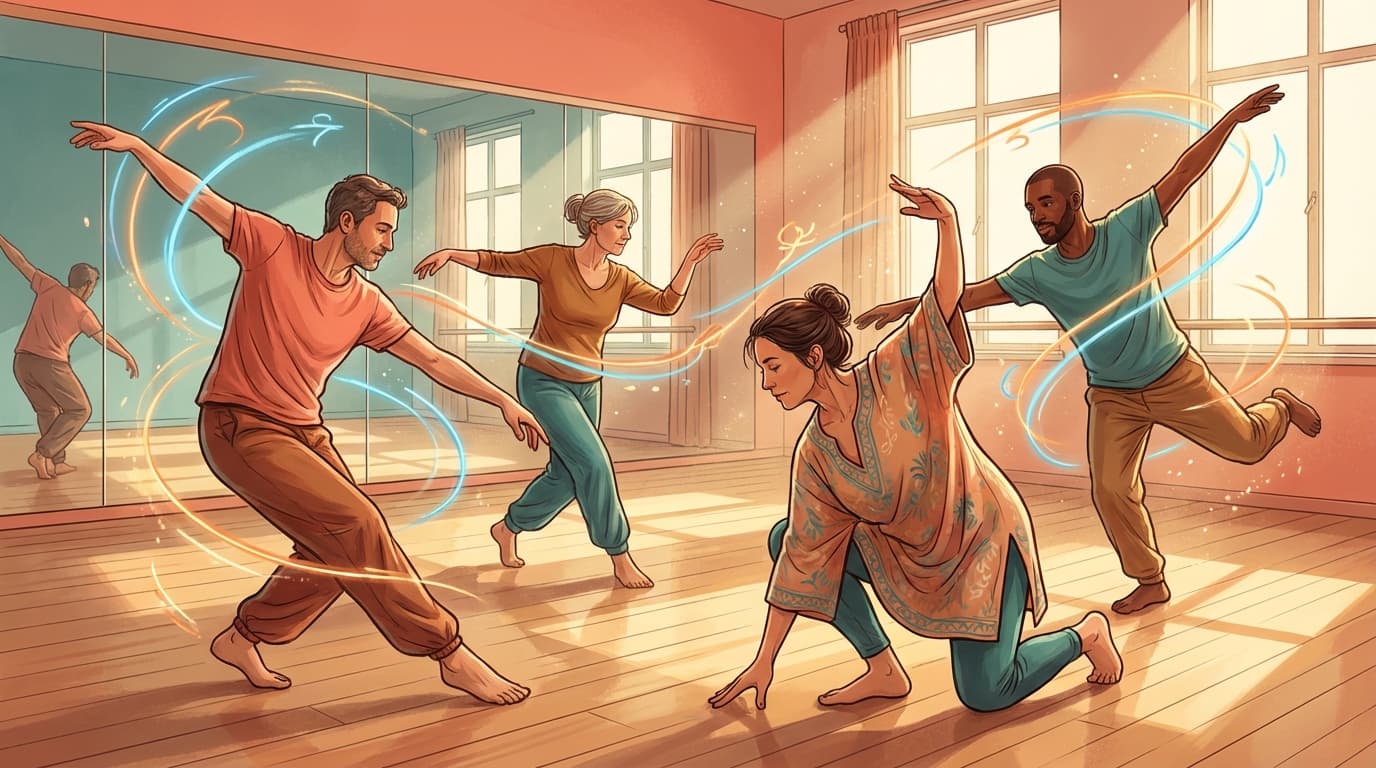
Biodanza: Dance of Life
Dance Movement Therapy

Biodanza: Dance of Life

Biodanza is a system of human integration developed by Rolando Toro Araneda in Chile in the 1960s. Based on music, movement and group encounter, it activates five lines of vivencia — vitality, sexuality, creativity, affectivity and transcendence — to strengthen identity, self-confidence and social connection.

Read more
Therapeutic Contact Improvisation
Dance Movement Therapy

Therapeutic Contact Improvisation

Contact Improvisation, created by Steve Paxton in 1972, is an improvised dance form based on tactile listening, weight sharing and the point of contact between dancers. Used therapeutically, it addresses trust, body boundaries, letting go and relating to others, with specific applications for touch phobia, social isolation and motor disability.

Read more