Pigeon Pose
The pigeon pose deeply stretches the piriformis, psoas, and glutes to release hip and lower back tension.
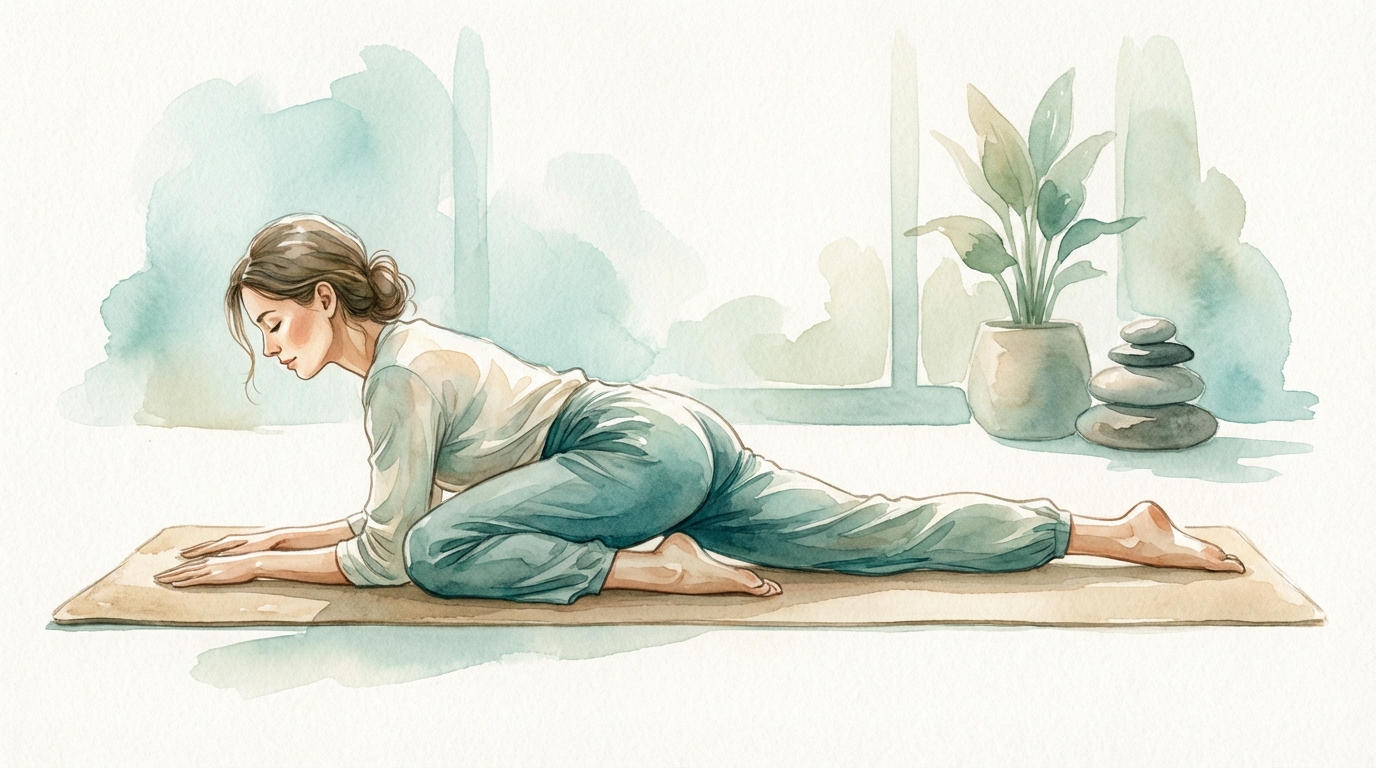
Pigeon Pose — Deep Hip Opening
The pigeon pose, from yoga (Eka Pada Rajakapotasana), is one of the most powerful positions for opening the hips and releasing deep pelvic tension. It simultaneously stretches the piriformis, glutes, and psoas — three key muscles often responsible for lower back pain and mobility restrictions. It is an intense but deeply liberating posture.
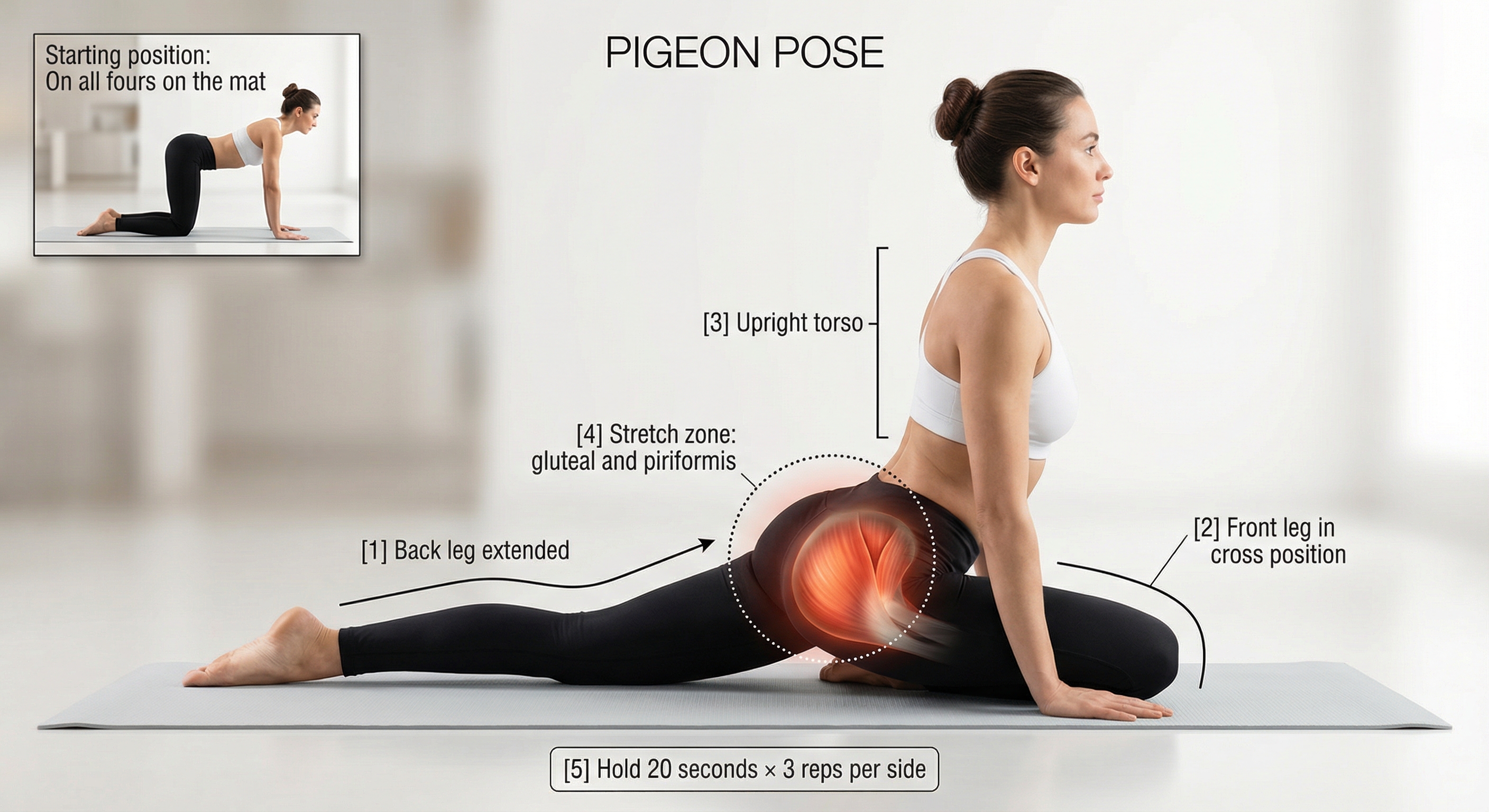
Why Practice the Pigeon Pose?
The hips are the body's crossroads — they connect the upper and lower body and carry much of our tension, including emotional tension. Prolonged sitting shortens the hip flexors (psoas) and tightens the external rotators (piriformis). The pigeon pose reverses this pattern by opening the hip joint in all its dimensions.
Anatomy Involved
- Piriformis muscle — a deep external rotator, intensely stretched on the front leg side.
- Iliopsoas muscle — the primary hip flexor, stretched on the back leg side.
- Gluteal muscles — the gluteus maximus, medius, and minimus are stretched on the front leg side.
- Tensor fasciae latae — a lateral hip muscle, stretched on the front side.
- Rectus femoris — part of the quadriceps, stretched on the back leg side.
Step-by-Step Instructions
Step 1 — Starting Position
Begin on all fours on a mat. Bring your right knee forward, between your hands. Place your right shin diagonally in front of you (the right foot moves toward the left hip).
Step 2 — Extend the Back Leg
Slide your left leg back until it is fully extended, top of the foot on the floor. Your pelvis lowers toward the floor. Make sure your hips stay squared (facing forward).
Step 3 — Adjust the Position
If your right hip does not touch the floor, place a cushion or folded blanket under your right buttock. Straighten your torso, hands on each side, and open your chest. Stay here if the stretch is already intense.
Step 4 — Deepen (Optional)
To deepen the stretch, slowly lean forward, resting on your forearms, then eventually your forehead. Hold for 30 to 60 seconds. Breathe deeply into the stretch sensation.
Duration and Repetitions
- Hold: 30 to 60 seconds per side
- Sets: 2 on each side
- Frequency: 3 to 5 times per week
Safety Tips
- Protect your front knee — if you feel knee pain, bring your front foot closer to your pelvis.
- Keep your hips squared (aligned forward) — do not let the back hip rotate outward.
- Use props (cushion, block) under the hip if needed — there is no shame in adapting the pose.
- Never force the descent — gravity and time will do the work.
- Contraindicated for recent knee or hip injuries without medical advice.
Who Benefits from This Exercise?
The pigeon pose is recommended for people with hip tension, sciatic pain, psoas stiffness, and for athletes (runners, cyclists, dancers). It suits intermediate-level practitioners. Beginners should start with the supine version (figure 4) before progressing to the full pigeon.
Diagrams and illustrations
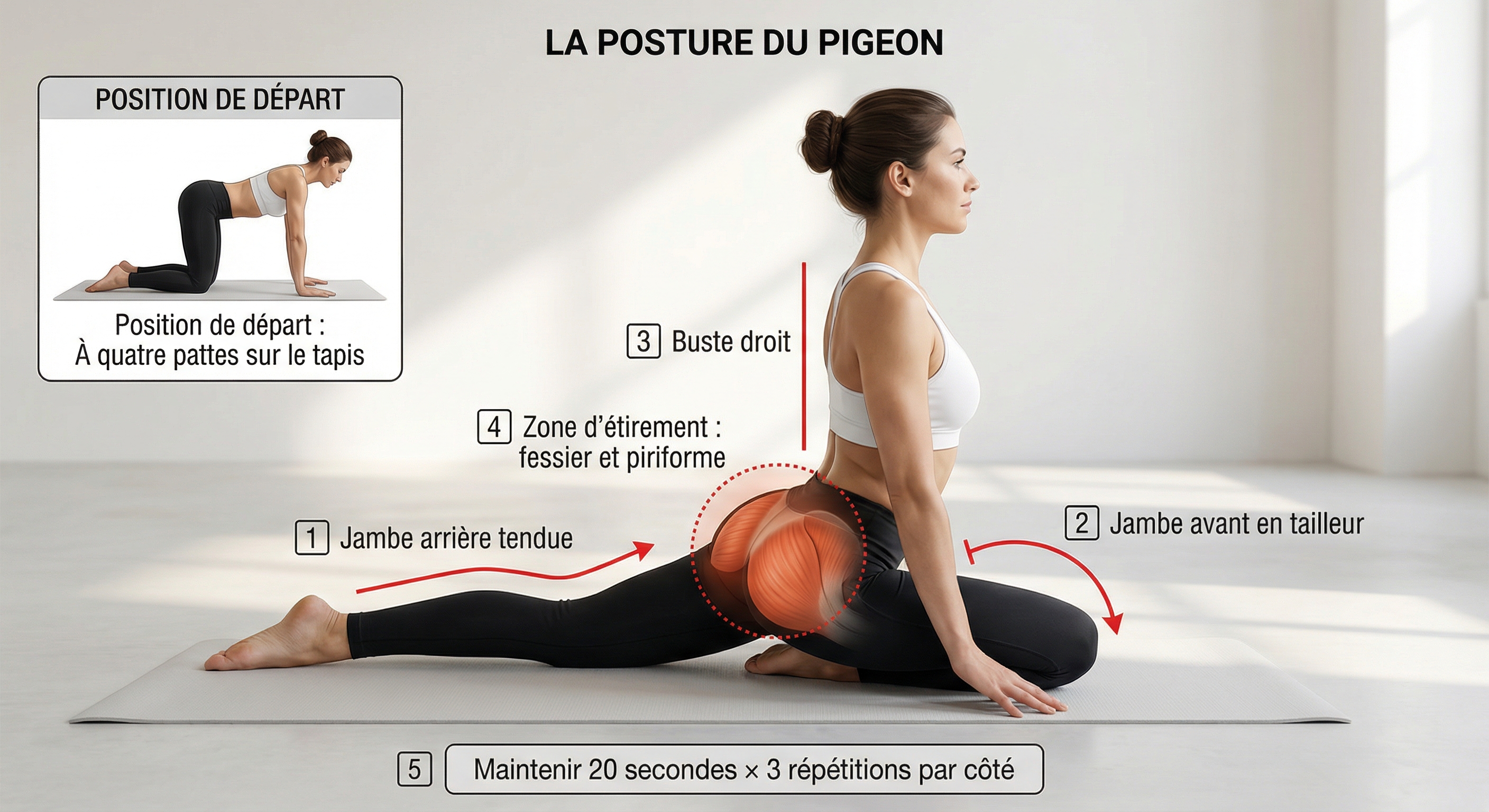
Pigeon pose illustration
Pigeon pose on the floor with front leg bent to stretch the hips.