Trunk Rotator Stretch
Standing trunk rotator stretch in 3 progressive stages, with torso rotation touching knee then ankle, 7-second holds per position.
Trunk Rotator Stretch — Three Progressive Stages
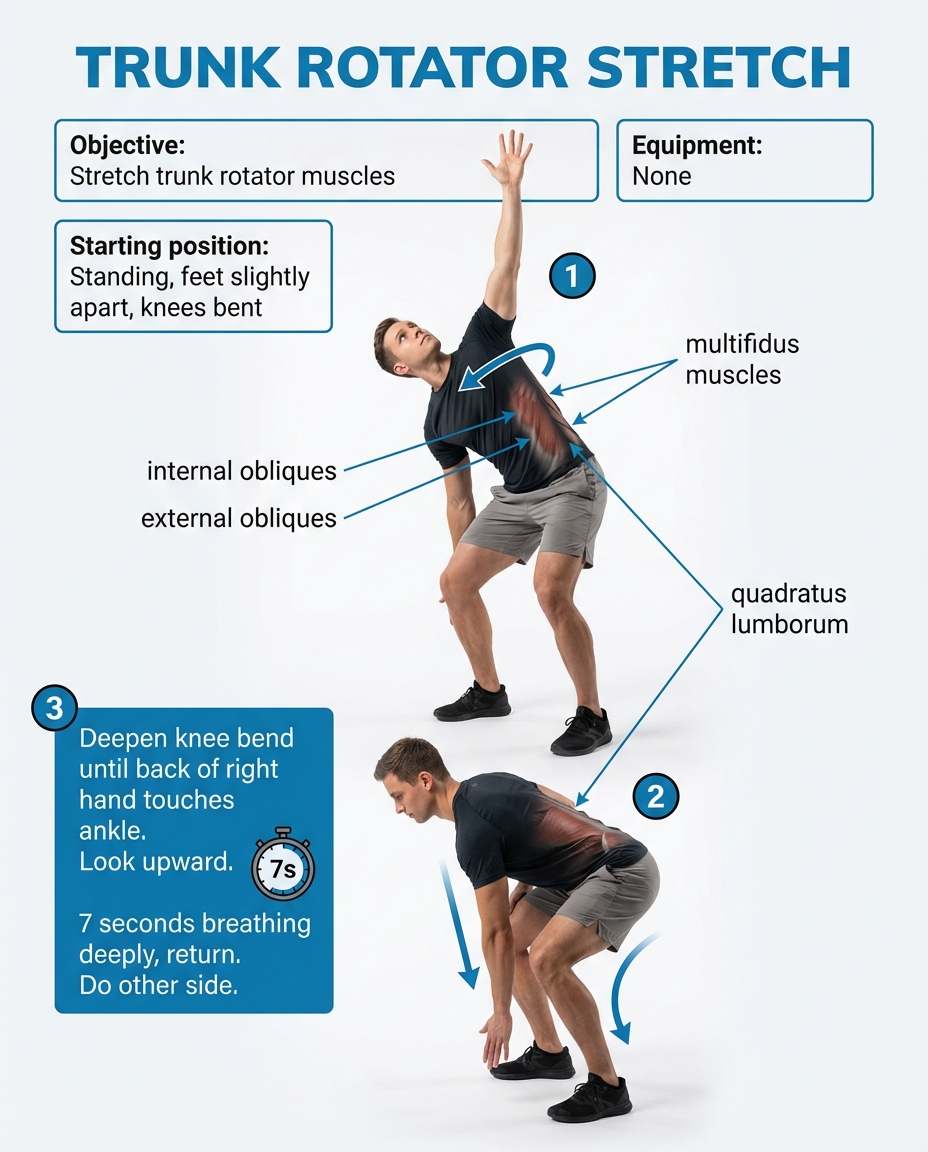
Trunk rotation is a fundamental movement involved in nearly all daily activities: turning around, reaching for objects to the side, walking, running. The trunk rotator muscles — internal and external obliques, multifidus, quadratus lumborum — must maintain optimal flexibility to allow these movements without pain or injury risk. This three-stage progressive exercise stretches the entire rotational chain of the trunk, from the lumbar region to the shoulder girdle.
Why Stretch the Trunk Rotators?
Sedentary lifestyles and prolonged static postures cause progressive shortening of the rotator muscles, reducing thoracolumbar rotational range. This loss of rotational mobility is a major risk factor for lower back pain, facet joint pain and disc herniations, as it forces vertebrae to compensate during sudden movements. A regular rotator stretching program maintains intervertebral disc health, improves segmental spinal coordination and reduces the risk of acute lumbago.
Anatomy Involved
- External and internal obliques — lateral abdominal muscles, the primary trunk rotators. The external oblique on one side works with the internal oblique on the opposite side to produce rotation.
- Multifidus — small deep paravertebral muscles, segmental stabilizers controlling fine intervertebral rotation.
- Quadratus lumborum — deep muscle connecting the ribs to the pelvis, involved in lateral flexion and lumbar stabilization during rotation.
- Thoracolumbar fascia — fibrous membrane transmitting rotational forces between trunk and pelvis.
Step-by-Step Instructions
Stage 1 — Gentle Rotation (Touch the Knee)
Stand with feet shoulder-width apart, arms at your sides. Rotate your torso to the right, letting your left hand descend toward the right knee. The right hand rises naturally behind you. Rotation comes from the trunk, not the hips — the pelvis stays stable and forward-facing. Hold 7 seconds. Return to center, then perform on the other side.
Stage 2 — Moderate Rotation (Touch the Shin)
From the same starting position, perform the same rotation but descend lower: the left hand reaches down to the right shin. Rotational range increases and the stretch intensifies in the obliques and quadratus lumborum. Hold 7 seconds. Alternate each side.
Stage 3 — Deep Rotation (Touch the Ankle)
For sufficiently flexible individuals, lower the hand to the opposite ankle. This maximum position engages the entire rotational muscle chain and provides a deep stretch of the multifidus and thoracolumbar fascia. Hold 7 seconds. Caution: only reach this amplitude if the first two stages are performed comfortably.
Duration and Repetitions
- Hold: 7 seconds per position per side
- Repetitions: 3 to 5 per side for each stage
- Progression: start with stage 1 alone, add subsequent stages over weeks
- Frequency: 1 to 2 times daily
- Total duration: approximately 8 minutes for all three complete stages
Safety Tips
- Rotation must come from the trunk, not the hips: imagine your pelvis is fixed in a vise and only your torso rotates.
- Do not bounce in the position — the stretch should be progressive and continuous.
- If you feel sharp pain on one side of the back, stop immediately and consult your practitioner.
- People with lateral disc herniation should avoid maximum rotations and limit themselves to stage 1 under supervision.
- Keep your knees slightly bent to protect the lower back.
Who Benefits from This Exercise?
This exercise is recommended for anyone wanting to maintain or improve rotational mobility, especially athletes in rotational sports (golf, tennis, martial arts), sedentary people with lumbar stiffness, and patients rehabilitating from low back pain. The three-stage progression allows adaptation to all flexibility levels, from beginner to advanced.
Diagrams and illustrations
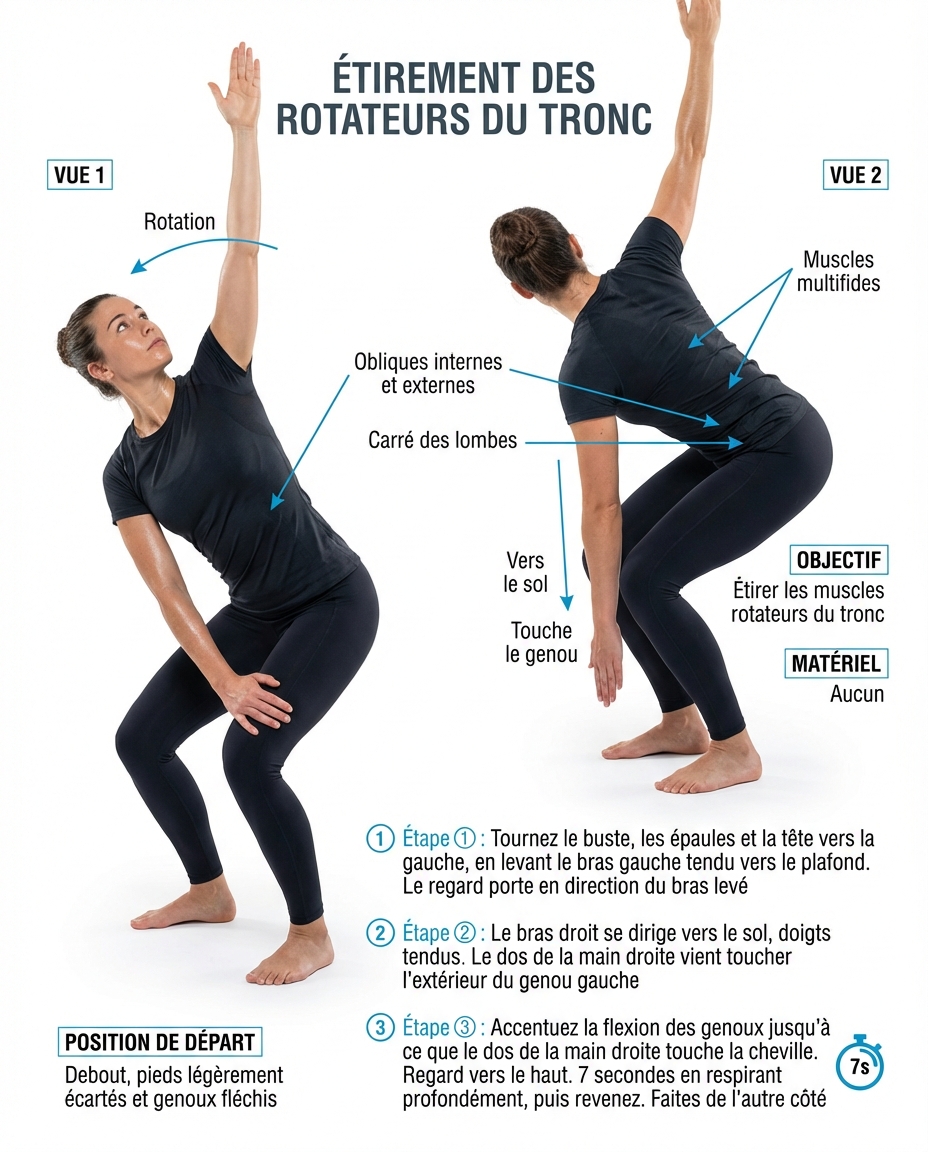
Trunk rotator stretch illustration
Standing torso rotation in three progressive stages: touch knee, shin and ankle.