Upper Back Release - Shoulder Stand
Supine shoulder stand posture with legs vertical for 90 seconds, to deeply release the trapezius, rhomboids and paravertebral muscles of the upper back.
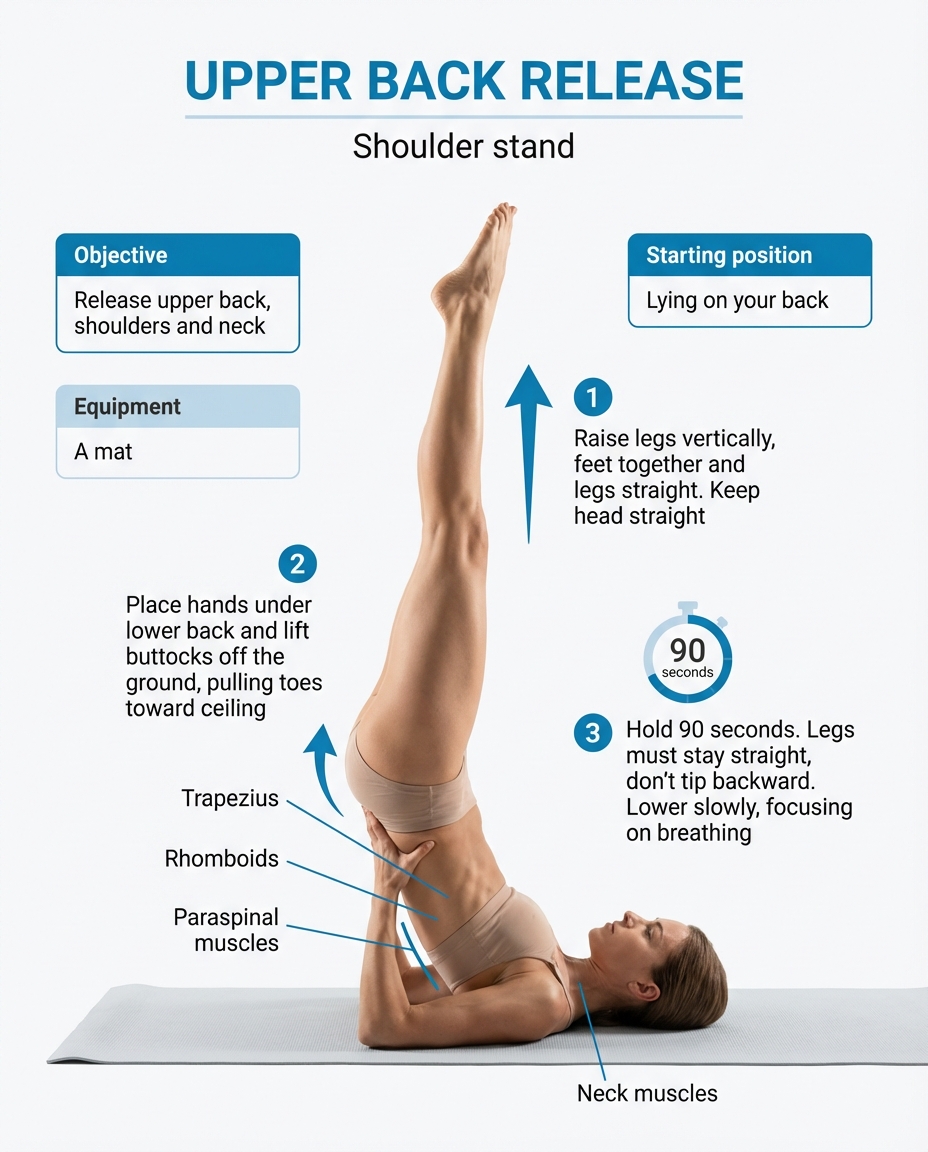
Upper Back Release — The Shoulder Stand
The shoulder stand is a deep passive release exercise that uses inverted gravity to decompress the upper back and neck muscles. In a supine position with legs vertical, the weight of the pelvis and legs creates gentle traction on the thoracic spine, allowing chronically contracted muscles to release naturally. This yoga-inspired posture is particularly effective for people suffering from stress-related tension or prolonged seated posture.
Why Practice the Shoulder Stand?
The upper back muscles — trapezius, rhomboids, levator scapulae — are the first to contract in response to stress and postural fatigue. This chronic contraction leads to tension headaches, interscapular pain and limited cervical mobility. The shoulder stand enables deep muscle relaxation by combining gravitational inversion with respiratory relaxation, offering lasting relief in just 90 seconds.
Anatomy Involved
- Trapezius — large diamond-shaped muscle covering the upper back; its three portions (upper, middle, lower) are the primary targets of this exercise.
- Rhomboids — deep muscles connecting the scapula to the spine, often harboring painful trigger points.
- Neck muscles — semispinalis, splenius and suboccipitals, released through cervical decompression.
- Paravertebral muscles — erector spinae that maintain spinal alignment and accumulate postural tension.
Step-by-Step Instructions
Step 1 — Setup
Lie on your back on a mat, arms at your sides, palms facing up. Bend your knees with feet flat on the floor. Take 3 to 5 deep abdominal breaths to relax the back muscles.
Step 2 — Raise the Legs
Bring your knees toward your chest, then gradually extend your legs toward the ceiling. The pelvis can remain on the floor (beginner version) or be lifted with hands supporting the lower back (advanced version). Legs should be as vertical as possible without forcing.
Step 3 — Hold and Breathe
Maintain the position for 90 seconds. Breathe slowly and deeply through the nose, expanding the abdomen on inhalation and letting it fall on exhalation. Let gravity do the work — do not contract the back muscles.
Step 4 — Controlled Descent
To exit the posture, slowly bend your knees toward your chest, then place your feet on the floor one at a time. Stay lying down for a few moments to savor the release sensation before getting up.
Duration and Repetitions
- Hold: 90 seconds
- Sets: 1 to 2
- Frequency: once daily, ideally in the evening before bed
- Total duration: approximately 4 minutes including setup and descent
Safety Tips
- The beginner version (pelvis on floor, legs against a wall) is recommended for those unaccustomed to inversion.
- Do not practice the full shoulder stand if you have glaucoma, uncontrolled hypertension, cervical disc herniation or during menstruation.
- If you feel dizzy, tingling in the hands or pressure in the head, come down immediately.
- Place a folded blanket under the shoulders to protect the cervical spine in the advanced version.
Who Benefits from This Exercise?
This exercise is ideal for people with chronic upper back tension, tension headaches, postural fatigue or accumulated stress. It is particularly beneficial at the end of a sedentary workday. The legs-against-wall version is accessible to everyone, including elderly individuals and complete beginners.
Diagrams and illustrations
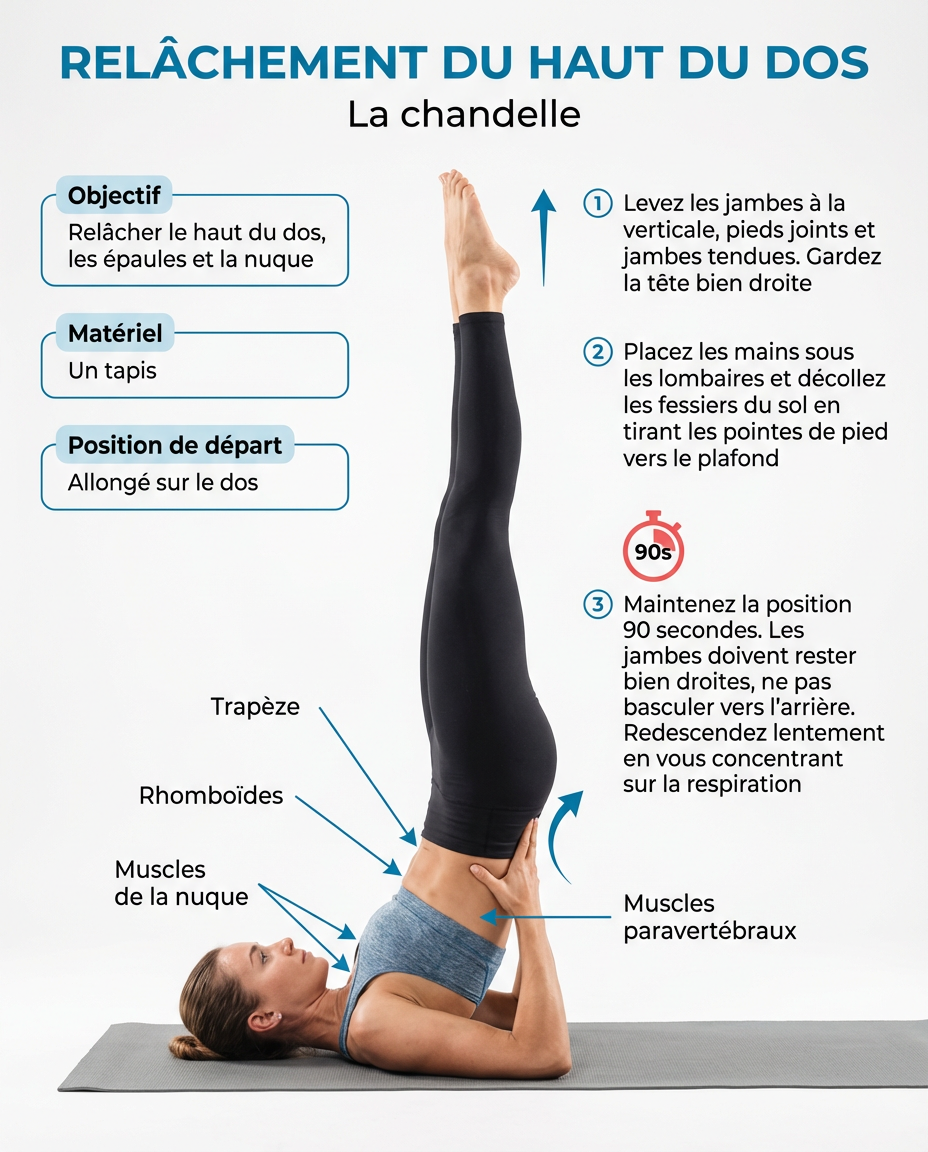
Shoulder stand posture illustration
Supine position with legs vertical for deep upper back release.