Hip Joint Flexibility
Hip flexibility exercise lying on the back, with circular leg movements to mobilize the hip joint in all directions.
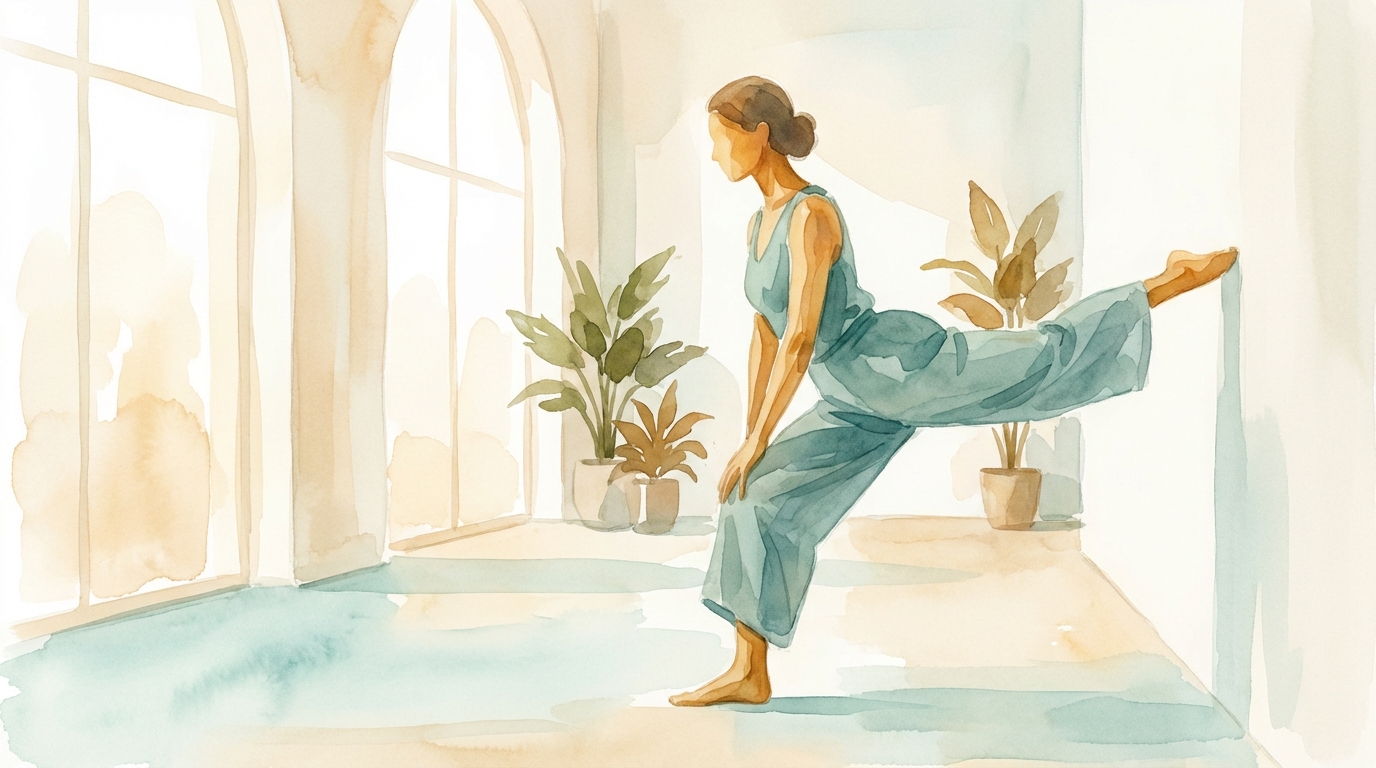
Hip Joint Flexibility — Lying Circles
Joint flexibility through circular movements is one of the gentlest and most comprehensive techniques to restore hip mobility. Unlike static stretches targeting a specific muscle group, leg circles mobilize the hip joint in all three planes — flexion/extension, abduction/adduction and internal/external rotation — in one fluid movement. This global approach nourishes articular cartilage, stimulates synovial fluid production and preserves the long-term health of the joint.
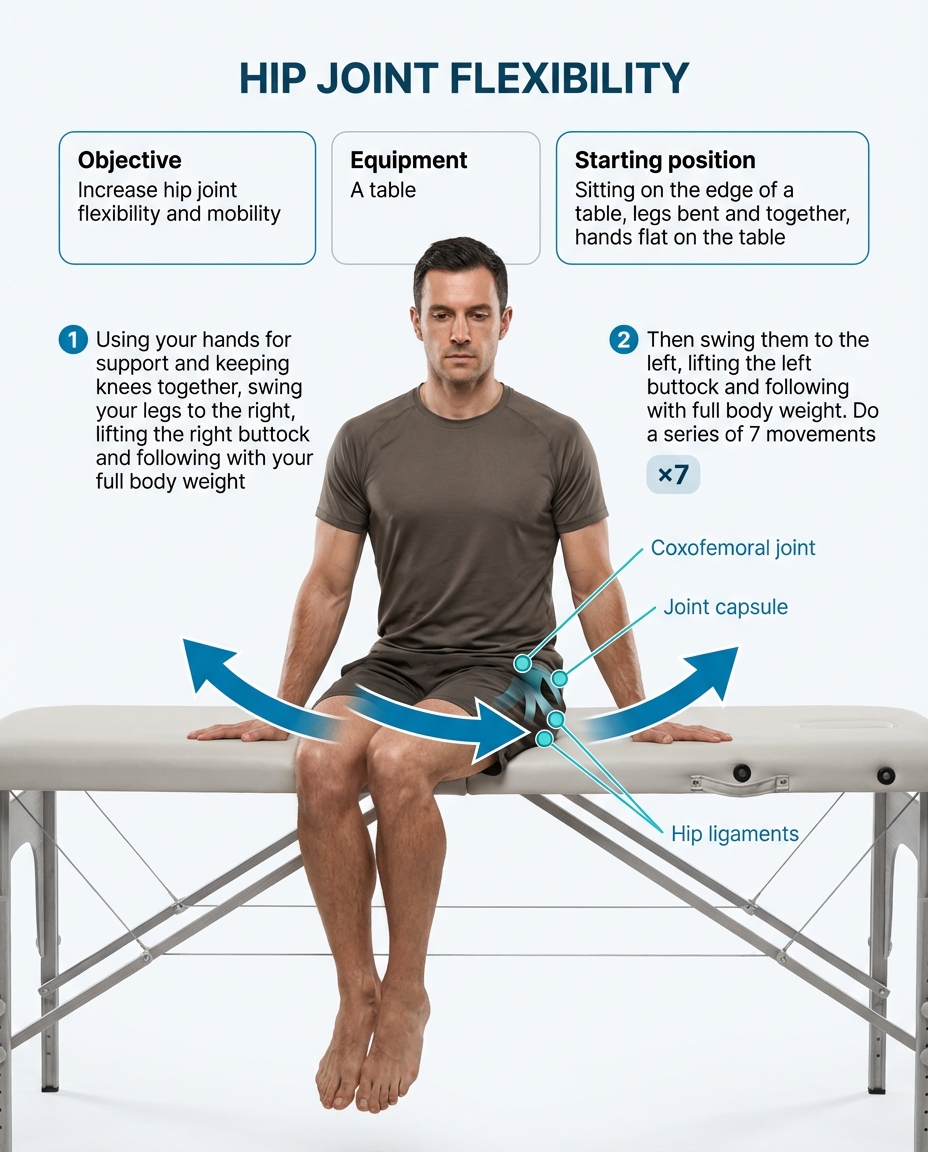
Why Improve Hip Flexibility?
The hip is a ball-and-socket joint designed for maximum mobility, but this mobility progressively decreases with age and sedentary lifestyle. Loss of rotational and abduction range is one of the first signs of joint aging. Circular movements combat this degradation by mobilizing all articular surfaces, simultaneously stretching capsular and ligamentous structures in all directions, and improving joint proprioception — the brain's ability to perceive hip position in space.
Anatomy Involved
- Hip joint — ball-and-socket joint (enarthrosis) between the femoral head and acetabulum of the hip bone, allowing six degrees of freedom.
- Joint capsule — fibrous envelope reinforced by the iliofemoral, pubofemoral and ischiofemoral ligaments.
- Acetabular labrum — fibrocartilaginous ring deepening the acetabular cavity, improving joint congruence.
- Iliopsoas — primary hip flexor, engaged during the flexion phase of the circle.
- Gluteus maximus — primary extensor, engaged during the extension phase.
Step-by-Step Instructions
Step 1 — Starting Position
Lie on your back, arms slightly spread for stability, palms down. The left leg stays straight on the floor (or knee bent for lumbar comfort).
Step 2 — Raise the Leg
Raise the right leg straight toward the ceiling, about 60-80° of flexion. The foot is relaxed or dorsiflexed as preferred.
Step 3 — Perform the Circles
Draw large circles with the straight leg, clockwise. Movement should be slow, fluid and controlled, exploring the full available range. The pelvis stays as stable as possible on the floor — the hip generates the movement, not the trunk. Perform 10 circles in one direction, then 10 in the other.
Step 4 — Switch Sides
Rest the right leg and repeat with the left. Compare sensations between sides — asymmetries may reveal specific joint restrictions.
Duration and Repetitions
- Repetitions: 10 circles each direction, per leg
- Sets: 2 to 3
- Tempo: slow and controlled, about 5 seconds per circle
- Frequency: daily, ideally morning upon waking
- Total duration: approximately 8 minutes
Safety Tips
- Start with small circles and gradually increase diameter as the joint warms up.
- If you feel a block or catch at a specific point in the circle, reduce range in that zone.
- Keep the lower back pressed to the floor to avoid lumbar compensation.
- With a hip replacement, consult your surgeon to validate allowed ranges.
Who Benefits from This Exercise?
This flexibility exercise is recommended for anyone wanting to maintain or improve hip mobility. It is especially useful for those with early-stage coxarthrosis, in post-operative recovery (with medical approval), or simply concerned about age-related joint stiffness. Dancers, yoga practitioners and martial artists will find it an excellent joint preparation exercise.
Diagrams and illustrations
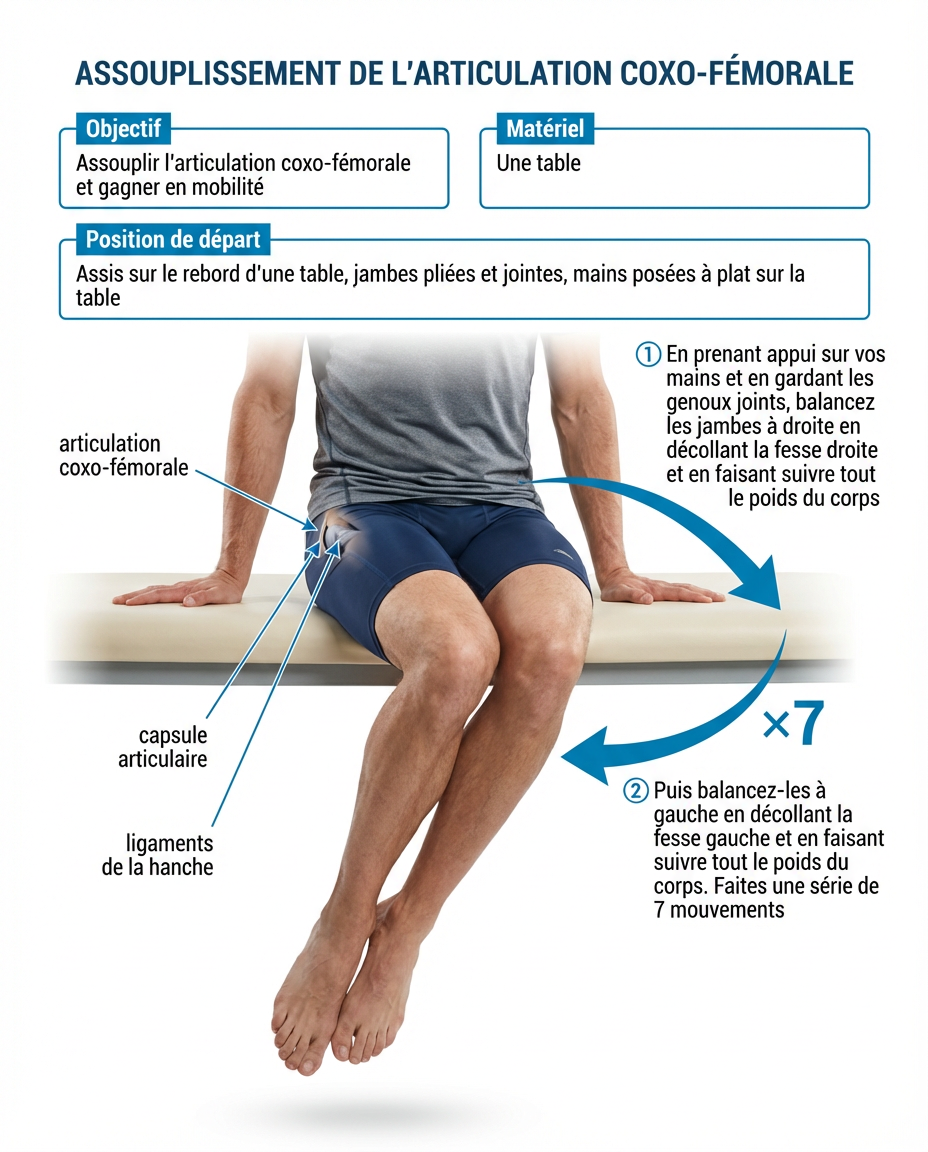
Hip joint flexibility illustration
Supine position with circular leg movements to improve hip flexibility.