Wrist Mobilization
Wrist mobilization in two steps: light shaking to release tension, then puppet-style rotations to restore joint range of motion.
Wrist Mobilization — Shaking and Puppet Rotations
Wrist mobilization is a two-phase joint unlocking exercise combining relaxing shakes and fluid rotations. Inspired by warm-up techniques from musicians and dancers, this exercise is particularly effective for reducing morning stiffness, preparing hands for work, and improving synovial circulation in the radiocarpal joint.
Why Mobilize the Wrists?
The wrist joint is one of the most complex in the human body. It allows movements in all planes — flexion, extension, radial and ulnar deviation, circumduction. Yet desk work and smartphone use lock the wrist in static positions for hours, depleting synovial fluid and progressively stiffening joint capsules. Regular mobilization reactivates synovial production, maintains ligament flexibility, and prevents tendinitis related to immobility.
Anatomy Involved
- Radiocarpal joint — the main wrist joint between the radius and the first row of carpal bones (scaphoid, lunate, triquetrum).
- Midcarpal joint — between the two rows of carpal bones, contributing to flexion and extension movements.
- Forearm muscles — the extensors (dorsal side) and flexors (palmar side) that drive the wrist.
- Joint capsule and ligaments — fibrous envelope and ligament reinforcements maintaining the joint, loosened through mobilization.
- Synovial fluid — natural lubricant produced by the synovial membrane, essential for proper joint function.
Step-by-Step Instructions
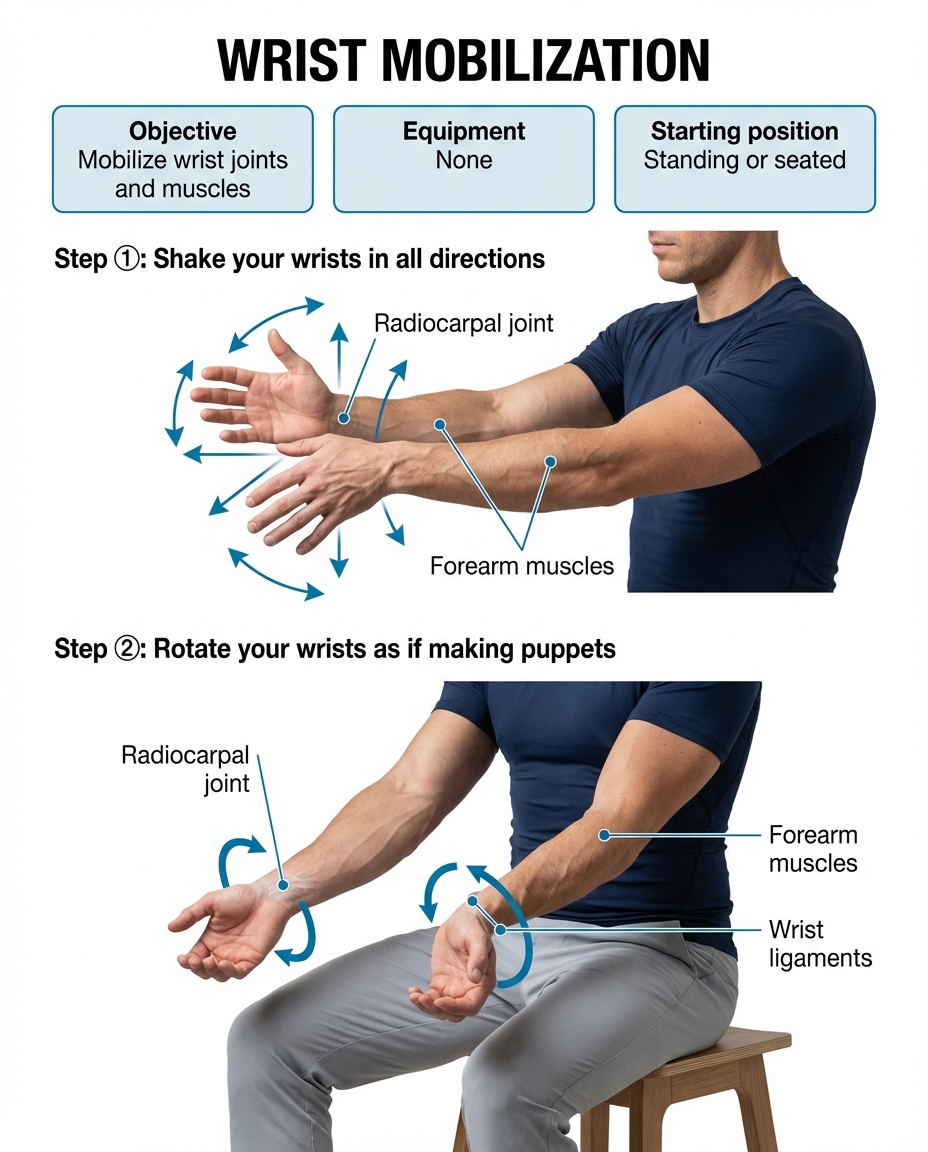
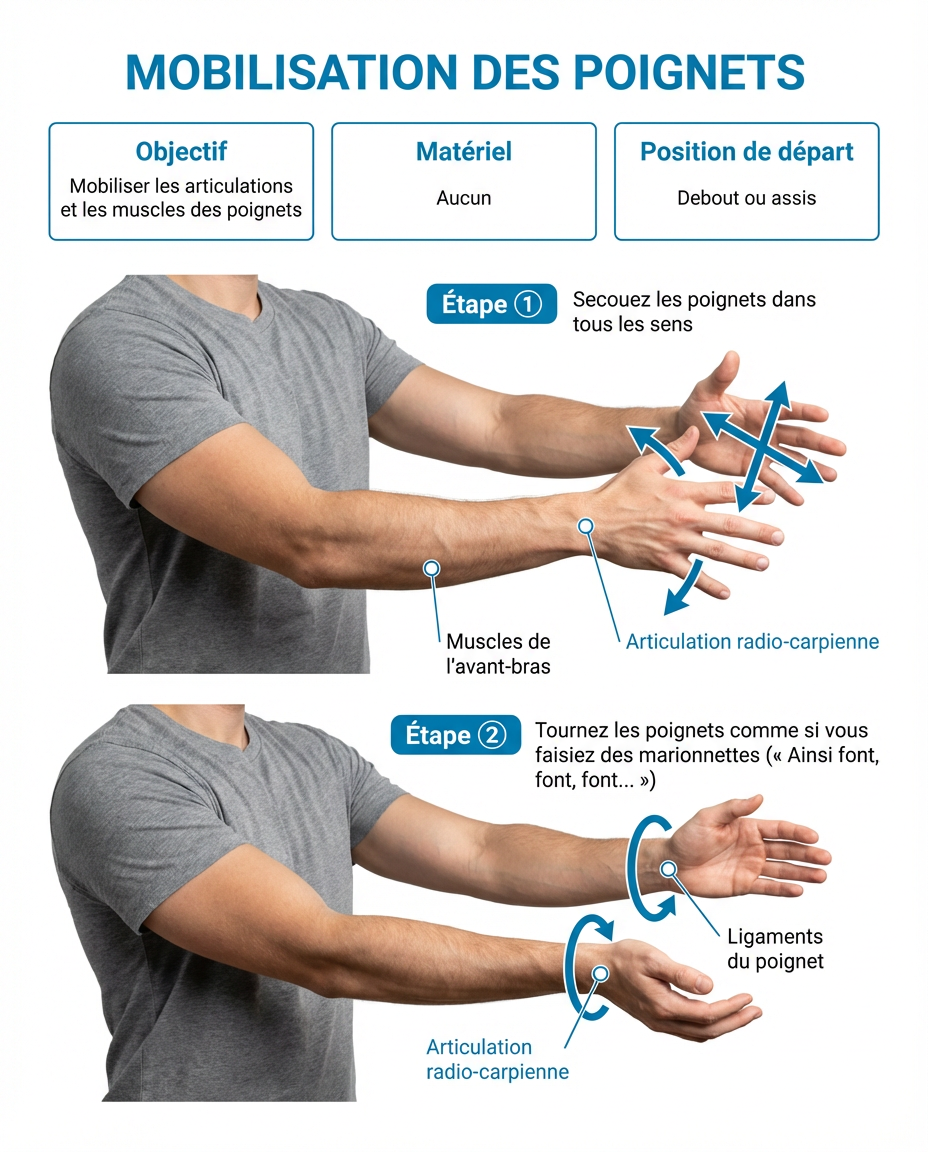
Step 1 — Relaxing Shakes (30 seconds)
Extend your arms in front of you at chest height, hands relaxed, fingers loose. Shake your hands vigorously up and down and side to side, as if drying water off your fingers. The movements should come from the wrists, not the shoulders. Continue for 30 seconds. You will feel a rush of warmth and lightness in your hands, a sign of circulatory activation.
Step 2 — Puppet Rotations (1 minute)
Join your hands palm to palm in front of your chest, fingers interlaced. Perform fluid, wide rotations with your linked wrists, drawing circles with your joined hands. Alternate 10 clockwise rotations, then 10 counterclockwise. The movement should be circular, continuous, and smooth. Imagine your hands as a puppet's connected by a string — the motion is supple and organic.
Step 3 — Alternating Flexion-Extension (30 seconds)
Separate your hands. Flex both wrists downward (palmar flexion) then upward (dorsal extension) in rapid but controlled alternation. Perform 20 cycles. This "pump" movement activates synovial fluid circulation in the joint.
Step 4 — Radial and Ulnar Deviations (30 seconds)
Arms extended in front of you, palms facing down, tilt your hands toward the thumb (radial deviation) then toward the little finger (ulnar deviation). Alternate 15 times on each side. This often-forgotten movement plane is essential for complete wrist mobility.
Duration and Repetitions
- Shaking: 30 seconds
- Puppet rotations: 10 + 10 (about 1 minute)
- Flexion-extension: 20 cycles (30 seconds)
- Deviations: 15 per side (30 seconds)
- Total duration: approximately 3 minutes
- Frequency: 3 to 5 times daily, especially during work breaks
Safety Tips
- Painless cracking sounds are harmless — they indicate gas release in the synovial fluid.
- Avoid sudden movements if you have a wrist ganglion cyst.
- If persistent pain occurs during rotations, reduce the range and consult your practitioner.
- People wearing a wrist brace should remove it for mobilization and replace it afterward.
Who Benefits from This Exercise?
This mobilization is universal — it suits everyone from office to workshop. It is particularly recommended for screen workers, musicians, craftspeople, athletes (tennis, badminton, climbing), and anyone with morning wrist stiffness. In just 3 minutes, it restores fluidity and comfort to the most-used joint in our hands.
Diagrams and illustrations
Wrist mobilization illustration
Two mobilization steps: hand shaking and puppet rotations with interlaced fingers.