Ankle & Foot Mobilization
Learn how to mobilize your ankles and feet while seated through gentle rotations and flexion/extension movements to improve joint flexibility.

Ankle & Foot Mobilization — Rotations and Flexions
The ankles and feet are the foundations of our body. They absorb the impact of walking, support our weight, and help us maintain balance. Yet we often neglect their care. This series of gentle mobilizations, performed while seated, helps restore flexibility to these essential joints and prevents stiffness.
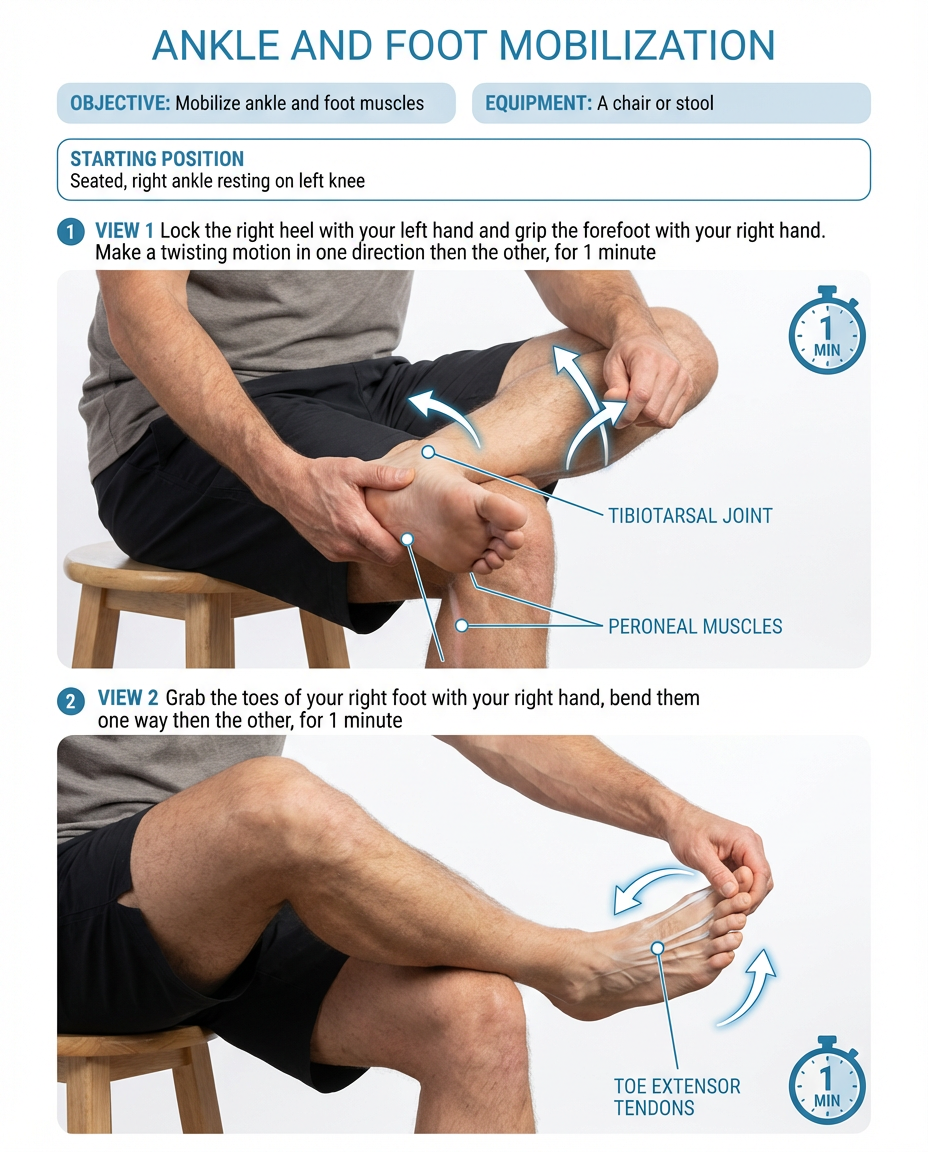
Why Mobilize the Ankles and Feet?
A stiff ankle limits walking range, increases the risk of sprains, and can cause pain that radiates up to the knee or hip. Prolonged wear of rigid shoes, sedentary lifestyles, or old injuries all contribute to reduced mobility in these joints. Regular mobilizations maintain cartilage health, stimulate local blood circulation, and improve proprioception — your body's ability to sense its position in space.
Anatomy Involved
- Talocrural joint (ankle) — the main joint allowing dorsiflexion and plantarflexion of the foot.
- Subtalar joint — enables inversion and eversion movements of the foot.
- Peroneal muscles — lateral ankle stabilizers, engaged during rotations.
- Tibialis anterior and triceps surae — responsible for dorsiflexion and plantarflexion respectively.
- Metatarsophalangeal joints — the small toe joints, essential for propulsion during walking.
Step-by-Step Instructions
Step 1 — Starting Position
Sit comfortably on a chair with your back straight. Place your feet flat on the floor with knees bent at 90 degrees. You can rest your hands on your thighs for stability. Take a few deep breaths to relax your entire body.
Step 2 — Ankle Rotations
Lift your right foot slightly off the floor while keeping your knee stable. Draw large circles with the tip of your foot, first clockwise. Perform 10 slow, controlled rotations, then switch direction for 10 more. You should feel the joint working without pain.
Step 3 — Flexion and Extension
With your foot still raised, point your toes toward the floor (plantarflexion) then pull them back toward you (dorsiflexion). Alternate between these two positions 15 times, taking time to reach the full range of each movement. This back-and-forth engages the tibialis anterior and triceps surae.
Step 4 — Toe Mobilization
Place your foot back on the floor and spread your toes as wide as possible, then curl them. Repeat 10 times. Then try lifting only your big toe while keeping the others down, and reverse. This strengthens the intrinsic muscles of the foot.
Step 5 — Switch Sides
Repeat all steps 2 through 4 with your left foot.
Duration and Repetitions
- Rotations: 10 in each direction, per foot
- Flexion/extension: 15 repetitions per foot
- Toe mobilization: 10 repetitions per foot
- Total duration: approximately 5 to 8 minutes
- Frequency: 1 to 2 times a day, ideally in the morning or after prolonged sitting
Safety Tips
- All movements should be slow and controlled — never force a range of motion that causes pain.
- If you hear a painless cracking sound, this is normal and harmless.
- If you experience sharp pain, swelling, or chronic ankle instability, consult your practitioner before performing these exercises.
- Avoid rapid rotations if you have a history of recent sprain (less than 6 weeks).
Who Benefits from This Exercise?
This exercise is ideal for anyone wishing to maintain ankle mobility: sedentary workers, elderly people looking to prevent falls, athletes warming up or recovering, and anyone rehabilitating after a sprain. It is accessible to all levels, including complete beginners.
Diagrams and illustrations
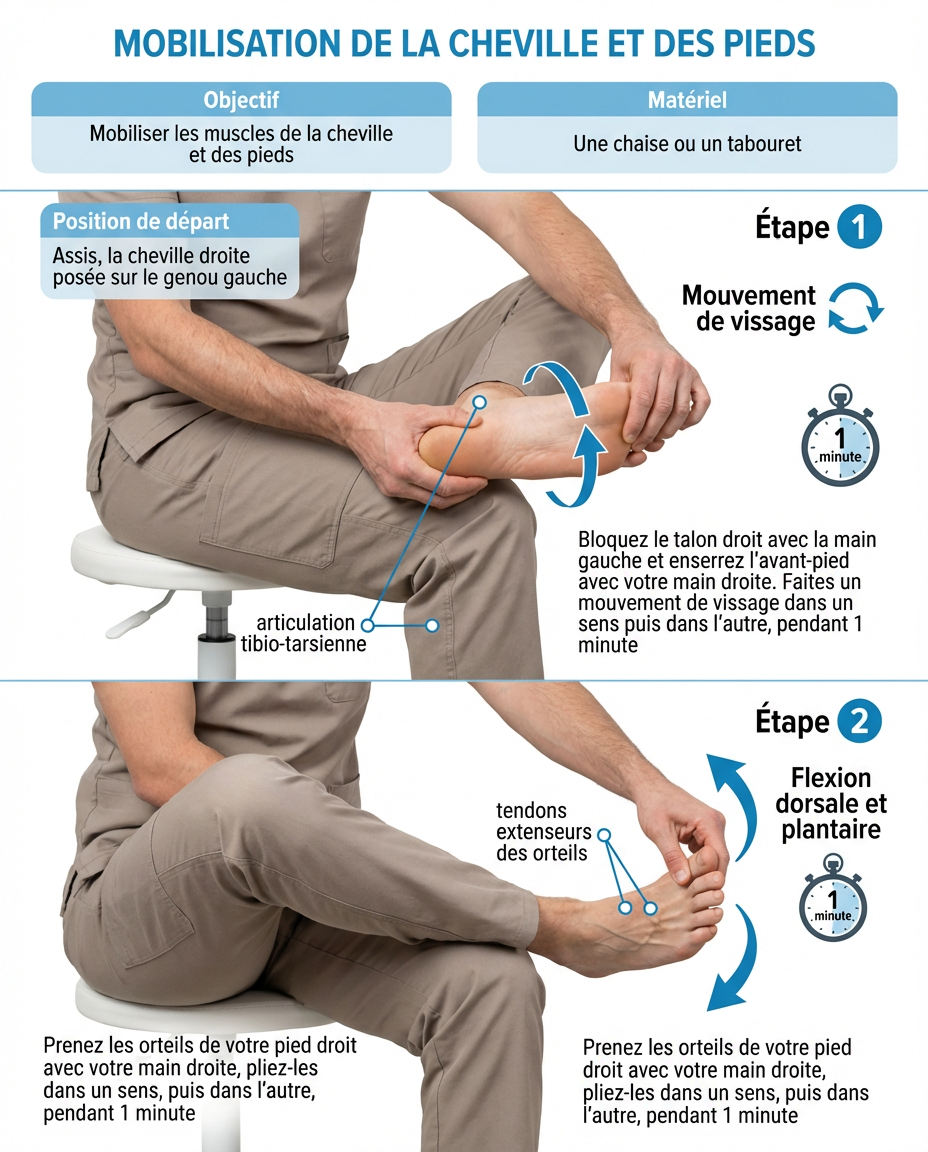
Ankle and foot mobilization illustration
Seated position with ankle rotations and foot flexion/extension movements.