Swimming
Pilates exercise mimicking the crawl stroke to strengthen the entire posterior chain with alternating arm-leg flutter kicks in prone position.
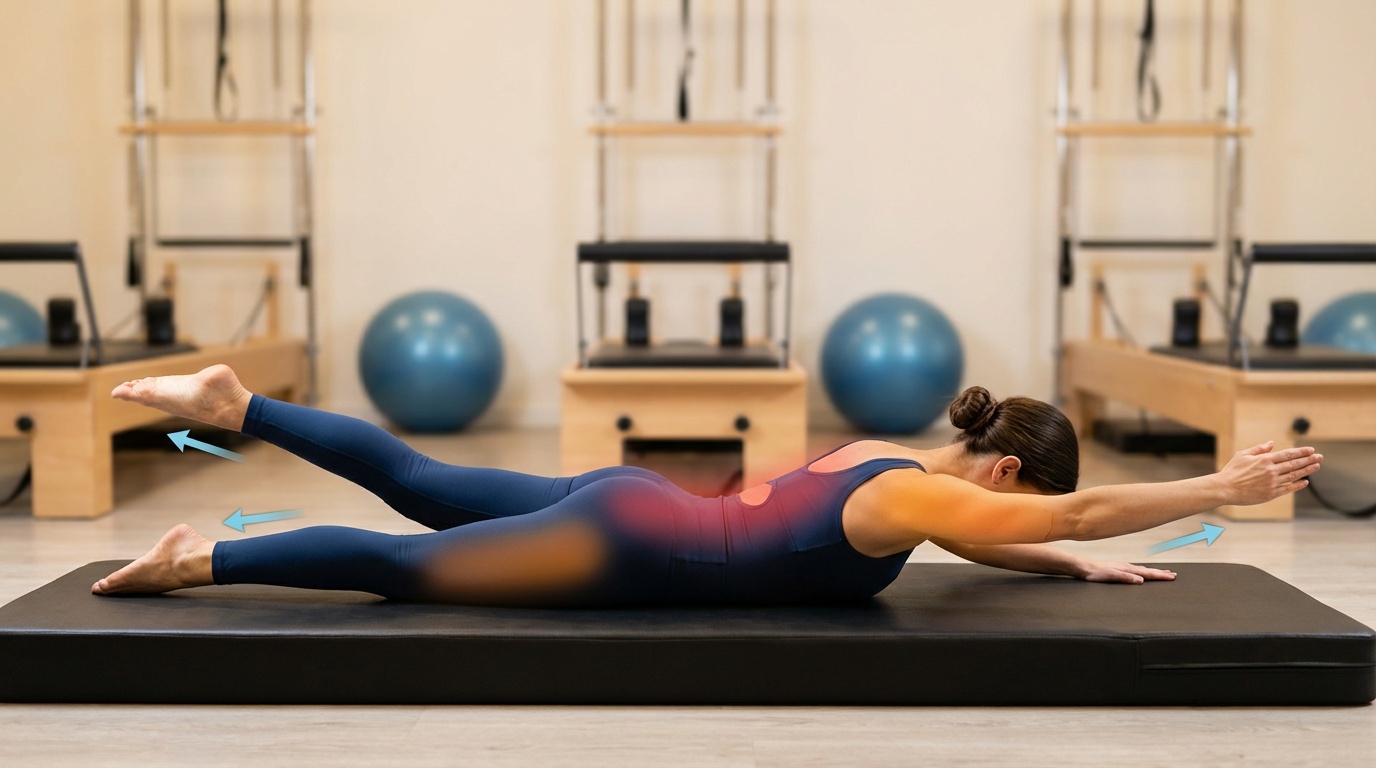
Swimming
Swimming is a Mat Pilates exercise that develops strength and endurance of the entire posterior chain. Mimicking the crawl stroke, it alternately engages the right and left sides of the body, developing cross-coordination and dynamic trunk stabilization. It is one of the most complete Pilates exercises for dorsal strengthening.
Targeted Anatomy
This exercise activates the entire posterior chain: the erector spinae maintain torso extension, the gluteus maximus and hamstrings lift and animate the legs. The posterior deltoids, middle and lower trapezius, and rhomboids control arm movements. The transversus abdominis and multifidus stabilize the trunk in counter-rotation. The crossed pattern (right arm-left leg) activates the crossed myofascial chains, essential for walking and running.
Step-by-Step Execution
- Starting position: Lie face down, arms extended beyond the head, legs extended behind. Forehead on the floor or slightly lifted.
- Engagement: Contract abdominals, glutes, and keep shoulders low. Simultaneously lift arms, head, torso, and legs off the floor.
- Alternating flutter: Raise right arm and left leg higher, then alternate with left arm and right leg. Movement is fast and dynamic, like swimming crawl.
- Breathing: Inhale for 5 beats, exhale for 5 beats (like the Hundred but in prone).
- Duration: Maintain for 30 seconds then rest.
Key Points and Breathing
- Gaze stays directed toward the floor to maintain cervical alignment.
- Flutter amplitude is small and controlled — speed does not sacrifice form.
- Pelvis remains stable and does not sway side to side.
- Navel is drawn toward the spine to protect the lumbar area.
Repetitions
3 sets of 30 seconds with 15 seconds rest between sets.
Modifications
- Beginner: Keep feet on the floor and only raise arms alternately. Or keep arms on the floor and only raise legs. Reduced duration to 15 seconds.
- Intermediate: Standard position, 3 x 30 seconds.
- Advanced: Add light wrist and ankle weights, increase duration to 45-60 seconds, faster tempo.
Contraindications
- Lumbar spinal stenosis.
- Symptomatic spondylolisthesis.
- Acute lower back pain (start with beginner version).
- Cervical pathologies (keep head low or use a forehead cushion).
Target Audience
Swimming suits all levels with described adaptations. It is used in rehabilitation to strengthen the posterior chain often weakened by sedentary postures. Swimmers and triathletes use it as a dryland exercise. Seniors benefit from the adapted version to prevent age-related kyphosis and maintain functional dorsal strength.