Lateral Bound
Unilateral lateral bound to develop lateral power, ankle stability, and dynamic proprioception.
Lateral Bound
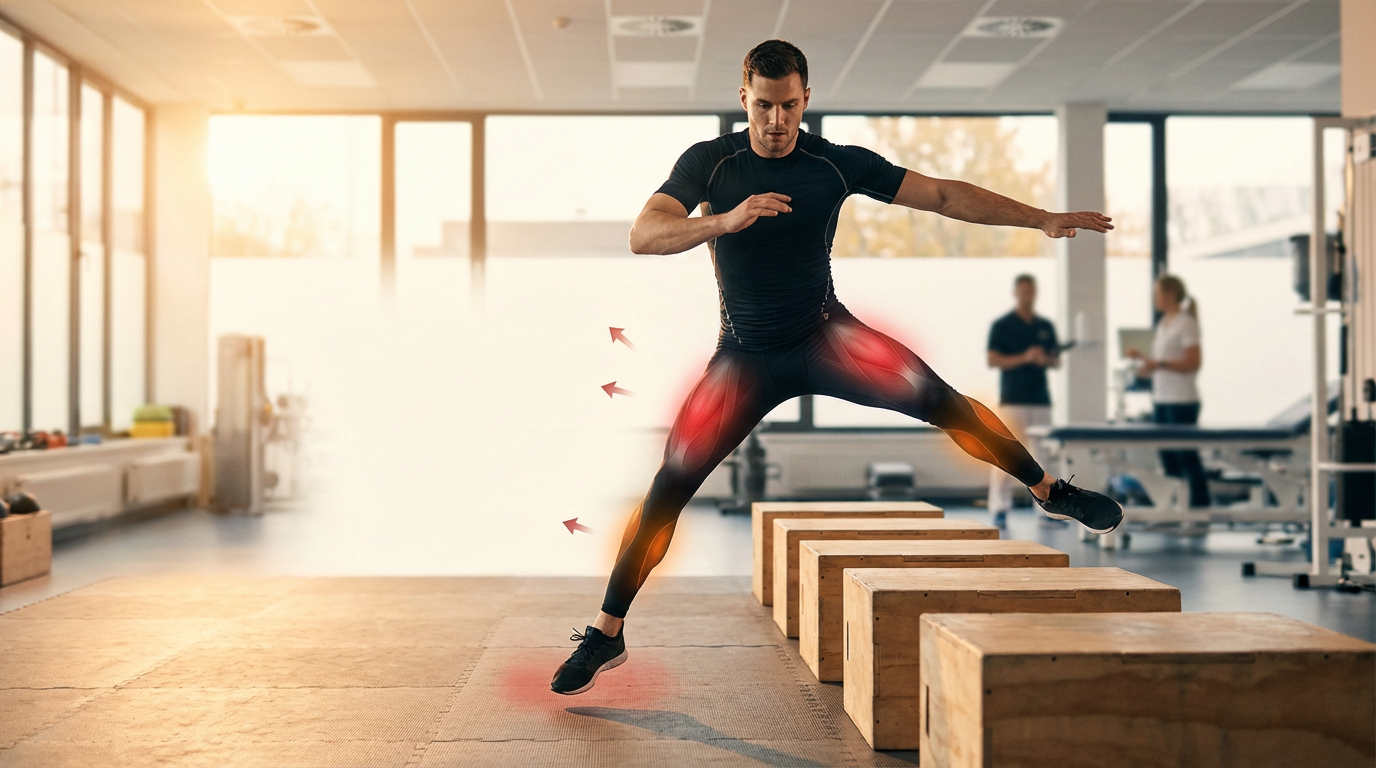
The lateral bound is a unilateral plyometric exercise in the frontal plane that develops lateral power and dynamic stability. By jumping from one foot to the other laterally, it specifically trains the hip abductors and adductors, essential for sports involving rapid direction changes.
Anatomy Targeted
The gluteus medius and gluteus minimus are the primary hip abductors, providing lateral propulsion. The gluteus maximus and quadriceps supply explosive power. The adductors of the landing leg absorb and decelerate lateral movement. The peroneal muscles and ankle stabilizers are heavily engaged for single-leg balance at landing. The obliques stabilize the trunk against lateral tilting.
Step-by-Step Execution
- Stand on one foot with the knee slightly flexed, the other foot off the ground.
- Push laterally as far as possible using the support leg.
- Land on the opposite foot, knee flexed, absorbing the impact.
- Stabilize for 1 to 2 seconds on one leg.
- Push back in the opposite direction to return to the starting point.
- Chain movements fluidly and with control.
Sets and Reps
3 sets of 8 reps per side. Rest 60 to 90 seconds between sets. Focus on bound distance and stabilization quality.
Safety Warnings
- Start with short bounds and progressively increase distance.
- The landing knee must stay aligned with the foot (no valgus).
- Fully stabilize before pushing back in the other direction.
- Practice on a non-slip, flat surface.
- This exercise is not recommended with recent ankle sprains or chronic ankle instability.
- Strengthen ankle stabilizers (balance exercises) before progressing.
Progressions
- Level 1: Short lateral bound with long stabilization (3 seconds).
- Level 2: Standard lateral bound with 1-2 second stabilization.
- Level 3: Chained lateral bounds without stabilization (continuous rebounding).
- Level 4: Lateral bounds over obstacles or on a decline.
Target Audience
Intermediate athletes seeking improved lateral power and ankle stability. Essential for team sport players (basketball, football, handball), skaters, and skiers. Also excellent for advanced rehabilitation after ankle sprains under physiotherapist supervision.