Lateral Stretch (Side Stretch)
The lateral stretch opens the ribs, lengthens the obliques and latissimus dorsi, and improves breathing capacity by releasing the intercostal muscles.
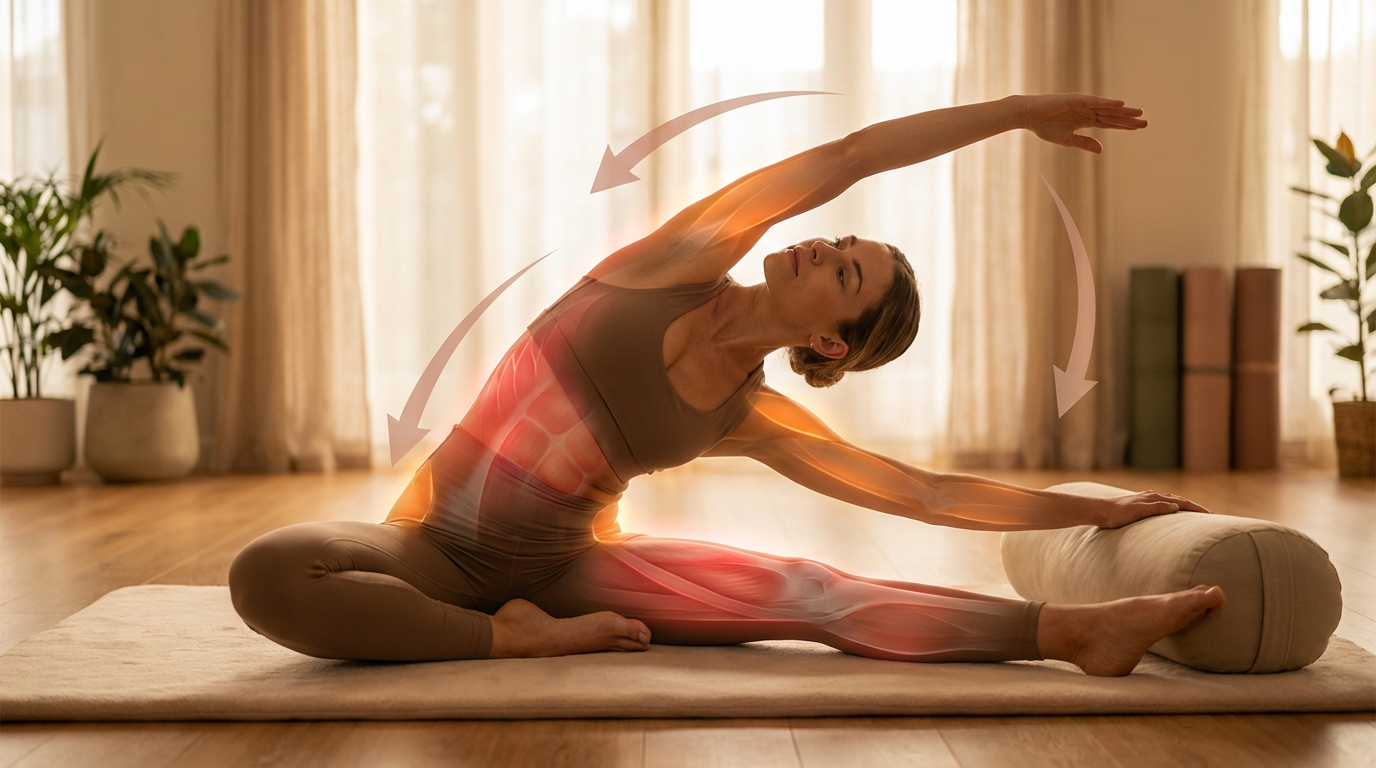
Lateral Stretch — Side Stretch
The lateral stretch is a fundamental movement often overlooked in stretching routines. Yet it targets a rarely worked area: the flank muscles and intercostals. These muscles, compressed by sitting, limit thoracic expansion and reduce breathing capacity. A few seconds of side stretching create an immediate sensation of openness and freedom in the trunk.
Targeted Anatomy
- External and internal obliques — lateral abdominal muscles responsible for trunk rotation and lateral flexion.
- Latissimus dorsi — the widest muscle in the body, stretched in its lateral portion.
- Intercostals — muscles between the ribs, essential to breathing mechanics.
- Quadratus lumborum — deep flank muscle connecting the last rib to the pelvis, often a source of lateral lower back pain.
Step-by-Step Instructions
Step 1 — Standing Position
Stand with feet hip-width apart. Raise the right arm above the head, palm facing inward, arm extended.
Step 2 — Lean Laterally
Slowly lean to the left, creating an arc with the right side of the body. The right arm follows the movement and extends overhead. The left hand can slide along the thigh for guidance.
Step 3 — Open the Ribs
Focus on opening the right ribs. Breathe deeply, sending air into the right flank. Each inhale should amplify the sensation of expansion. Avoid rotating the torso — the movement is strictly lateral.
Step 4 — Hold
Hold for 30 seconds. Slowly return to vertical. Switch sides. Perform 2 to 3 sets per side.
Duration and Frequency
- Hold: 30 seconds per side
- Sets: 2-3 per side
- Frequency: daily, ideal upon waking or between hours of desk work
Safety Tips
- Do not rotate the torso — the lean must remain purely lateral to target the correct muscles.
- Do not force downward — let gravity and breathing guide the deepening.
- If you feel lower back pain, reduce the range.
- Keep the hips facing forward — do not let them shift laterally.
Variations
- Seated on a chair — same movement in a seated position, useful at the office.
- Arms crossed overhead — grip the wrist of the raised arm with the other hand for additional traction.
- With an exercise ball — lying laterally on a Swiss ball for a deeper stretch and spinal decompression.
Target Audience
Beneficial for everyone without exception. Particularly recommended for sedentary individuals, yoga practitioners, singers and wind instrument players (improved lung capacity), and anyone suffering from lateral trunk stiffness.
Diagrams and illustrations
Lateral stretch illustration
Standing lateral stretch with arm overhead, 30 seconds per side.