Range of Motion Improvement - Lying Bicycle
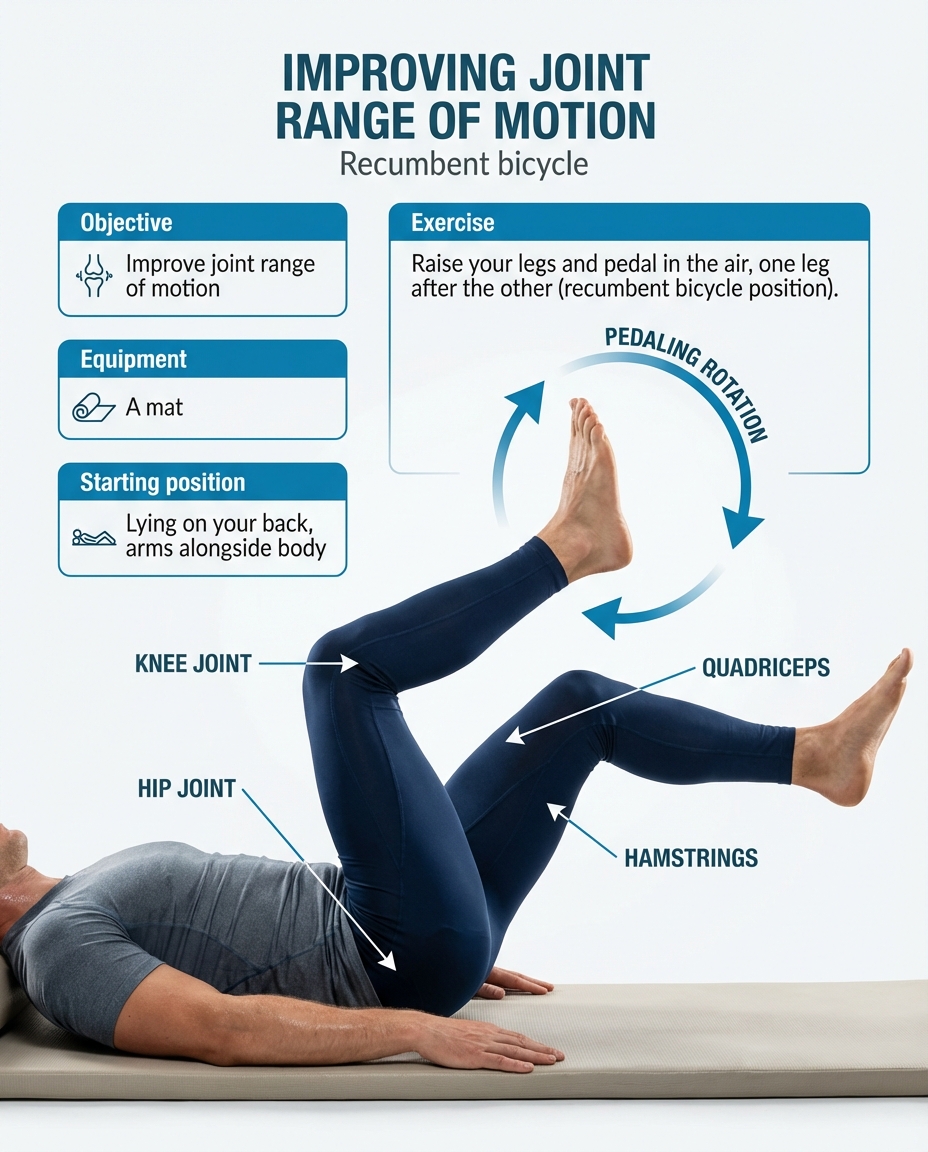
Lying bicycle exercise (air pedaling) on the back to improve hip and knee range of motion while mobilizing hamstrings and quadriceps.

Range of Motion Improvement — Lying Bicycle
The lying bicycle exercise — air pedaling while supine — is a remarkably gentle active mobilization technique for hip and knee joints. By reproducing the circular pedaling movement without load or impact, you mobilize both joints through their full flexion and extension range while alternately activating quadriceps and hamstrings. This cyclic movement improves joint lubrication, stimulates proprioception and prepares the lower limbs for more intense activities.
Why Practice the Lying Bicycle?
After immobilization, surgery or simply with age, joints progressively lose range of motion. The lying bicycle recovers this range safely and controllably, without the gravitational stress of standing. The pedaling movement is naturally fluid and cyclic, avoiding sudden movements that might irritate sensitive joint structures. Additionally, the supine position protects the lumbar spine, allowing people with lower back pain to work on lower limb mobility safely.
Anatomy Involved
- Hamstrings — three muscles (biceps femoris, semitendinosus, semimembranosus) at the back of the thigh, activated during the knee flexion phase of pedaling.
- Quadriceps — all four heads activated during knee extension, providing the push in the pedaling movement.
- Iliopsoas — hip flexor activated during the upstroke phase.
- Gluteus maximus — hip extensor activated during the downstroke phase.
- Hip and knee joints — continuously mobilized through their full functional range.
Step-by-Step Instructions
Step 1 — Starting Position
Lie on your back, arms at sides or hands under buttocks for pelvic support. Bend both knees and lift feet off the floor, thighs about 45° from horizontal.
Step 2 — Begin Pedaling
Perform a slow, controlled pedaling motion as if riding a bicycle. One leg extends while the other flexes, alternating fluidly. Aim to maximize each movement's range: full knee extension at the bottom, maximum flexion at the top.
Step 3 — Vary Rhythm and Direction
After 30 seconds of forward pedaling, reverse direction for 30 seconds (backward pedaling). Backward pedaling engages hamstrings and glutes more, providing complementary work. Vary circle size: small fast circles then large slow circles.
Step 4 — Duration
Continue for 2 to 5 minutes, regularly alternating direction and rhythm. Finish with a few seconds of very slow pedaling for a joint cool-down.
Duration and Repetitions
- Duration: 2 to 5 minutes continuous
- Alternation: 30 seconds forward / 30 seconds backward
- Frequency: 1 to 2 times daily
- Progression: increase duration by 30 seconds per week
Safety Tips
- Lower back must stay in contact with the floor — if it arches, reduce movement range or place hands under buttocks.
- Movement should be fluid without jerking — avoid sudden accelerations.
- If you feel painful cracking in knee or hip, reduce range or stop.
- Breathe naturally throughout — do not hold your breath.
Who Benefits from This Exercise?
The lying bicycle is ideal for those rehabilitating knee or hip, post-operative (with medical approval), or with lower limb osteoarthritis. It also works as a warm-up before sports or an active recovery exercise. People with reduced mobility and elderly individuals will find it a safe, beneficial exercise for maintaining joint range of motion.
Diagrams and illustrations
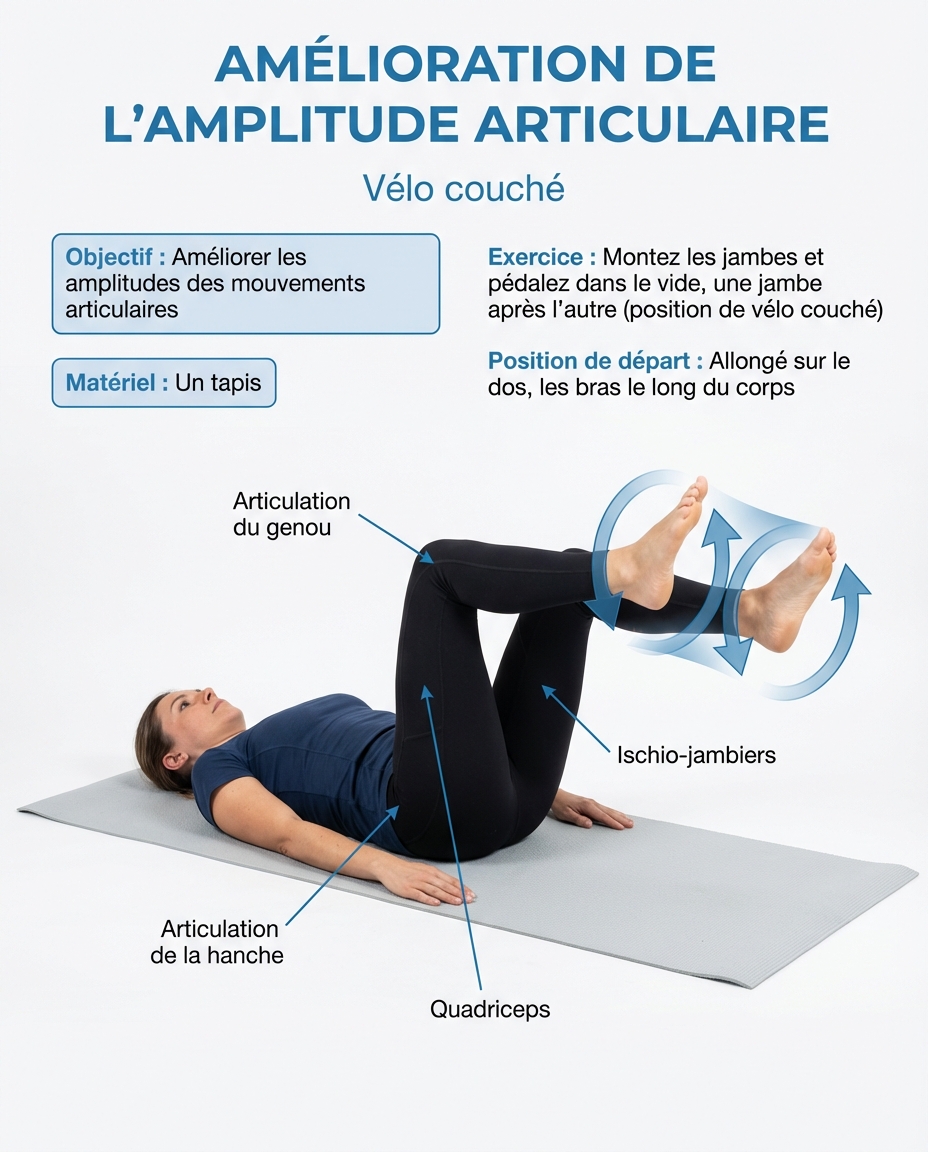
Lying bicycle illustration
Supine position with air pedaling movement for hip and knee mobilization.