Ring Dips
Unstable version of dips intensely recruiting stabilizers with Ring Turn Out at the top.
Updated
Introduction
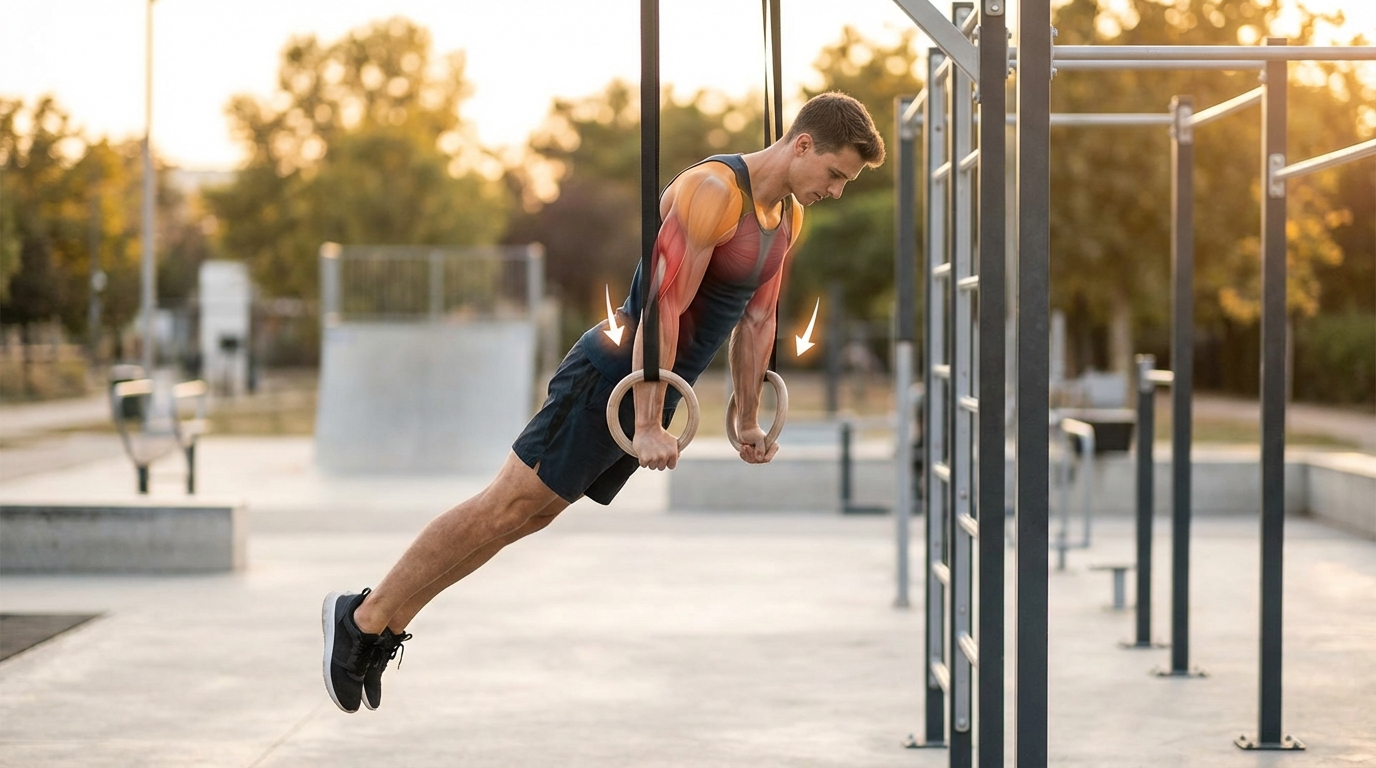
Ring dips add an instability dimension that considerably increases stabilizer muscle recruitment. Rings move freely, demanding superior control. At the top, the practitioner turns the rings palms forward (Ring Turn Out) to maximize contraction and demonstrate control.
Anatomy and Muscles Worked
- Primary muscles: pectorals, triceps + increased shoulder stabilizers
- Secondary muscles: deltoids, serratus anterior
- Stabilizers: rotator cuff (intense engagement), core
Step-by-Step Instructions
- Mount to support position on rings, arms straight.
- Stabilize rings against your body, core engaged.
- Lower in control keeping rings close to torso.
- Push up while exhaling.
- At top, turn rings outward (Ring Turn Out) palms forward.
Recommended Sets and Reps
- Prerequisites: ring support hold 30s, 15+ bar dips
- Intermediate: 3 sets of 5 to 8
- Advanced: 3 sets of 8 to 12 with RTO
Common Mistakes
- Rings flaring out: keep rings close to the body.
- No Ring Turn Out: turn rings at top for full engagement.
- Too much depth: do not descend beyond 90 degrees.
Safety
Instability increases injury risk. Master ring support hold before attempting dips. Progress gradually from bar dips.
Variations
- Assisted ring dips (feet on floor or band)
- Weighted ring dips
- Deep ring dips (full range, advanced)
Target Audience
Intermediate to advanced practitioners with solid bar dips foundation and ring stability.
Diagrams and illustrations
Ring Dips — Illustration
Technical illustration for ring dips.