Press to Handstand
Controlled rise from floor to handstand without momentum requiring exceptional strength and flexibility.
Updated
Introduction
The press to handstand involves rising from the floor to handstand without any momentum, purely through shoulder strength and core compression. It is one of the most impressive calisthenics exercises, requiring both considerable deltoid strength and excellent hamstring flexibility.
Anatomy and Muscles Worked
- Primary muscles: deltoids, core (intense compression), triceps
- Secondary muscles: trapezius, hip flexors
- Flexibility: hamstrings, spine
Step-by-Step Instructions
- Standing or in straddle position, lean forward and place hands on floor.
- Transfer weight onto hands by pushing shoulders forward.
- Slowly raise legs toward handstand without any momentum or jump.
- Movement should be fluid and continuous.
- Arrive in stable handstand and hold.
Recommended Sets and Reps
- Prerequisites: solid handstand 30s+, good hamstring flexibility
- Advanced: 5 sets of 3 to 5 reps
Common Mistakes
- Using momentum: ascent must be purely controlled.
- Lack of flexibility: work flexibility in parallel.
- Shoulders not far enough forward: lean is essential.
Safety
Master handstand before attempting press. Progress via straddle press (easier than legs together). Wrists are heavily stressed.
Variations
- Straddle press to handstand
- Pike press to handstand (legs together, harder)
- Negative press (lower from handstand in control)
Target Audience
Advanced practitioners who master handstand and possess good flexibility.
Diagrams and illustrations
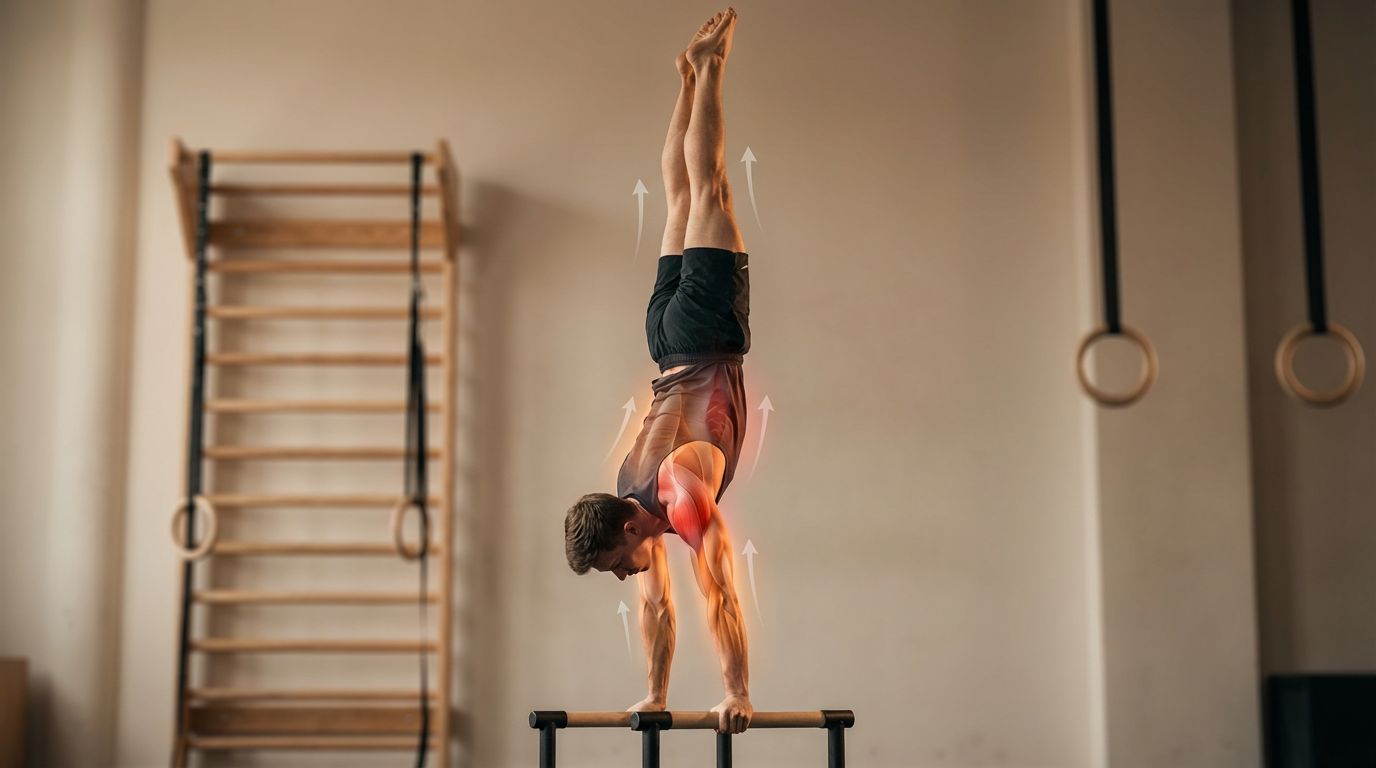
Press to Handstand — Illustration
Technical illustration for press to handstand.