Front Lever
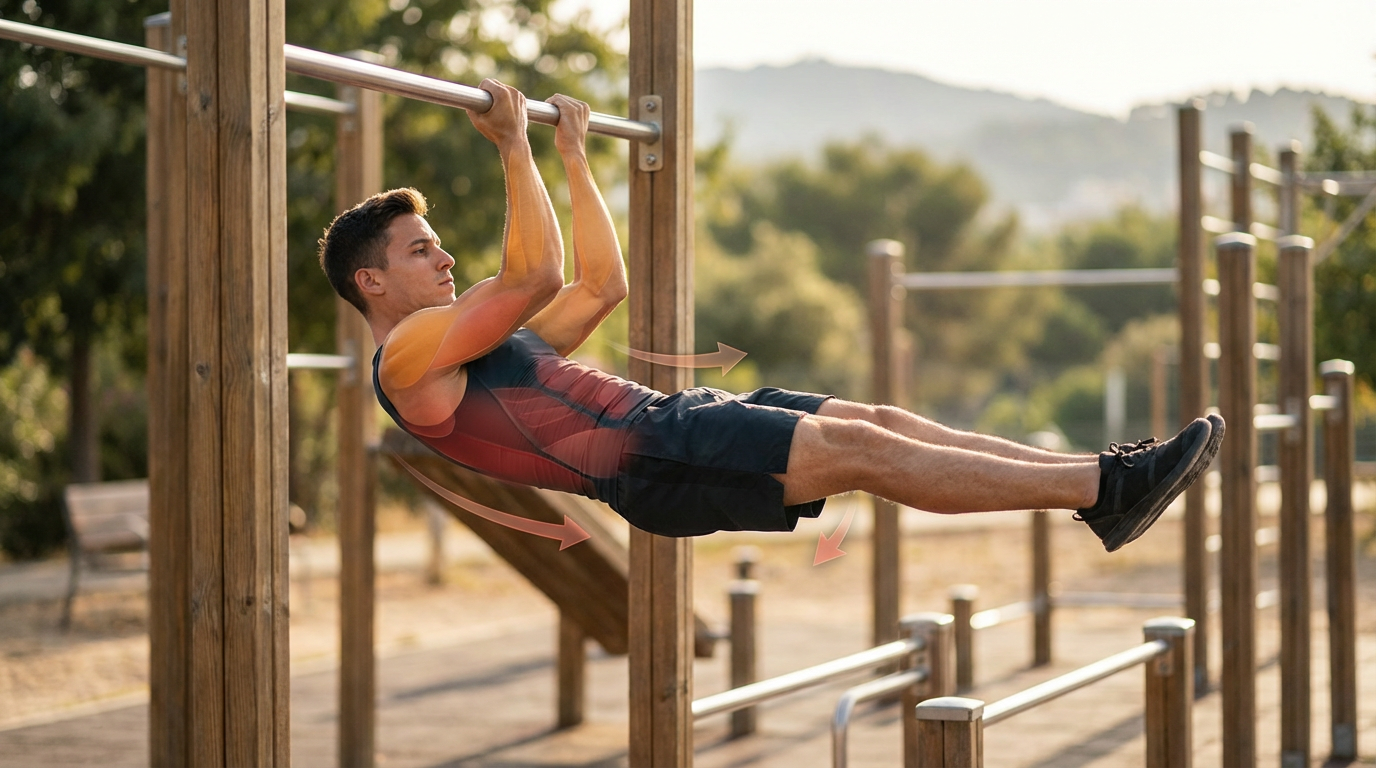
Isometric horizontal position facing upward while hanging from the bar, requiring extreme back and core strength.
Updated
Introduction
The front lever is a static figure where the practitioner, hanging from the bar with straight arms, holds the body perfectly horizontal facing upward. It is one of the most impressive and demanding calisthenics skills, requiring exceptional lat and core strength.
Anatomy and Muscles Worked
- Primary muscles: latissimus dorsi, abdominals (transverse, rectus)
- Secondary muscles: rhomboids, posterior deltoid, glutes
- Stabilizers: full core, biceps (isometric)
Step-by-Step Instructions
- Hang from the bar, overhand grip at shoulder width.
- Engage lats and abs to raise the body to horizontal.
- Body must be rigid like a plank, facing the ceiling.
- Arms perfectly straight, shoulders engaged.
- Hold the position as long as possible.
Recommended Sets and Reps
- Progressions: Tuck (5-10s) → Advanced tuck → One leg → Straddle → Full
- Advanced: 5 sets of 5 to 10 seconds depending on progression
Common Mistakes
- Hips dropping: strengthen core and lats.
- Bent arms: arms must stay perfectly straight.
- Progressing too fast: respect progression steps.
Safety
The front lever places intense stress on biceps and shoulders. Progress very gradually and warm up thoroughly. Biceps tendinitis is a risk if progression is too rapid.
Variations
- Tuck front lever (knees bent)
- Straddle front lever (legs apart)
- Front lever raises (dynamic up-down)
Target Audience
Advanced to expert practitioners. The front lever is a long-term goal that may require months or even years of progressive training.
Diagrams and illustrations
Front Lever — Illustration
Illustration of technique for front lever.