Dumbbell Press
The dumbbell press offers a greater range of motion than the barbell and allows unilateral work of the pectorals, deltoids and triceps.
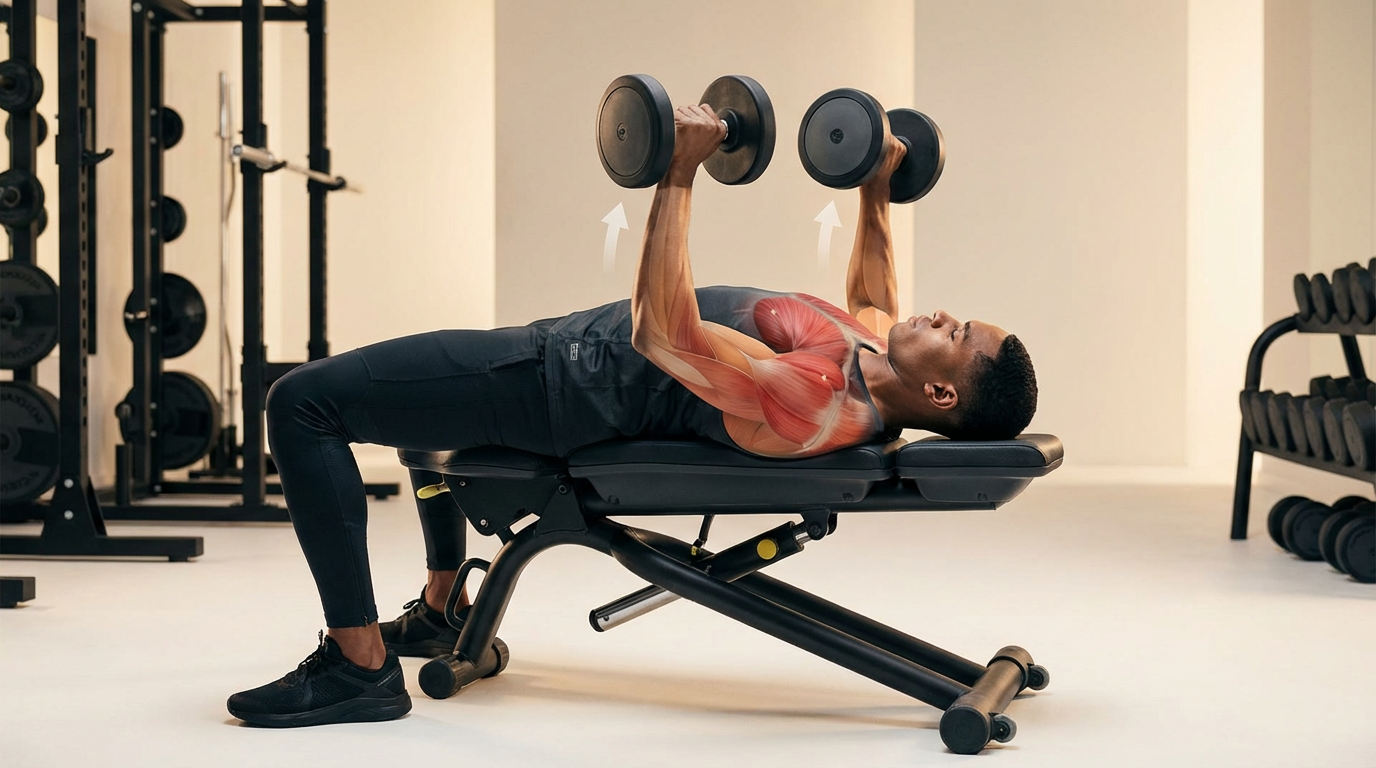
Dumbbell Press — Range of Motion and Muscular Balance
The dumbbell press is a powerful alternative to the barbell bench press. Thanks to the freedom of movement dumbbells provide, each arm works independently, which corrects muscular imbalances and allows a greater range of motion for a deeper pectoral stretch.
Muscles Involved
- Pectoralis major: primary target, worked through a wider range of motion than with a barbell.
- Anterior deltoids: stabilize and assist the press.
- Triceps brachii: responsible for elbow extension.
- Shoulder stabilizers: more engaged than with a barbell due to dumbbell instability.
Step-by-Step Instructions
Step 1 — Getting Into Position
Sit on a flat bench with a dumbbell in each hand resting on your thighs. Roll back onto the bench while bringing the dumbbells above your chest, arms extended. Retract your shoulder blades.
Step 2 — The Descent
Lower the dumbbells by opening your elbows to approximately 45° from the torso. The dumbbells reach chest level with thumbs facing each other. Feel the deep pectoral stretch.
Step 3 — The Press
Press the dumbbells upward while bringing them slightly closer together. Exhale during the effort. Contract the pectorals at the top of the movement.
Step 4 — End of Set
At the end of the set, bring the dumbbells back to your thighs while sitting up, or set them on the floor in a controlled manner.
Sets and Reps
4 sets of 10-12 reps. Rest 60-90 seconds. Loads will be lower than the barbell press, which is normal.
Common Mistakes
- Loads too heavy: with dumbbells, stabilization demands more energy. Reduce by 20-30% compared to the barbell.
- Dumbbells clashing at the top: keep a slight gap to maintain tension.
- Descending too fast: control the eccentric phase over 2-3 seconds.
Safety Tips
Learn the kick-up technique for getting heavy dumbbells into starting position. Do not hesitate to ask for help with heavy loads. If training alone, set the dumbbells on the floor at the end of each set rather than throwing them.
Variations
- Incline dumbbell press: emphasis on upper chest.
- Neutral grip dumbbell press: palms facing each other, less shoulder stress.
- Alternating dumbbell press: one arm at a time for more core engagement.
Who Is This Exercise For?
This exercise suits all levels. It is especially recommended for those with imbalances between sides or shoulder pain with the barbell, thanks to the rotational freedom dumbbells provide.