Shoulder Bridge
Pilates exercise combining the glute bridge with unilateral leg extension to strengthen glutes and develop pelvic stabilization.
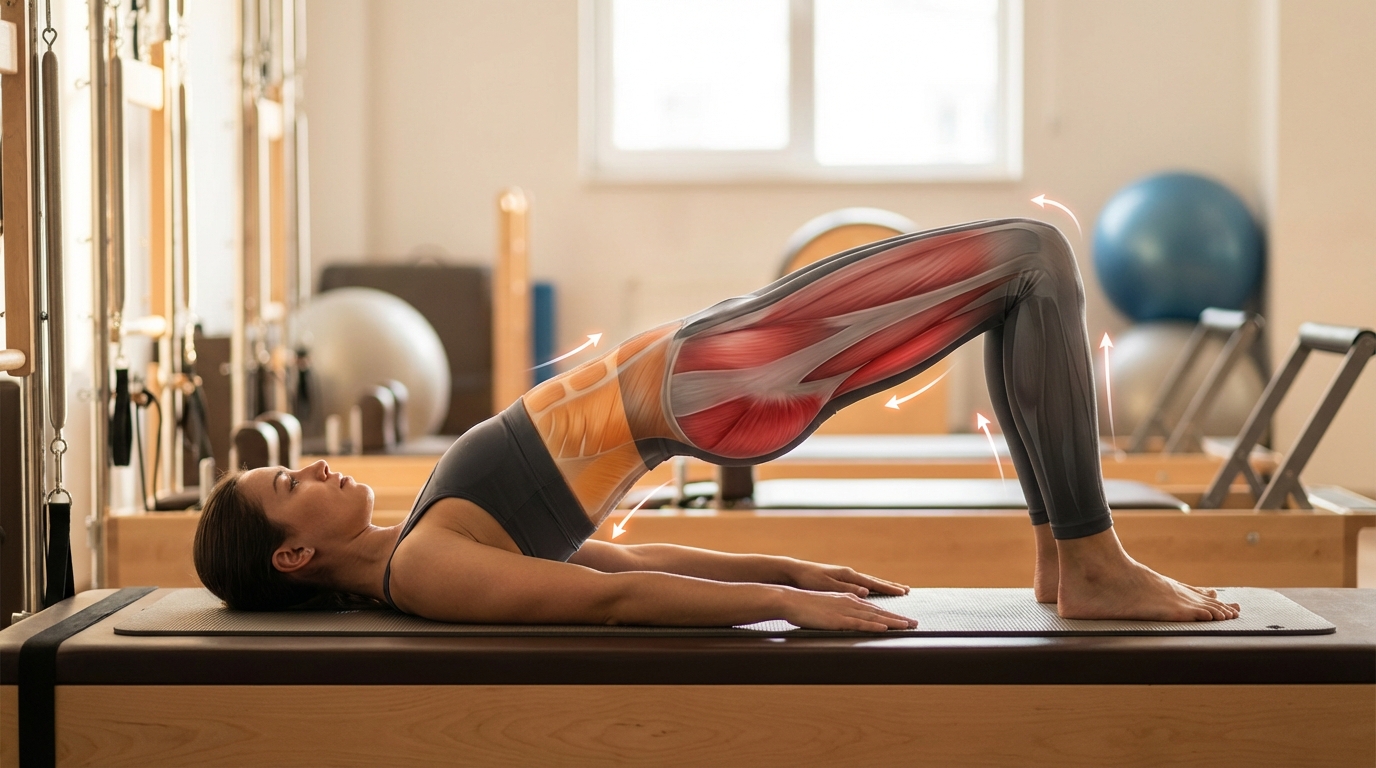
Shoulder Bridge
The Pilates Shoulder Bridge goes beyond the simple glute bridge by adding a unilateral challenge. By maintaining the bridge position while extending one leg, this exercise reveals and corrects strength asymmetries between the two sides of the pelvis. It is an exercise of choice for functional glute strengthening and lumbo-pelvic stabilization.
Targeted Anatomy
The gluteus maximus is the primary driver of hip extension maintaining the bridge. The gluteus medius on the support side works intensely to prevent the pelvis from dropping on the lifted leg side. The hamstrings assist extension. The transversus abdominis and multifidus stabilize the lumbar spine. The quadriceps of the lifted leg control knee extension. The erector spinae maintain spinal alignment.
Step-by-Step Execution
- Starting position: Lie on your back, feet on the floor hip-width apart, arms alongside the body.
- Bridge up: Exhale and lift the pelvis, peeling the spine off the floor vertebra by vertebra. Create a straight line from shoulders to knees.
- Leg extension: Stabilize the pelvis, then extend the right leg toward the ceiling, foot pointed.
- Leg movement: Lower the extended leg toward the floor (to the height of the opposite knee), then raise it back to ceiling. The pelvis does not move.
- Repetitions: 5 leg movements on the right, replace foot, then switch sides.
- Descent: Place both feet down and unroll the spine to the floor vertebra by vertebra.
Key Points and Breathing
- The pelvis must remain perfectly horizontal during leg movement — this is the main test.
- Do not lift the pelvis too high: avoid lumbar hyperextension.
- Weight is distributed between both shoulders and the support foot.
- Inhale lowering the leg, exhale raising it.
Repetitions
5 movements per leg.
Modifications
- Beginner: Simple bridge (no leg lift), hold 10 seconds at top. Or lift foot just a few centimeters off the floor.
- Intermediate: Standard position with 5 kicks per leg.
- Advanced: Add a circle with the lifted leg at the top, or hold single-leg bridge for 15 seconds.
Contraindications
- Sacroiliac instability (unilateral movement may worsen).
- Weight-bearing knee pathologies (adapt support foot position).
- Acute lower back pain (stay with simple bilateral bridge).
Target Audience
The Shoulder Bridge is essential for runners, cyclists, and any athlete requiring unilateral glute strength. In rehabilitation, it is widely used for postpartum strengthening, hip rehabilitation (post-prosthesis advanced phase), and pelvic strength imbalance correction. Seniors use the simplified version to maintain functional strength for walking and stair climbing.