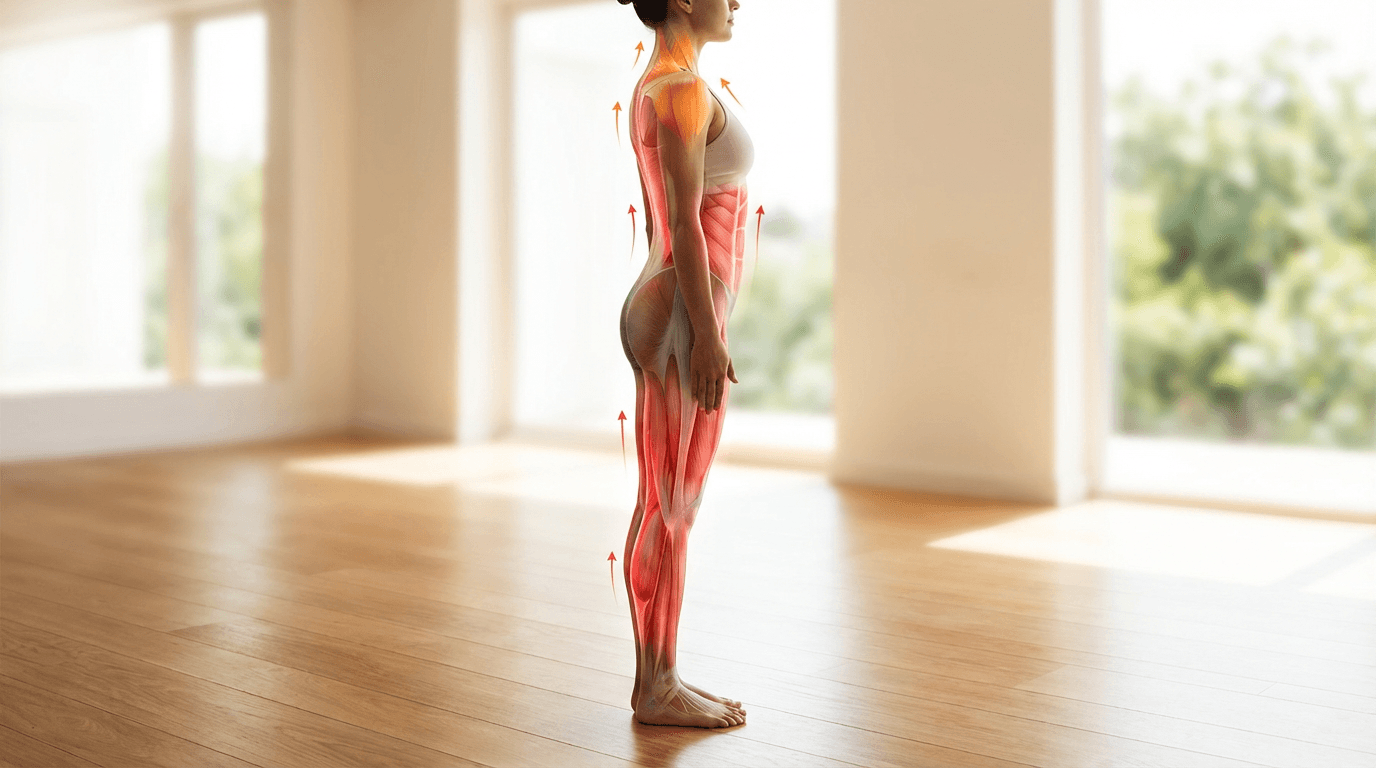
Tadasana — Mountain Pose
Tadasana (mountain pose) is the foundational yoga pose, the basis of all standing poses, developing alignment, grounding and body awareness.
Tadasana — Mountain Pose (तडासन)
Tadasana, from the Sanskrit tada (mountain) and asana (pose), is the foundational yoga pose. Though it may appear simple — just standing — it forms the basis of all standing poses and develops a refined awareness of body alignment. It is in Tadasana that you learn to distribute weight evenly, engage deep muscles and find the vertical axis of the body.
Therapeutic Benefits
- Postural alignment — corrects postural imbalances and strengthens awareness of pelvis, spine and head placement.
- Grounding and stability — develops foot proprioception and connection to the ground.
- Deep muscular strengthening — activates the transversus abdominis, quadriceps and ankle stabilizer muscles.
- Mental calm — the still posture promotes concentration and presence.
Anatomy Involved
Tadasana subtly engages the entire body: intrinsic foot muscles ensure weight distribution, quadriceps stabilize the knees, the psoas and deep abdominals maintain a neutral pelvis, the rhomboids and lower trapezius open the chest, and deep neck muscles align the head on the vertebral axis.
Step-by-Step Instructions
Step 1 — Foot Placement
Stand with feet together or hip-width apart (depending on your build). Distribute weight evenly across the four corners of each foot: base of the big toe, base of the little toe, inner and outer edges of the heel. Toes are active and spread.
Step 2 — Leg Activation
Gently engage the quadriceps to lift the kneecaps without hyperextending the knees. Thighs spiral slightly inward. The pelvis is in neutral — neither anterior nor posterior tilt.
Step 3 — Spinal Lengthening
Lengthen the spine upward toward the ceiling. The chest opens naturally, shoulders roll back and down. Arms are alongside the body, palms facing forward (receptive) or toward the thighs.
Step 4 — Head Placement
The chin is parallel to the floor, the crown of the head rises toward the ceiling. The back of the neck is long, the gaze soft at the horizon.
Breathing and Duration
Hold for 5 to 10 deep, steady breaths through the nose. Inhale feeling the upward lengthening, exhale reinforcing the grounding. This pose can be held up to 1 minute for deeper body awareness work.
Contraindications
- Severe orthostatic hypotension (add slight movement)
- Significant dizziness (practice near a wall)
Modifications
- Beginner: feet hip-width apart for more stability, back against a wall to feel alignment.
- Advanced: close the eyes to intensify proprioceptive work, or rise onto the toes (Utthita Tadasana).
Target Audience
Tadasana is suitable for all levels and all ages. It is particularly beneficial for people with poor posture, sedentary workers, and as a centering pose between dynamic sequences.