Pelvic Tilt
The pelvic tilt is a fundamental exercise for strengthening deep core muscles and relieving lower back pain.
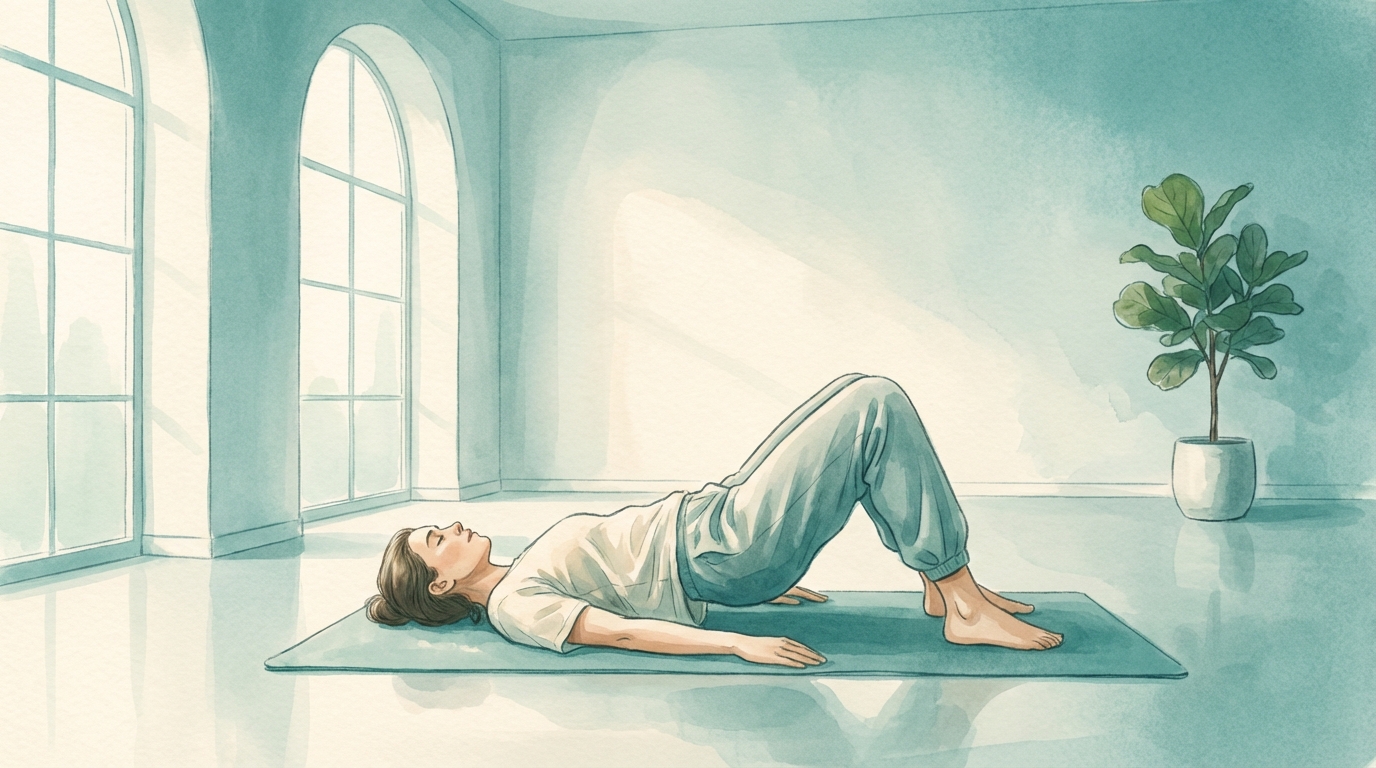
Pelvic Tilt — Fundamental Lower Back Strengthening
The pelvic tilt is one of the most accessible and effective exercises for relieving lower back pain. By learning to control the movement of your pelvis, you strengthen the transversus abdominis, your spine's natural corset. It is often the first exercise prescribed by physiotherapists and osteopaths.
Why Practice the Pelvic Tilt?
Many cases of lower back pain are linked to an imbalance between the deep abdominal muscles and the spinal erectors. When the abdominals are weak, the back arches excessively (hyperlordosis), creating compression on the lumbar vertebrae. The pelvic tilt retrains the coordination between these muscle groups and restores a neutral spinal alignment.
Anatomy Involved
- Transversus abdominis — the deepest abdominal muscle, wrapping around the trunk like a belt and stabilizing the lumbar spine.
- Erector spinae muscles — muscles running along the spine, responsible for back extension.
- Lumbar multifidus — small deep muscles between each vertebra, essential for segmental stabilization.
- Pelvic floor muscles — work in synergy with the transversus during the tilt.
Step-by-Step Instructions
Step 1 — Starting Position
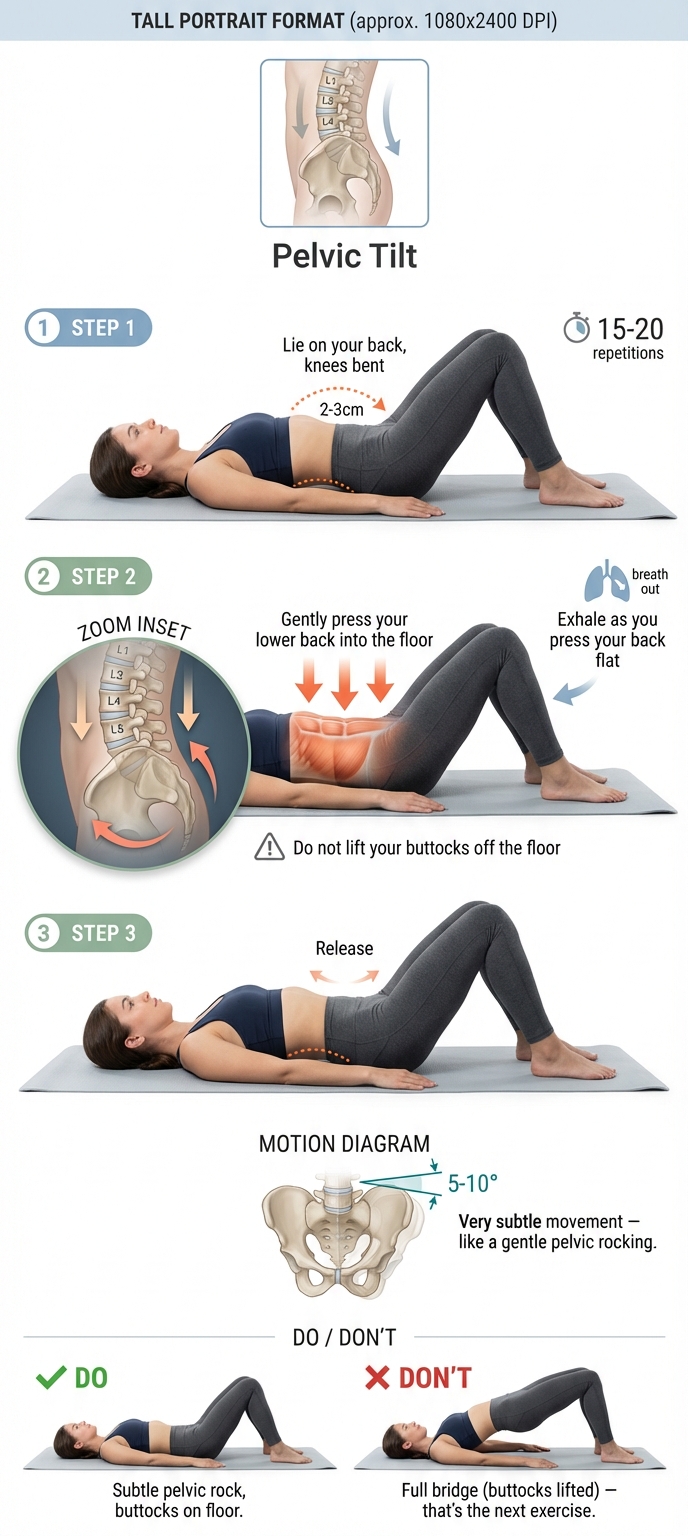
Lie on your back with knees bent, feet flat on the floor hip-width apart. Place your arms at your sides, palms facing down. Notice the natural space between your lower back and the floor — this is your natural lordosis.
Step 2 — Tilt Backward (Posterior Tilt)
As you exhale, engage your deep abdominals and gently press your lower back into the floor, as if trying to crush a walnut under your lumbar spine. Your pelvis tilts slightly upward. Imagine drawing your belly button toward your spine.
Step 3 — Return to Neutral
As you inhale, gently release and let your back return to its natural curve. The movement is subtle and controlled — this is not a large motion but a precise muscular activation.
Duration and Repetitions
- Repetitions: 15 to 20 tilts
- Sets: 2 to 3
- Pace: slow and controlled, synchronized with breathing
- Frequency: daily, ideally in the morning
Safety Tips
- The movement is small and controlled — do not lift your buttocks off the floor.
- Breathe steadily: exhale as you tilt, inhale as you release.
- Do not clench your glutes or thighs — only the deep abdominals should be working.
- If you feel pain, reduce the range of motion.
- This exercise is safe during pregnancy (with medical approval), but consult your midwife.
Who Benefits from This Exercise?
The pelvic tilt is suitable for virtually everyone: people with chronic lower back pain, postpartum women, older adults, athletes in rehabilitation, or anyone wanting to improve their posture. It is an essential foundation exercise for anyone starting a back strengthening program.
Diagrams and illustrations
Pelvic tilt illustration
Supine pelvic tilt exercise in 3 steps to strengthen the transversus.