Single-Leg Hop
Unilateral forward hop to strengthen propulsion power and single-leg stability.
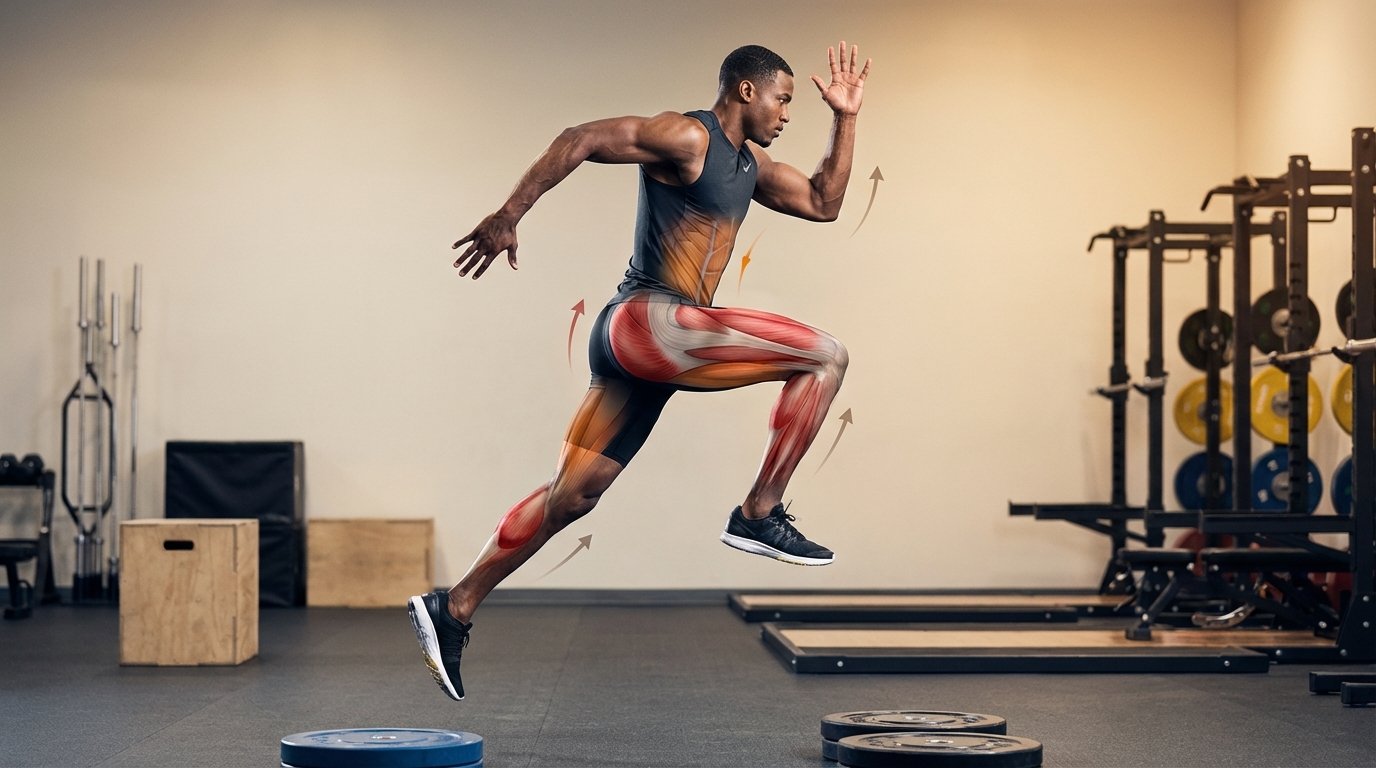
Single-Leg Hop
The single-leg hop is a unilateral plyometric exercise that involves jumping forward on one leg and landing on the same leg. This exercise develops unilateral propulsion power, ankle and knee stability, and dynamic proprioception. It is widely used in sports rehabilitation and physical preparation.
Anatomy Targeted
The quadriceps of the support leg provide knee extension during propulsion. The gluteus maximus extends the hip. The calf (gastrocnemius and soleus) completes the extension chain. The gluteus medius stabilizes the pelvis in single-leg stance. The peroneal muscles and posterior tibialis stabilize the ankle. The eccentric quadriceps and hamstrings absorb landing impact.
Step-by-Step Execution
- Stand on one leg with the other leg bent at 90 degrees behind you.
- Slightly flex the support knee and swing your arms backward.
- Jump forward by explosively pushing through the support leg.
- Land on the same leg, knee flexed, absorbing the impact in a controlled manner.
- Stabilize for 2 seconds before the next jump.
- Repeat the prescribed number of reps then switch legs.
Sets and Reps
3 sets of 5 reps per leg. Rest 60 to 90 seconds between sets. Work both legs equally.
Safety Warnings
- Master static single-leg balance (minimum 30 seconds) before attempting this exercise.
- The knee must stay aligned with the foot on landing (no valgus).
- Start with short distances and progressively increase.
- Soft, non-slip surface mandatory.
- Stop immediately if knee or ankle pain occurs.
- This exercise is often used as a functional test after ACL reconstruction: only perform with medical clearance in that context.
Progressions
- Level 1: Hop in place (vertical, same leg) with stabilization.
- Level 2: Single-leg hop forward, moderate distance.
- Level 3: Chained single-leg hops (3 consecutive jumps).
- Level 4: Triple hop test (3 chained jumps for maximum distance) or lateral single-leg hops.
Target Audience
Intermediate athletes and those in advanced sports rehabilitation. Essential for runners, football players, and basketball players. Used as an assessment tool for strength symmetry between legs. Particularly relevant after knee injury to evaluate return to sport readiness.