Humeral Head Recentering
Isometric humeral head recentering exercise, standing with resistance band or against a wall, to stabilize the shoulder and correct muscle imbalances.
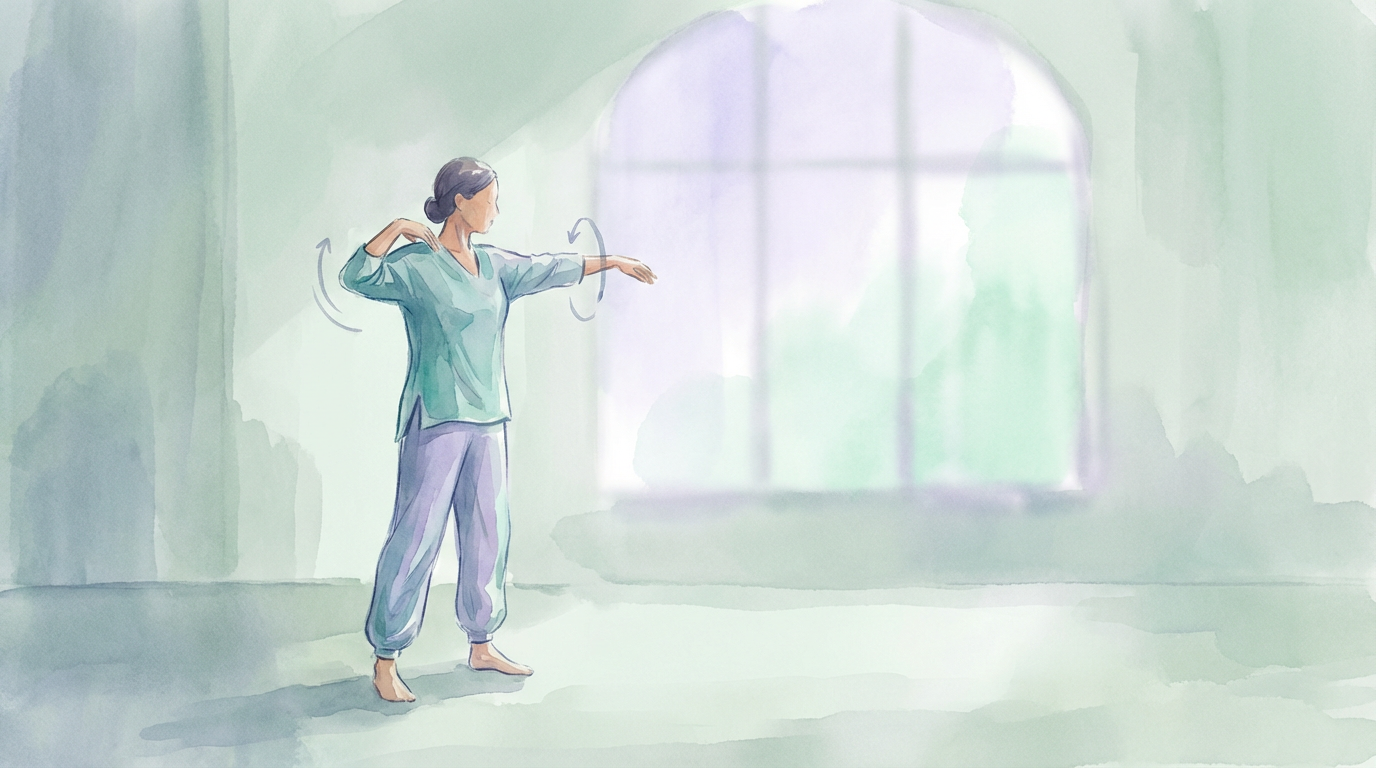
Humeral Head Recentering — Isometric Exercise
Humeral head recentering is a fundamental exercise in shoulder rehabilitation. When the humeral head migrates upward or forward in the glenoid cavity, it compresses the rotator cuff tendons against the acromion, creating painful subacromial impingement. This exercise uses isometric contractions — muscle force without joint movement — to reprogram the optimal position of the humeral head and strengthen the deep stabilizing muscles.
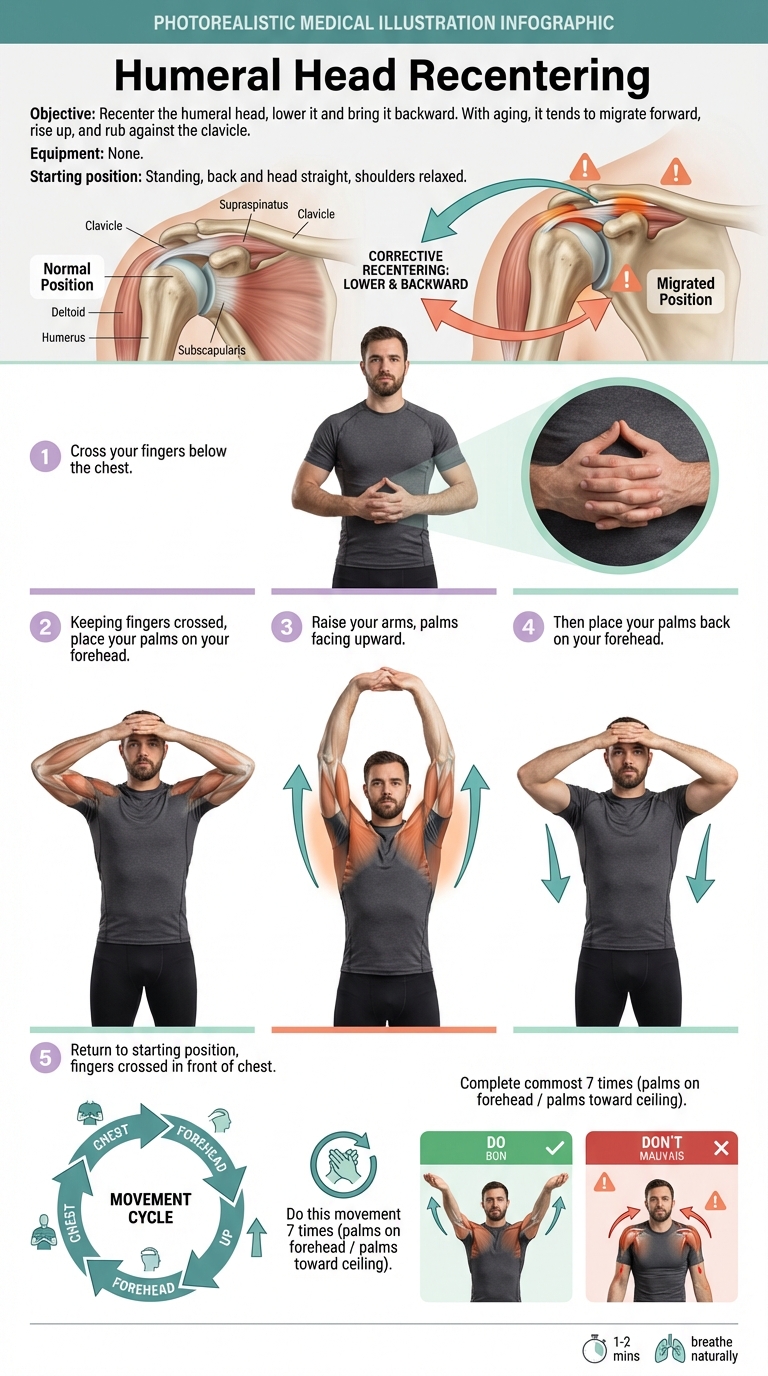
Why Recenter the Humeral Head?
Subacromial impingement is the most common cause of shoulder pain in adults. It occurs when the rotator cuff, weakened or imbalanced, can no longer keep the humeral head well centered in the glenoid. The deltoid, too dominant, pulls the head upward, pinching the tendons and bursa. Isometric recentering restores balance between the depressors (infraspinatus, teres minor, teres major) and elevators (deltoid, supraspinatus), enabling pain-free shoulder movement.
Anatomy Involved
- Rotator cuff — the four stabilizing muscles (supraspinatus, infraspinatus, teres minor, subscapularis) that actively center the humeral head.
- Deltoid — a powerful muscle that, without counterbalance, can decenter the humeral head upward.
- Latissimus dorsi and teres major — humeral head depressors, essential for recentering.
- Glenohumeral capsule — fibrous joint envelope whose laxity or stiffness influences joint centering.
Step-by-Step Instructions
Option A — With Resistance Band
Attach a light-to-medium resistance band at elbow height to a fixed point (door handle, bar). Stand with elbow bent at 90°, arm against your body, holding the band. Push outward (external rotation) against the band resistance without moving your arm. Hold the isometric pressure for 10 seconds. Release for 5 seconds. Repeat 7 times. Then turn around to work internal rotation the same way.
Option B — Against a Wall
Stand facing a wall, elbow bent at 90°, place your fist against the wall. Push your fist into the wall without your arm moving, activating the cuff muscles isometrically. Hold 10 seconds, release 5 seconds. Repeat 7 times. Do the same from the side and with your back to the wall to target all directions.
Duration and Repetitions
- Isometric hold: 10 seconds
- Rest: 5 seconds between repetitions
- Repetitions: 7 per direction
- Directions: external rotation, internal rotation, flexion, extension
- Frequency: 1 to 2 times daily
- Total duration: approximately 10 minutes
Safety Tips
- Isometric effort should be moderate: about 30–50% of your maximum strength. The goal is to recruit stabilizers, not to force.
- The arm must not move during contraction: all work is static.
- Avoid holding your breath: breathe normally throughout the exercise.
- If you experience acute pain during the exercise, stop and consult your practitioner to check cuff integrity.
Who Benefits from This Exercise?
This exercise is recommended for people with subacromial impingement, cuff tendinopathy, shoulder instability or in post-surgical rehabilitation. It also suits athletes wanting to prevent shoulder injuries, especially in throwing and racket sports. The wall version is accessible to everyone, while the band allows graduated progression.
Diagrams and illustrations
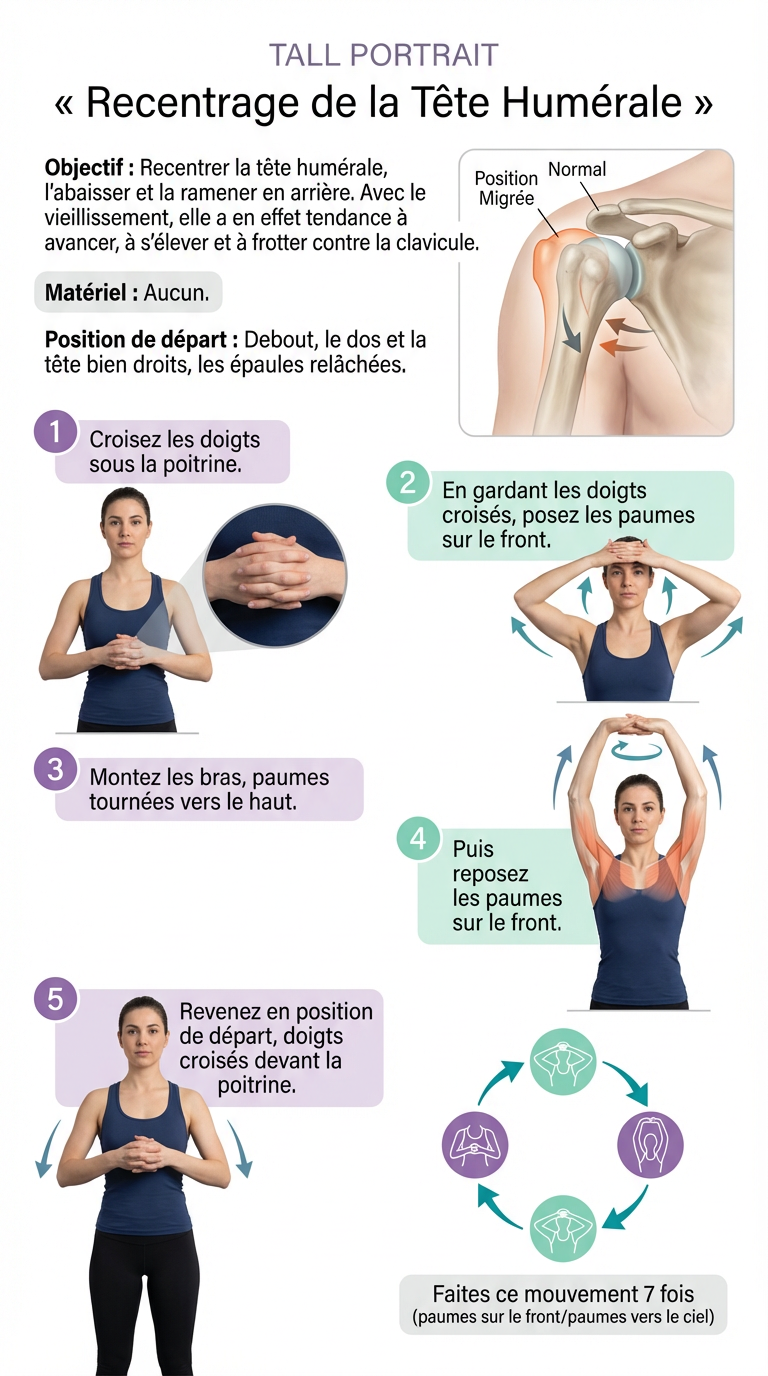
Humeral head recentering illustration
Standing isometric exercise with resistance band or against wall for humeral head recentering.