Balance Board — Stabilization
Proprioception and balance exercise targeting stabilisateurs cheville and moyen fessier for joint stabilization and fall prevention.
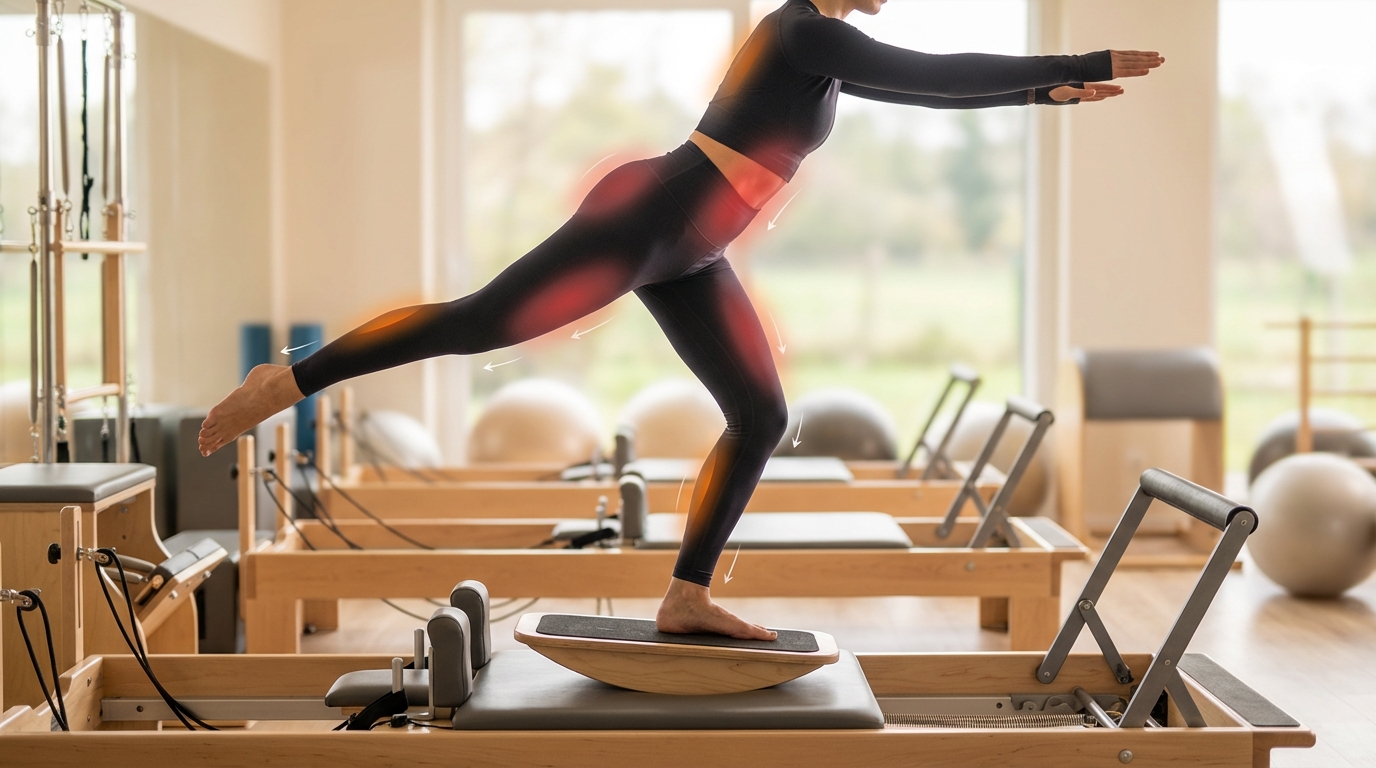
Balance Board — Stabilization
This proprioception and balance exercise is fundamental in postural rehabilitation and fall prevention. Proprioception — the body's ability to perceive its position in space — is an essential sensory system that naturally declines with age and after injury. This exercise trains proprioceptive receptors in joints, muscles, and tendons to improve dynamic and static balance.
Targeted Anatomy
Primary muscles: stabilisateurs cheville, moyen fessier, core, propriocepteurs. Proprioceptive receptors in ankle, knee, and hip joints are continuously stimulated. The vestibular system and vision (when available) complete the balance triad. Intrinsic foot muscles play a crucial role in fine postural adjustments.
Step-by-Step Execution
- Starting position: Adopt the specific exercise position ensuring a safe environment (near a wall or chair for safety).
- Engagement: Engage core, fix a point ahead (if eyes open). Distribute weight evenly.
- Hold: Maintain position actively correcting oscillations. Muscles work in constant rapid adjustments.
- Progression: Increase duration, change surface, close eyes, add arm or head movements.
Key Points
- Breathe naturally — do not hold breath.
- Postural corrections should be subtle and constant.
- If you lose balance, replace foot and restart.
- Progression must be gradual: stable → unstable surface, eyes open → closed.
Duration and Sets
3 sets of 30-60 seconds per position. 15 seconds rest between sets.
Modifications
- Beginner: Stable surface, eyes open, hand on wall. 15-30 seconds.
- Intermediate: Balance pad, eyes open, no support. 30-45 seconds.
- Advanced: Bosu or balance board, eyes closed, add head/arm movements. 45-60+ seconds.
Contraindications
- Acute vertigo or untreated vestibular pathologies.
- Severe ankle or knee joint instability.
- Recent non-consolidated fracture.
- Severe peripheral neuropathy (supervision needed).
Target Audience
Essential for seniors in fall prevention, athletes rehabilitating after ankle sprain or knee ligament reconstruction, post-stroke patients in motor recovery, and anyone improving overall postural stability.