Pectoral Stretch (Doorway/Wall)
The doorway pectoral stretch opens the chest, corrects rounded shoulders and restores shoulder mobility impaired by prolonged sitting.
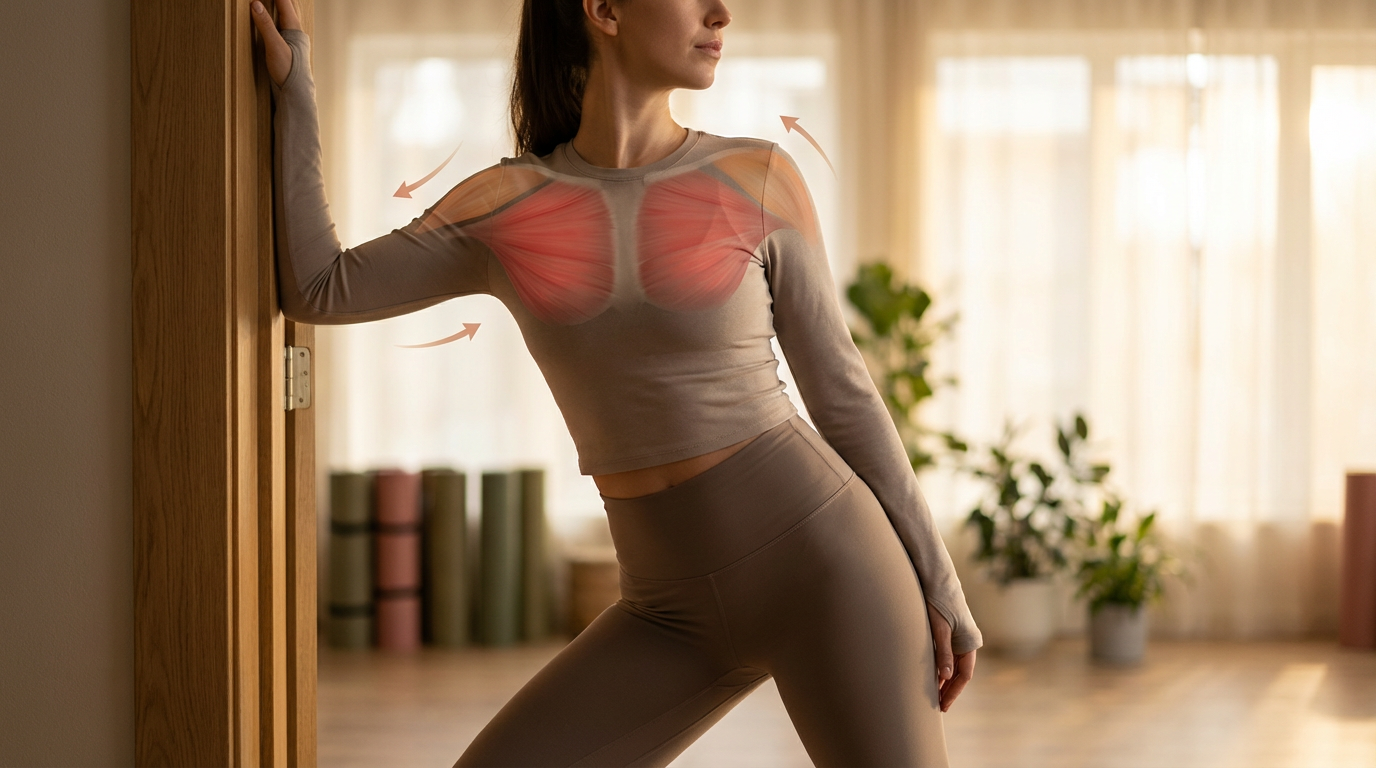
Pectoral Stretch in a Doorway
The pectoral muscles — pectoralis major and minor — are among the most engaged muscles in modern daily life. Whether typing on a keyboard, holding a steering wheel or carrying loads, they contract constantly. This constant engagement shortens them, pulling the shoulders forward and creating the classic rounded shoulders posture. Regular pectoral stretching is one of the simplest and most effective actions to restore healthy postural alignment.
Targeted Anatomy
- Pectoralis major — superficial chest muscle responsible for adduction and internal rotation of the arm. It is the primary muscle shortened in sedentary individuals.
- Pectoralis minor — deep muscle attaching to the scapula, pulling it forward when tight.
- Anterior deltoid — the front part of the shoulder, stretched simultaneously during this exercise.
- Pectoral fascia — connective tissue wrapping the pectorals, often adhered and restrictive.
Step-by-Step Instructions
Step 1 — Position in the Doorway
Stand in a doorway. Place your right forearm on the door frame, elbow at shoulder height, forming a 90-degree angle at the elbow. Fingers point upward.
Step 2 — Step Forward and Rotate
Step your right foot forward through the doorway. Slowly rotate your torso to the left, away from the arm on the frame. You should feel a deep stretch across the chest and front of the right shoulder.
Step 3 — Adjust Intensity
To vary the fibers being stretched, change the elbow height: higher than the shoulder targets the pectoralis minor and lower fibers, lower targets the upper fibers. Keep the back straight and core engaged.
Step 4 — Hold and Breathe
Hold the position for 30 to 45 seconds. Breathe deeply, directing air toward the stretched area. With each exhale, rotate a little further. Switch sides and repeat for 2 to 3 sets.
Duration and Frequency
- Hold: 30-45 seconds per side
- Sets: 2-3 per side
- Frequency: daily, especially after screen work
Safety Tips
- Never force beyond moderate tension — the stretch should be comfortable, not painful.
- Do not let the shoulder rise toward the ear; keep it low and relaxed.
- If you have a history of shoulder dislocation, consult before practicing.
- Engage the core to avoid arching the back during the rotation.
Variations
- Both arms simultaneously — both forearms on the frame, walk your body through.
- Wall corner — same principles, using a wall corner.
- On the floor — lying on a foam roller along the spine, arms open in a T position.
Target Audience
This stretch is recommended for anyone working at a desk, weight training enthusiasts (after bench press), swimmers and anyone with rounded shoulders. Suitable for all levels, from beginner to advanced athlete.
Diagrams and illustrations
Pectoral stretch illustration
Pectoral stretch in a doorway with a 30-45 second hold.