Natarajasana — Dancer Pose
Natarajasana (dancer) combines balance, backbend and quadriceps stretch in a graceful yet demanding pose.
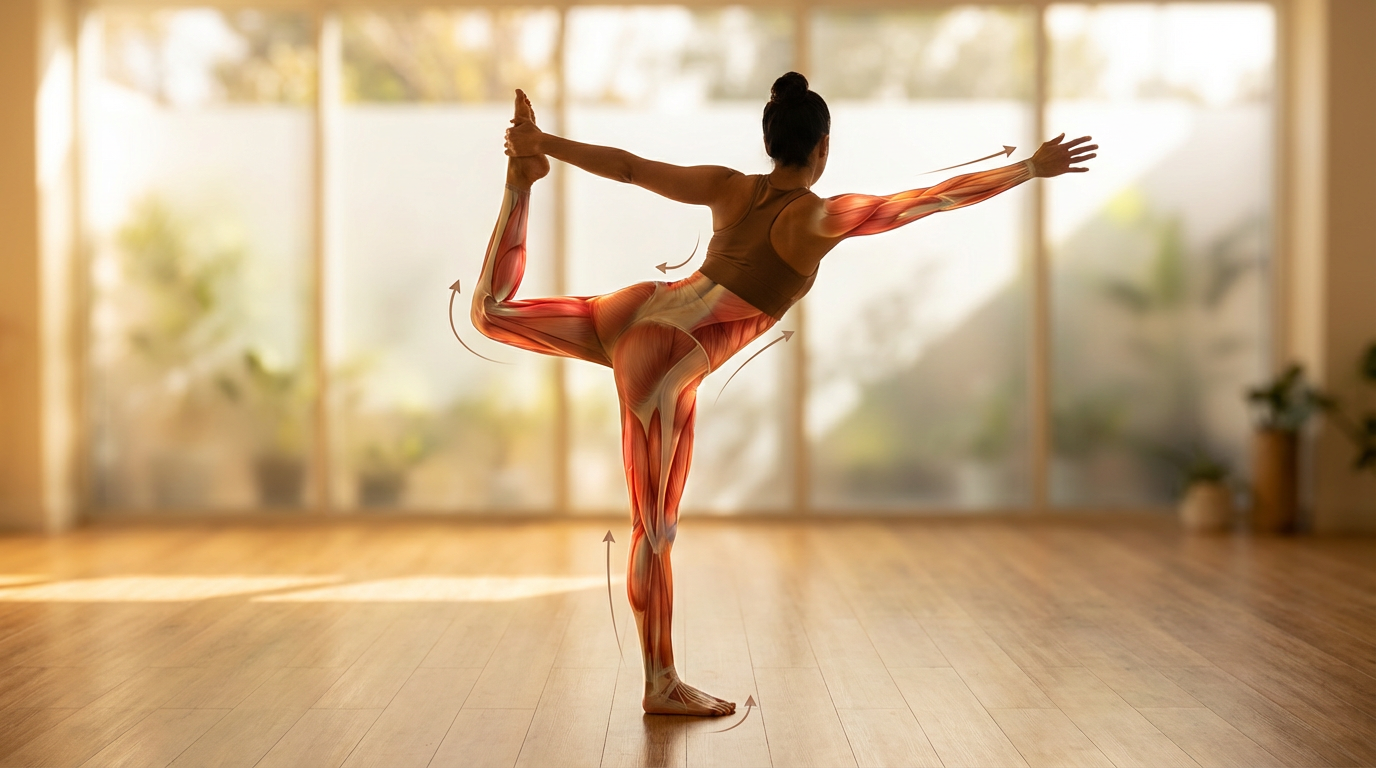
Natarajasana — Dancer Pose (नटराजासन)
Natarajasana, from the Sanskrit Nataraja (lord of the dance, a name of Shiva), is a balance pose embodying grace and beauty of movement. Standing on one leg, the practitioner catches a foot behind and opens the body into a backbend while maintaining balance. This pose simultaneously develops shoulder and quadriceps flexibility, standing leg strength and concentration.
Therapeutic Benefits
- Dynamic balance — the backward extension shifts the center of gravity, demanding constant adjustment.
- Quadriceps stretch — the back leg quadriceps and psoas are deeply stretched.
- Shoulder opening — catching the foot behind stretches the anterior deltoid and pectorals.
- Backbend — controlled arching mobilizes the thoracic spine.
- Confidence and grace — develops presence and elegance in movement.
Anatomy Involved
The back leg quadriceps femoris is maximally stretched. The iliopsoas lengthens simultaneously. The back leg gluteus maximus and hamstrings push the foot into extension. Spinal erectors create the backbend. The anterior deltoid of the catching shoulder stretches in rotation. The standing leg gluteus medius stabilizes the pelvis.
Step-by-Step Instructions
Step 1 — Grounding
Stand on one leg, fix a drishti ahead. Standing leg is stable, knee slightly unlocked.
Step 2 — Foot Grip
Bend the back knee and catch the ankle or top of the foot with the same-side hand (inside grip). Knee points down.
Step 3 — Extension
Gently lean forward while pushing the foot backward and upward. The front arm extends forward for balance. Create tension between foot push and hand resistance.
Step 4 — Opening
Open the chest, lift the sternum. The back leg rises as high as flexibility allows. The trunk tilts forward to counterbalance.
Breathing and Duration
Hold for 5 to 8 breaths per side. Calm breathing is essential for balance. Each inhale elevates, each exhale stabilizes.
Contraindications
- Knee injury in the bent leg
- Lower back issues — avoid excessive extension
- Shoulder injury — do not force the grip
- Vertigo
Modifications
- Beginner: use a strap around the foot to ease the grip. Keep torso upright without leaning forward. Free hand on a wall.
- Advanced: catch the foot with both hands behind the head (full version), or Natarajasana with flip grip.
Target Audience
Natarajasana is an intermediate pose suited for practitioners with a balance and flexibility foundation. Excellent for dancers, gymnasts and anyone seeking to develop grace and body openness.
Diagrams and illustrations

Natarajasana illustration
Natarajasana — Dancer Pose with correct alignment.