Muscle Strengthening - Sciatica Prevention
This muscle strengthening program targets the glutes and back muscles to prevent sciatica episodes through alternating leg raises.
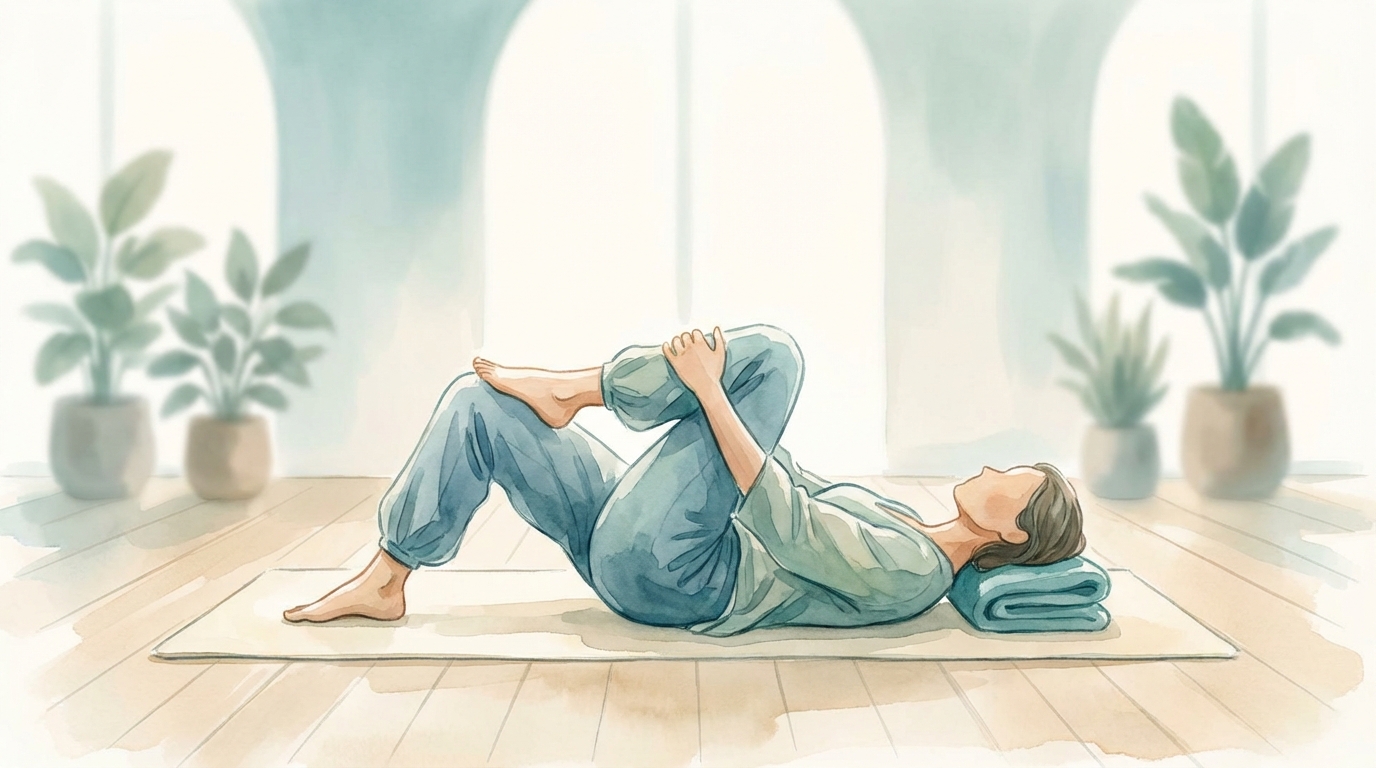
Muscle Strengthening — Preventing Sciatica
Sciatica often occurs in the context of muscular weakness in the back and pelvis. When the muscles that support the lumbar spine and stabilize the pelvis are insufficient, the vertebrae and discs become overloaded, potentially compressing the sciatic nerve. This targeted strengthening program reinforces the protective muscles to significantly reduce the risk of sciatic recurrence.
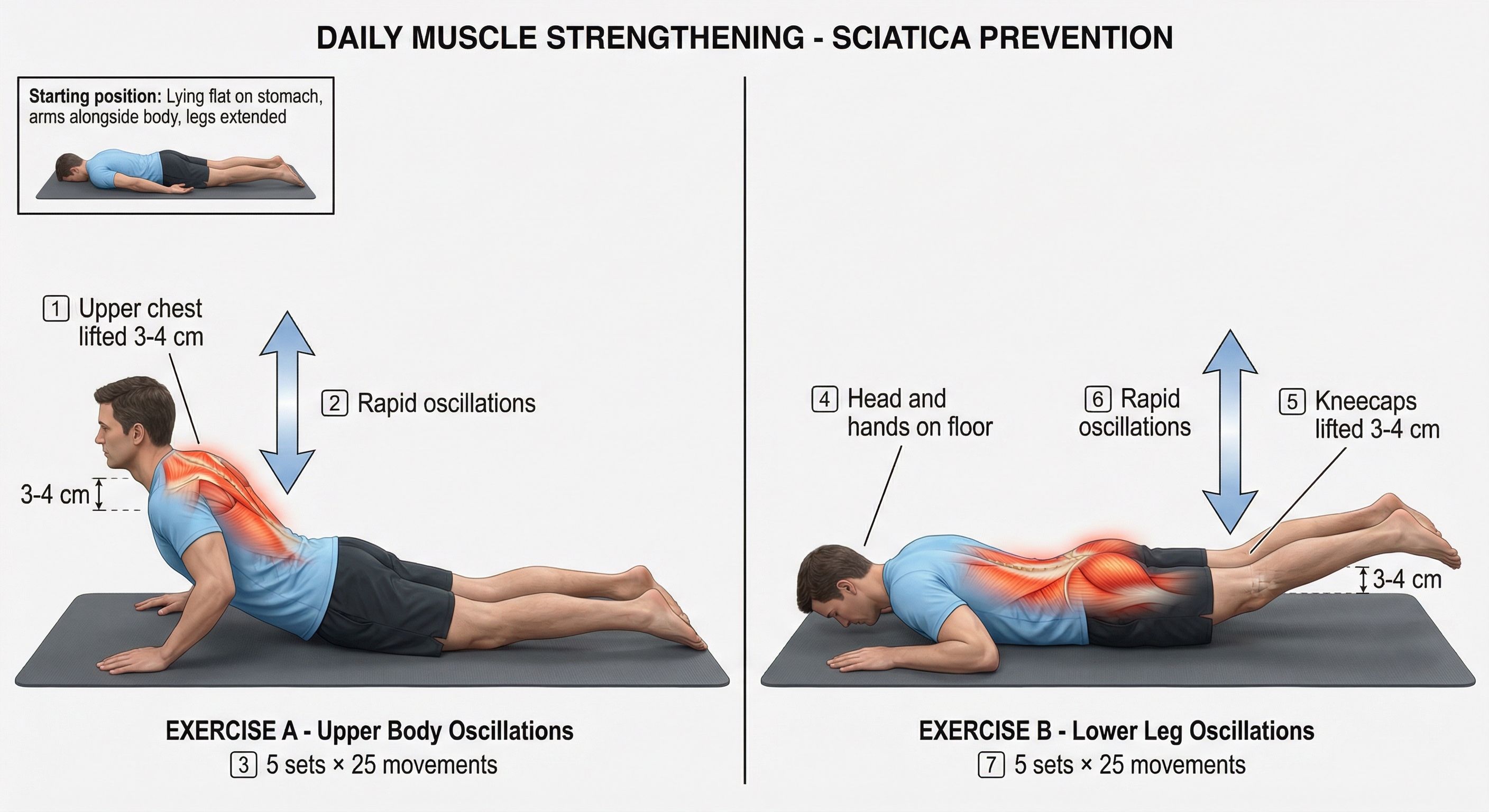
Why Strengthen to Prevent Sciatica?
Prevention is always better than treatment. About 80% of sciatica recurrences happen in people who did not strengthen their muscles after the first episode. Strong glutes stabilize the pelvis, solid back muscles protect the spine, and engaged abdominals maintain intra-abdominal pressure. It is this muscular synergy that protects the sciatic nerve.
Anatomy Involved
- Gluteal muscles (gluteus maximus and medius) — major pelvic stabilizers, their weakness is directly linked to sciatica recurrence.
- Back muscles (erector spinae, multifidus) — maintain vertebral alignment and protect the discs.
- Deep abdominal muscles (transversus) — create a support sheath around the spine.
- Sciatic nerve — the longest nerve in the body, running from the lumbar spine through the buttock and down the leg.
Step-by-Step Instructions
Main Exercise — Alternating Leg Raises
Step 1 — Starting Position
Lie on your back with knees bent, feet flat on the floor. Arms at your sides. Gently engage your abdominals by drawing your belly button toward your spine. Your lower back stays in contact with the floor.
Step 2 — Right Leg Raise
As you exhale, slowly raise your right leg straight toward the ceiling, to 45-60 degrees. Keep your pelvis stable — do not let your lower back lift off the floor. Hold for 3 seconds at the top.
Step 3 — Controlled Descent
As you inhale, slowly lower the leg back down. Control the descent over 3 seconds. Do not rest the leg completely — keep it a few centimeters off the floor before raising again.
Step 4 — Alternate
Perform 10 raises per leg, alternating right and left. Rest for 30 seconds between sets. Perform 3 sets total.
Duration and Repetitions
- Repetitions: 10 per leg
- Sets: 3
- Rest: 30 seconds between sets
- Frequency: 3 to 4 times per week
- Progression: increase to 15 reps then add ankle weights
Safety Tips
- Do not perform this exercise during an acute sciatica episode — wait for the recovery phase.
- The lower back must remain in contact with the floor at all times.
- If you feel pain radiating down the leg, stop immediately.
- Start with a reduced range if needed — quality matters more than height.
- Consult your practitioner before starting this program if you have a history of disc herniation.
Who Benefits from This Exercise?
This program is specifically designed for people who have suffered from sciatica and want to prevent recurrence, at-risk individuals (sedentary, manual workers, drivers), and anyone wanting to strengthen the protective muscles of the back and pelvis. It suits beginner to intermediate levels.
Diagrams and illustrations
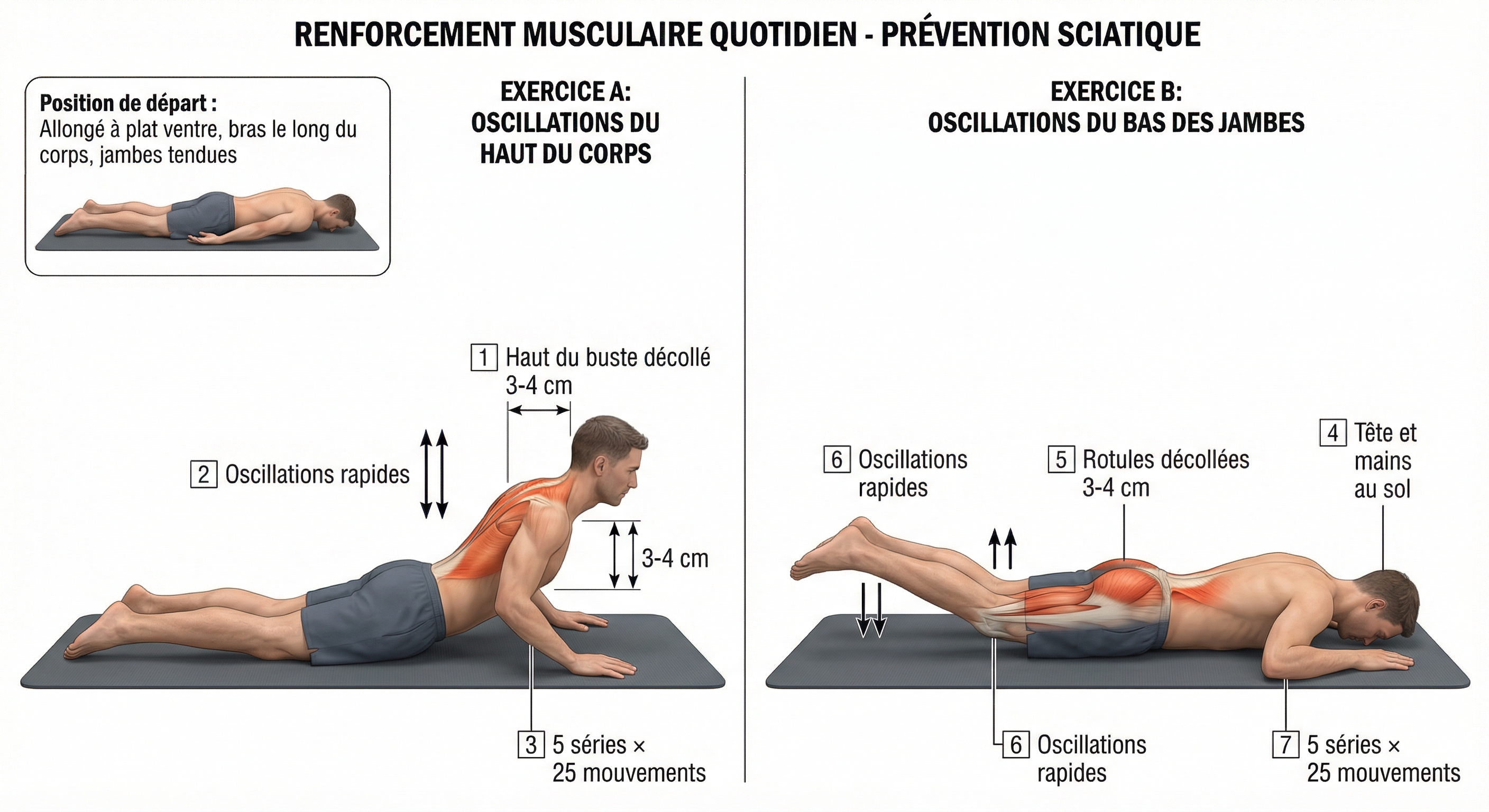
Sciatica prevention strengthening illustration
Alternating leg raises while lying down to strengthen glutes and back muscles.