Foot & Ankle Strengthening - Varied Walking
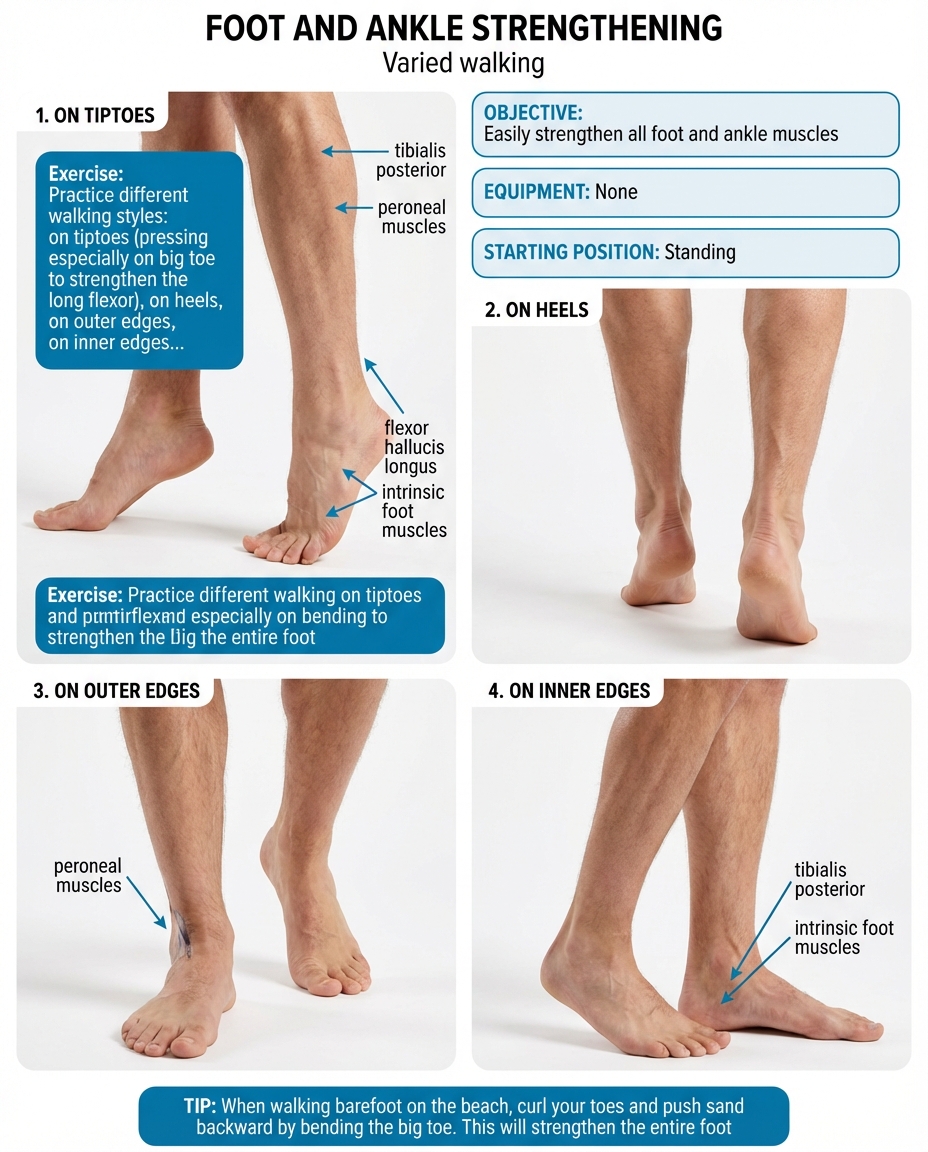
Foot and ankle strengthening program based on four walking types: on heels, outer edge, inner edge, and on toes.

Foot & Ankle Strengthening — Varied Walking in 4 Types
Varied walking is a functional strengthening program that uses four different walking types to engage all muscles of the foot and ankle. Unlike static exercises, this dynamic approach replicates real-world foot usage conditions and improves strength, stability, and proprioception simultaneously. Each walking type targets specific muscle groups, providing a complete workout in just a few minutes.
Why Vary Walking Types?
The foot contains 26 bones, 33 joints, and over 100 muscles, tendons, and ligaments. By always walking the same way, on flat surfaces in rigid shoes, we only engage a fraction of this complexity. Varied walking awakens dormant muscles, strengthens often-neglected lateral stabilizers, and stimulates plantar mechanoreceptors. This translates to better ankle stability, reduced sprain risk, and improved dynamic balance, which is particularly valuable with age.
Anatomy Involved
- Peroneal muscles (longus and brevis) — lateral stabilizers engaged during inner and outer edge walking.
- Tibialis anterior — main dorsiflexion muscle, heavily engaged during heel walking.
- Triceps surae (gastrocnemius + soleus) — the engine of toe walking, propelling each step.
- Tibialis posterior — inner arch support, engaged during inner edge walking.
- Intrinsic foot muscles — all the small sole muscles, constantly activated for ground adaptation.
- Lateral and medial ankle ligaments — indirectly reinforced by engaging stabilizer muscles.
Step-by-Step Instructions
Type 1 — Heel Walking
Walk a distance of 10 to 15 meters placing only your heels on the ground, toes raised as high as possible. Keep your back straight, arms at your sides or on your hips. This walk intensely engages the tibialis anterior and toe extensors. Perform 2 round trips.
Type 2 — Outer Edge Walking
Walk the same distance by supinating your feet: press on the outer edge of the foot with the sole turned slightly inward. This walk strengthens the peroneal muscles and lateral ankle stabilizers. Perform 2 round trips. Caution: if your ankles are unstable, reduce the distance and keep a wall nearby.
Type 3 — Inner Edge Walking
Walk by pronating your feet: press on the inner edge of the foot with the sole turned slightly outward. This walk targets the tibialis posterior and strengthens the medial arch. Perform 2 round trips. This is an excellent exercise for flat feet.
Type 4 — Toe Walking
Walk the same distance standing on your toes, heels well off the ground. Try to rise as high as possible with each step. This walk powerfully engages the triceps surae and intrinsic foot muscles. Perform 2 round trips.
Complete Circuit
Chain all 4 walking types without pause, forming a circuit. Repeat the full circuit 2 to 3 times.
Duration and Repetitions
- Distance per type: 10 to 15 meters round trip × 2
- Circuits: 2 to 3 complete circuits
- Total duration: approximately 8 to 12 minutes
- Frequency: 3 to 5 times per week
Safety Tips
- Practice barefoot or in non-slip socks on a clean, smooth surface.
- Start slowly — outer and inner edge walking can destabilize fragile ankles.
- For recent sprains (less than 3 months), consult your practitioner before practicing edge walking.
- If you lose balance, simply place your foot flat and resume.
- Elderly individuals should practice near a wall or railing for support if needed.
Who Benefits from This Exercise?
This varied walking program suits all ages and fitness levels. It is particularly recommended for sprain prevention in athletes, post-rehabilitation strengthening, fall prevention in the elderly, and overall posture improvement. Those with flat feet or unstable ankles will find a progressive, functional way to strengthen their support base.
Diagrams and illustrations
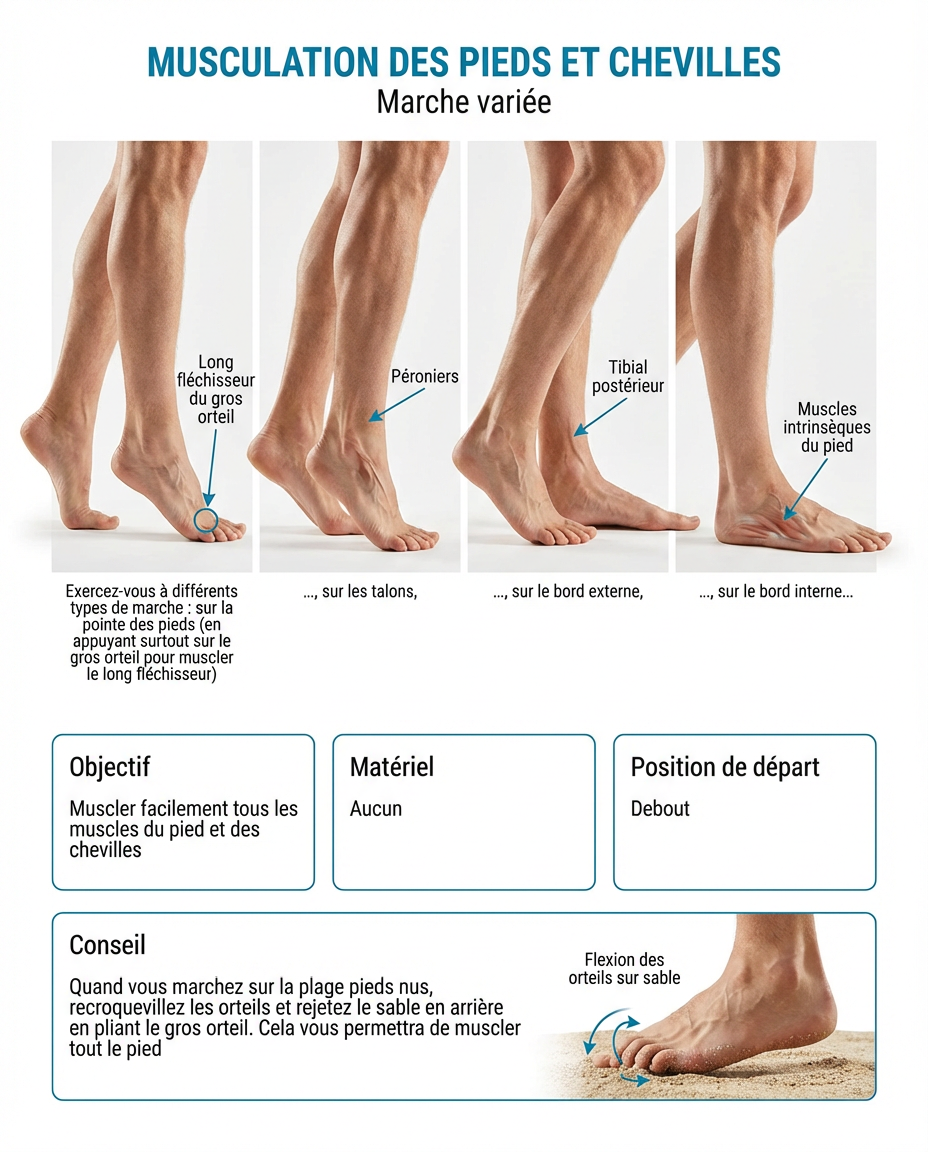
Foot and ankle strengthening through varied walking illustration
Four walking types illustrated: on heels, outer edge, inner edge, and on toes.